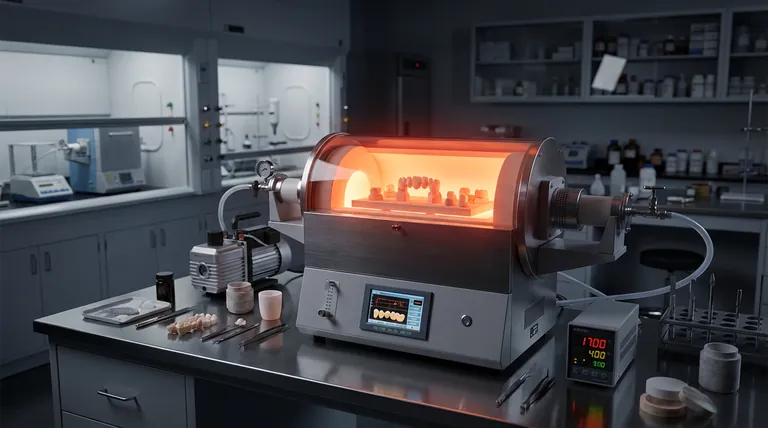
The Artisan's Dilemma
Every dental technician pursues a form of perfection. The goal is to create a ceramic restoration so lifelike in its color, translucency, and strength that it's indistinguishable from nature itself.
Yet, in a conventional furnace, the very air we breathe becomes an invisible saboteur. The process of firing, intended to create, can introduce subtle but critical flaws, turning a potential masterpiece into a costly failure.
This isn't a failure of skill, but a problem of physics. The battle is fought on a microscopic scale, against two fundamental forces: oxidation and trapped gas.
The Physics of a Flawed Firing
To appreciate the solution, we must first understand the problem. When porcelain powder is heated in an open atmosphere, the environment itself works against the desired outcome.
Oxidation: The Thief of Color
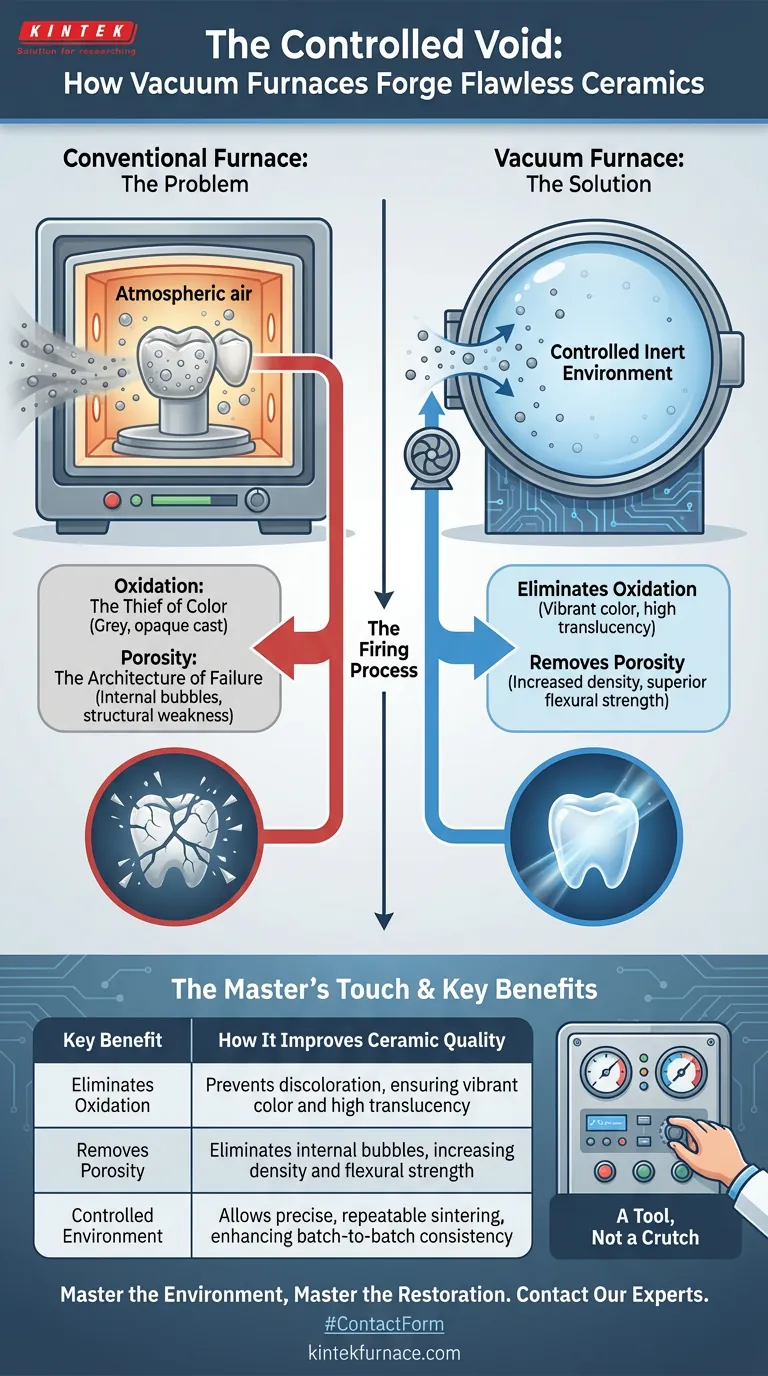
Porcelain's beautiful shades are derived from metallic oxides. When heated in the presence of the 21% oxygen in our air, these elements can oxidize further.
This unwanted chemical reaction dulls the material, often creating a grey or opaque cast. The intended vibrant color is lost, making it impossible to perfectly match a patient's natural dentition. It’s a frustrating, last-minute corruption of the artisan's careful work.
Porosity: The Architecture of Failure
As the furnace heats, porcelain particles begin to sinter—softening and fusing together. In a normal atmosphere, air becomes trapped in the countless microscopic voids between these particles.
As temperatures soar, this trapped air expands. It forms tiny bubbles, creating internal porosity. These voids are more than just blemishes; they are structural weak points. They scatter light, reducing translucency, and act as stress concentrators, making the final restoration brittle and prone to fracture.
Engineering a Perfect Void
The elegance of the vacuum furnace lies not in adding something to the process, but in taking something away. By evacuating the air from the chamber, it creates a controlled, inert environment—a near-perfect void where the porcelain can achieve its full potential.
Preserving Light and Life
By removing oxygen, the vacuum furnace completely prevents oxidation. The metallic oxides retain their intended state, resulting in a cleaner, more vibrant color.
More importantly, it enhances translucency. Without contaminants and microscopic bubbles to scatter it, light can pass through the ceramic structure more naturally. The result is a restoration that doesn't just match a color swatch but mimics the depth and vitality of a real tooth.
Forging Uncompromised Strength
The vacuum pulls air from between the porcelain particles before they have a chance to fuse. When the material reaches its sintering temperature, there are no trapped gases to form bubbles.
The particles coalesce into a solid, homogenous mass. This dramatic increase in density directly translates to superior flexural strength. The final product isn't just beautiful; it's durable and resilient, free from the built-in weaknesses that cause fractures. Creating such a pristine environment is the core function of high-performance lab furnaces like those engineered by KINTEK, where control is paramount.
The Master's Touch: Nuances of Control
A vacuum furnace is a precision instrument, not an automatic fix. Its power lies in the control it gives the operator, which requires understanding its nuances.
The Critical Moment: Breaking the Vacuum
The firing cycle doesn't remain in a vacuum from start to finish. After the porcelain has fully sintered into a dense mass, the vacuum is released. This "break vacuum" stage allows atmospheric pressure to gently compress the softened ceramic, further consolidating its structure and creating a smooth, glazed surface. The timing of this moment is critical and separates good results from great ones.
A Tool, Not a Crutch
This technology amplifies the skill of the technician; it doesn't replace it. A vacuum furnace cannot correct for poor material buildup or contamination introduced before firing. It provides the ideal environment for properly handled materials to achieve their peak properties. The psychology is simple: great tools enable great artists to push the boundaries of their craft.
From Theory to Practice: A Table of Control
Understanding the why allows you to manipulate the how. The function of the vacuum directly translates to control over the final product's key properties.
| Key Benefit | How It Improves Ceramic Quality |
|---|---|
| Eliminates Oxidation | Prevents discoloration, ensuring vibrant color and high translucency for superior aesthetics. |
| Removes Porosity | Eliminates internal bubbles, increasing density and flexural strength for durable, fracture-resistant ceramics. |
| Controlled Environment | Allows precise, repeatable sintering in an oxygen-free atmosphere, enhancing batch-to-batch consistency. |
Ultimately, mastering ceramic restorations is about mastering the environment in which they are created. By removing the unpredictable variable of air, a vacuum furnace provides the control needed to achieve consistent, high-quality results. Whether your application is in a dental lab, materials science research, or advanced manufacturing, the principles of creating a controlled void are universal. At KINTEK, we specialize in building customizable Muffle, Tube, and Vacuum furnaces that provide exactly this level of environmental control.
If your work demands uncompromising quality and material integrity, exploring how a precision-engineered vacuum system can elevate your process is the logical next step. Contact Our Experts
Visual Guide
Related Products
- Vacuum Hot Press Furnace Machine Heated Vacuum Press Tube Furnace
- Vacuum Hot Press Furnace Machine Heated Vacuum Press
- 600T Vacuum Induction Hot Press Vacuum Heat Treat and Sintering Furnace
- 2200 ℃ Tungsten Vacuum Heat Treat and Sintering Furnace
- Vacuum Heat Treat Sintering Furnace with Pressure for Vacuum Sintering
Related Articles
- How Vacuum Hot Press Furnaces Transform Advanced Material Engineering
- How to Select the Right Vacuum Hot Pressing Furnace Temperature for Your Materials
- Beyond the Parts List: The Real Reason Your Vacuum Hot Press Fails (And How to Fix It)
- Why Your High-Temperature Materials Fail: The Hidden War Inside Your Furnace
- Is Your Material Data Real? Why Temperature Gradients Are Sabotaging Your Cu2Se Resistivity Measurements



















