Beyond Heat: The Criticality of the Environment
Imagine an engineer inspecting a turbine blade destined for a jet engine. It will spin at 10,000 RPM in a blisteringly hot environment. Its success or failure hinges not just on the alloy's formula, but on an invisible factor: the purity of its creation. A microscopic layer of oxide, formed during heat treatment, could initiate a catastrophic fracture.
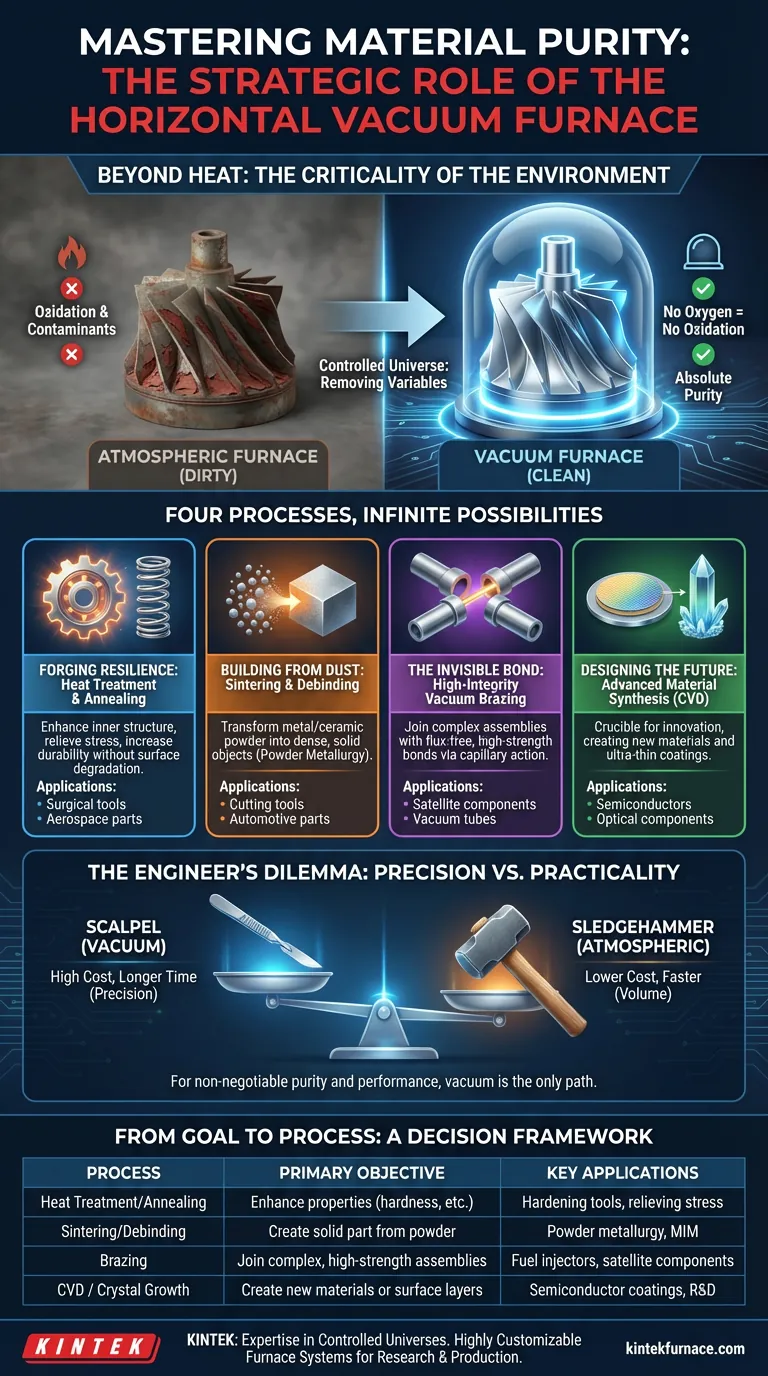
We intuitively focus on temperature when we think of furnaces. But for high-performance materials, the most critical element is often not the heat applied, but the environment in which it's applied. A vacuum furnace is not merely a heater; it is a precisely controlled universe, defined by the powerful presence of nothing.
The Logic of Nothingness: Why a Vacuum is a Powerful Tool
As terrestrial beings, we are surrounded by air. It’s a psychological leap to understand that for many advanced processes, the most crucial ingredient is the complete absence of this atmosphere. By removing gases, we remove variables. We remove threats.
The Enemy of Strength: Preventing Oxidation
At high temperatures, the oxygen in the air is not a neutral bystander; it is an aggressive reactant. It latches onto metal surfaces, forming brittle, flaky oxide layers that compromise structural integrity, conductivity, and appearance. A vacuum eliminates this threat entirely.
This isn't just about aesthetics. For a medical implant or an aerospace component, an oxidized surface is a potential point of failure. The vacuum ensures the final part is bright, clean, and possesses the pure, unadulterated properties of the base metal.
The Foundation of Trust: Ensuring Absolute Purity
Beyond oxygen, the atmosphere contains moisture, nitrogen, and other trace contaminants. In the world of semiconductors or sensitive electronics, even parts-per-million of an unwanted element can ruin a multi-million dollar production run.
A vacuum environment provides a sterile field for thermal processing, guaranteeing that the only reactions occurring are the ones you designed.
A Controlled Universe: Four Processes, Infinite Possibilities
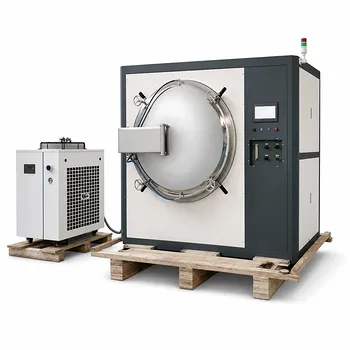
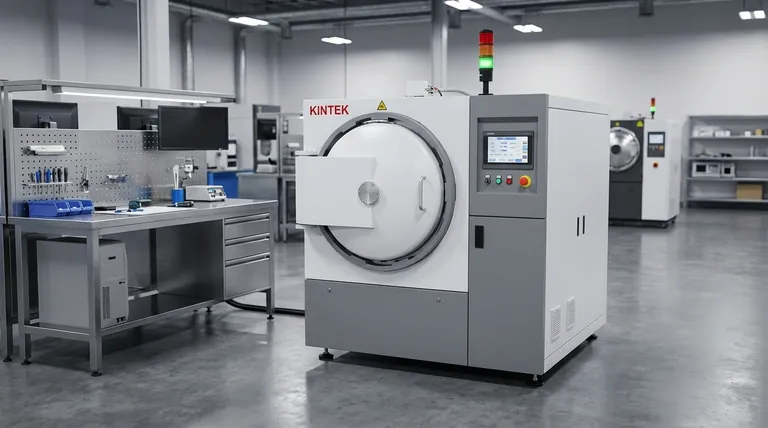
A horizontal vacuum furnace is a workshop capable of executing fundamentally different tasks. Each one leverages the pristine environment to achieve a specific engineering goal.
Forging Resilience: Heat Treatment and Annealing
This is about modifying a material’s inner structure. Think of hardening the steel for a surgical scalpel to ensure it holds a razor-sharp edge, or annealing a delicate component to relieve internal stresses built up during manufacturing, making it more ductile and resilient. In a vacuum, these property enhancements happen without any surface degradation.
Building from Dust: Sintering and Debinding
Sintering is the near-magical process of transforming compacted metal or ceramic powder into a solid, dense object. By heating the powder below its melting point, the particles fuse together. This is the heart of powder metallurgy, creating everything from tungsten carbide cutting tools to complex automotive parts. The vacuum ensures that the bonds between particles are pure and strong.
The Invisible Bond: High-Integrity Vacuum Brazing
Brazing joins two parts using a filler metal with a lower melting point. In a vacuum, the molten filler flows into the joint via capillary action, creating a bond that is often stronger than the parent materials. Because this happens cleanly, without flux, it’s the only way to create the complex, hermetically sealed assemblies found in satellite wave-guides or electrical grid vacuum interrupters.
Designing the Future: Advanced Material Synthesis
For researchers and pioneers, the vacuum furnace is a crucible for innovation. It's where new materials are born. Processes like Chemical Vapor Deposition (CVD) lay down ultra-thin, durable coatings on substrates, creating the next generation of semiconductors or wear-resistant surfaces. It is the controlled environment required for growing the perfect monocrystalline silicon that powers our digital world.
The Engineer's Dilemma: Precision vs. Practicality
A vacuum furnace is a scalpel, not a sledgehammer. Its power comes with trade-offs, and true engineering wisdom lies in knowing when to use it.
- The Price of Perfection: These systems are inherently more complex and costly than atmospheric furnaces. The vacuum pumps, chambers, and control systems require significant investment and specialized knowledge.
- The Currency of Time: Pulling a hard vacuum is not instantaneous. The pump-down and backfill cycles add to the total process time, making it less suitable for high-volume applications where surface finish is not a primary concern.
It is overkill for materials and processes insensitive to the atmosphere. But for applications where purity and performance are non-negotiable, it is the only viable path.
From Goal to Process: A Decision Framework
Choosing the right thermal process begins with your end goal. The process, in turn, dictates the equipment. Are you enhancing, joining, creating from powder, or inventing something new?
| Process | Primary Objective | Key Applications |
|---|---|---|
| Heat Treatment/Annealing | Enhance material properties (hardness, etc.) | Hardening tools, relieving stress in aerospace parts |
| Sintering/Debinding | Create a solid part from powder | Powder metallurgy, Metal Injection Molding (MIM) |
| Brazing | Join complex, high-strength assemblies | Fuel injectors, satellite components, vacuum tubes |
| CVD / Crystal Growth | Create new materials or surface layers | Semiconductor coatings, optical components, R&D |
Achieving these outcomes—from a perfectly stress-relieved medical implant to a flawlessly brazed satellite assembly—is not a matter of chance. It requires an environment of absolute control. This is where the engineering of the furnace itself becomes paramount.
KINTEK's expertise lies in creating these controlled universes. With deep R&D and in-house manufacturing, we provide not just standard equipment, but highly customizable Muffle, Tube, Vacuum, and CVD furnace systems designed to meet your specific research or production needs. To master your materials, you first have to master their environment. Contact Our Experts
Visual Guide
Related Products
- Small Vacuum Heat Treat and Tungsten Wire Sintering Furnace
- Vacuum Heat Treat Sintering Furnace with Pressure for Vacuum Sintering
- 2200 ℃ Graphite Vacuum Heat Treat Furnace
- High Pressure Laboratory Vacuum Tube Furnace
- 2200 ℃ Tungsten Vacuum Heat Treat and Sintering Furnace
Related Articles
- Why Your Stainless Steel Parts Fail Pressure Tests—and How Vacuum Sintering Fixes the Density Gap
- Why Your Electrochromic Electrodes Fail During Sintering—And How Vacuum Control Restores Transparency
- Why Your Sintered Parts Fail: It’s Not Just About Heat, But Pressure and Purity
- Beyond the Program: Why Your Sintering Fails and How to Guarantee Uniformity
- Why Your 3D-Printed Maraging Steel Parts Aren't Performing—And How to Fix the Structural Weakness