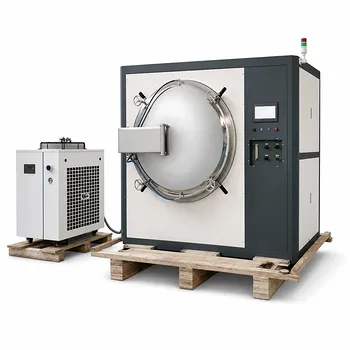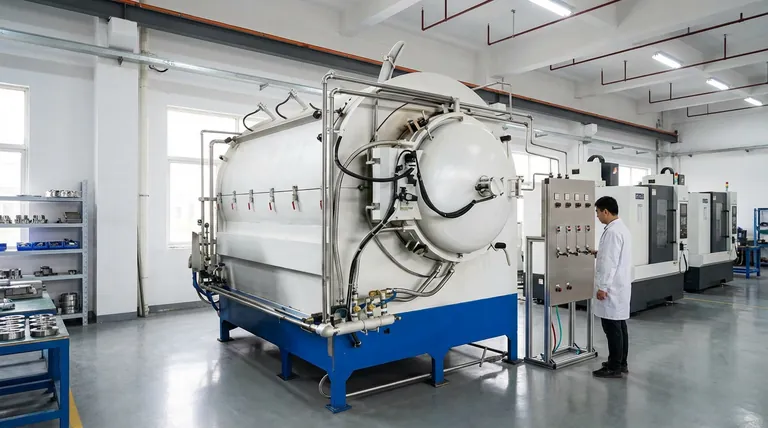
The Allure of Overkill
There's a deep-seated human bias to believe that "more" is always "better." We want the fastest car, the sharpest camera, the most powerful computer. In engineering, this bias can lead to a costly and inefficient sin: over-engineering.
Nowhere is this principle more visible than in the world of thermal processing. The choice of a vacuum pump for a furnace isn't just a technical specification; it's a statement of purpose. And in many industrial applications, the most elegant solution is not the most powerful one.
Deconstructing "Low Vacuum": A Philosophy of Purpose
The term "low vacuum" sounds underwhelming, as if it were a subpar condition. But in materials science, it describes a precisely controlled environment, engineered for a specific job. It is not a flaw; it is a feature.
A World of Practical Application
Imagine a workshop producing steel components for the automotive industry. The goal of heat treatment—like annealing or brazing—is to alter the metal's properties, making it stronger or more ductile. The primary enemy here is gross oxidation from the ambient air.
These processes don't require the absolute purity of a semiconductor cleanroom. They require a cost-effective, reliable method to remove the bulk of reactive gases. This is the world of the low vacuum furnace.
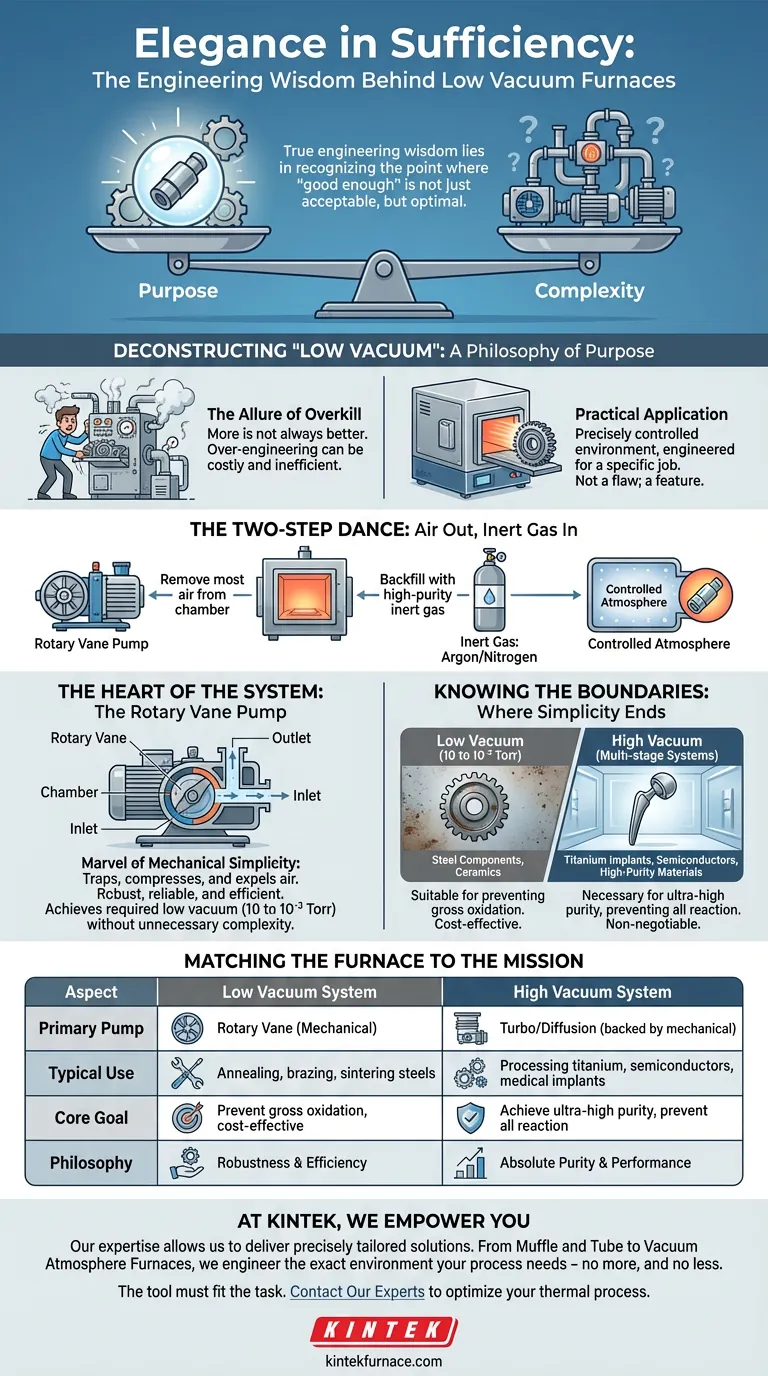
The Two-Step Dance: Air Out, Inert Gas In
The process is beautifully straightforward.
- A mechanical pump removes most of the air from the furnace chamber.
- The chamber is then backfilled with a high-purity inert gas, like argon or nitrogen.
This creates a controlled, non-reactive atmosphere at a fraction of the cost and complexity of a high vacuum system. It's the perfect environment for materials like steel and many ceramics.
The Heart of the System: The Rotary Vane Pump
The rotary vane pump is the unsung hero of these furnaces. Its design has remained fundamentally unchanged for decades, not because of a lack of innovation, but because it is a near-perfect solution for its intended task.
A Marvel of Mechanical Simplicity
These pumps work by trapping volumes of air, compressing them, and expelling them. They are mechanical, robust, and exceptionally reliable. They efficiently pull the chamber pressure down to the low vacuum range (typically 10 to 10⁻³ Torr), which is all that's required.
The Psychology of "Good Enough"
Why not use a more powerful turbomolecular or diffusion pump? Because it would be like using a surgical scalpel to chop firewood. These advanced pumps are designed for high and ultra-high vacuum applications, where every last molecule matters.
Using one in a low vacuum furnace would not improve the final product but would dramatically increase cost, complexity, and maintenance. True engineering wisdom lies in recognizing the point where "good enough" is not just acceptable, but optimal.
Knowing the Boundaries: Where Simplicity Ends
Of course, this elegant sufficiency has its limits. Understanding these boundaries is critical to avoiding catastrophic process failures.
The Invisible Threat: Contamination
Low vacuum systems inherently have more residual gas molecules and a higher risk of minor contamination, such as oil vapor from the mechanical pump itself. For steel gears, this is irrelevant.
But for a titanium medical implant, even a microscopic layer of oxygen can compromise its biocompatibility and structural integrity. For high-purity or highly reactive materials, the simplicity of a low vacuum system becomes a liability. This is where high vacuum, with its multi-stage pumping systems, becomes non-negotiable.
Matching the Furnace to the Mission
The material is always the master. Its chemical and physical requirements dictate the necessary processing environment. Choosing the right furnace is about aligning the equipment's capability with the material's sensitivity.
This is where having a partner with deep expertise in both equipment design and material science becomes invaluable. Whether your work demands the robust simplicity of a low vacuum setup or the pristine conditions of a high vacuum system, the core principle is the same: the tool must fit the task.
| Aspect | Low Vacuum System | High Vacuum System |
|---|---|---|
| Primary Pump | Rotary Vane (Mechanical) | Turbo/Diffusion (backed by a mechanical pump) |
| Typical Use | Annealing, brazing, sintering steels | Processing titanium, semiconductors, medical implants |
| Core Goal | Prevent gross oxidation, cost-effective | Achieve ultra-high purity, prevent all reaction |
| Philosophy | Robustness & Efficiency | Absolute Purity & Performance |
At KINTEK, our expertise in R&D and manufacturing allows us to deliver precisely tailored solutions. Our range of customizable Muffle, Tube, and Vacuum Atmosphere Furnaces are engineered to provide the exact environment your process needs—no more, and no less. We empower researchers and engineers to achieve their goals by providing the right tool for the job.
Understanding these first principles is the key to optimizing any thermal process. To ensure your equipment perfectly aligns with your material's needs and your operational goals, Contact Our Experts.
Visual Guide
Related Products
- Small Vacuum Heat Treat and Tungsten Wire Sintering Furnace
- Molybdenum Vacuum Heat Treat Furnace
- Vacuum Heat Treat Sintering Furnace with Pressure for Vacuum Sintering
- 2200 ℃ Tungsten Vacuum Heat Treat and Sintering Furnace
- 2200 ℃ Graphite Vacuum Heat Treat Furnace
Related Articles
- Why Your Stainless Steel Parts Fail Pressure Tests—and How Vacuum Sintering Fixes the Density Gap
- Why Your Electrochromic Electrodes Fail During Sintering—And How Vacuum Control Restores Transparency
- Why Your Sintered Parts Fail: It’s Not Just About Heat, But Pressure and Purity
- Beyond the Program: Why Your Sintering Fails and How to Guarantee Uniformity
- Why Your 3D-Printed Maraging Steel Parts Aren't Performing—And How to Fix the Structural Weakness