The Unseen Enemy
Imagine an engineer developing a new alloy for an aerospace component. The material's success—its strength, its resistance to failure under extreme stress—hinges on something they cannot see: the near-total absence of a few stray molecules.
At the high temperatures required for material processing, the ordinary air we breathe becomes a highly corrosive agent. Oxygen and water vapor, harmless in our daily lives, become aggressive contaminants, ready to form unwanted oxides and compromise the integrity of a carefully designed material.
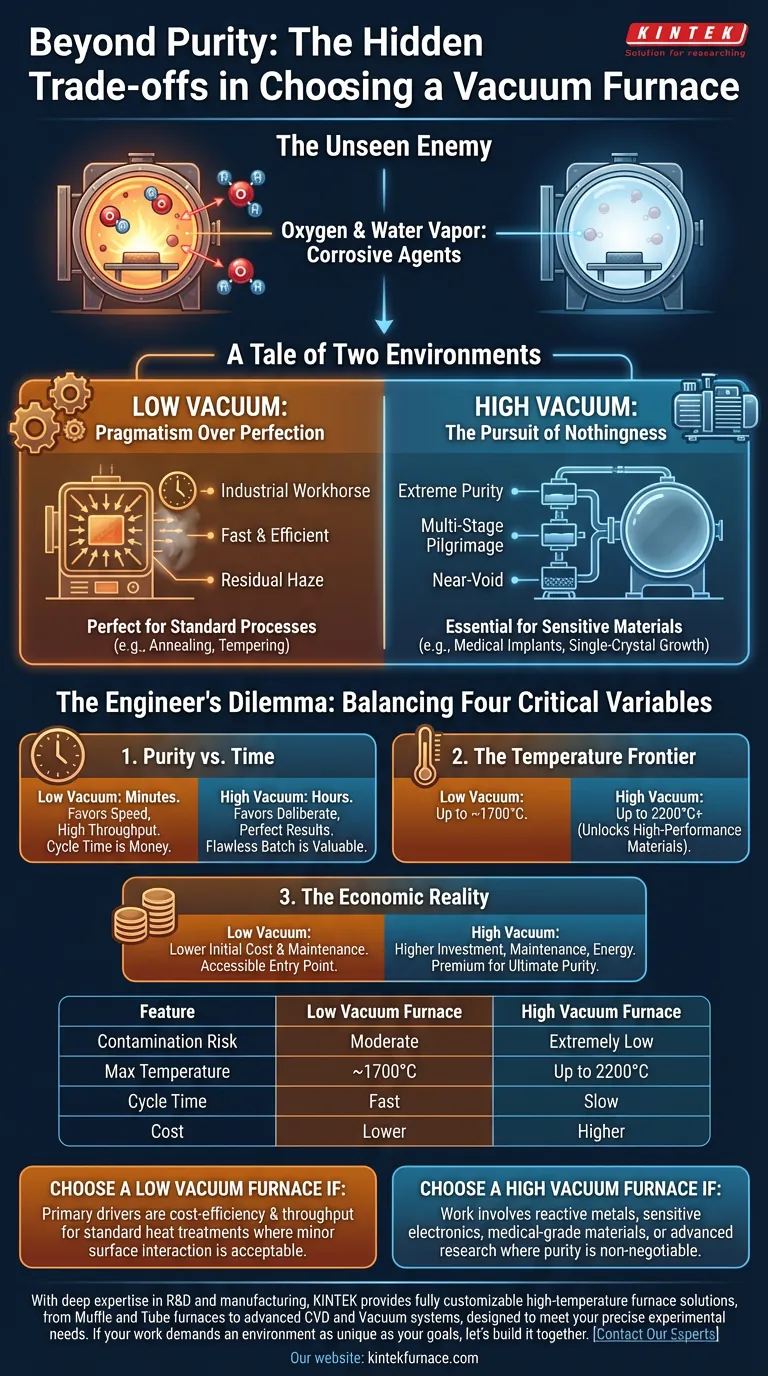
This is why we turn to vacuum furnaces. But the choice isn't simply "vacuum or no vacuum." It's a strategic decision between two fundamentally different philosophies: low vacuum and high vacuum. This choice is a masterclass in trade-offs.
A Tale of Two Environments
The word "vacuum" suggests emptiness, but in materials science, it's a spectrum. The quality of that emptiness dictates what's possible within the furnace chamber.
The Low Vacuum World: Pragmatism Over Perfection
A low vacuum furnace is an industrial workhorse. Its pumping system is designed for speed and efficiency, removing the vast majority of the atmosphere from the chamber quickly.
However, a "vast majority" is not the entirety. A residual haze of molecules remains. For many standard processes like annealing or tempering, this environment is perfectly adequate. It's a pragmatic choice where the goal is throughput and cost-efficiency, and a moderate, acceptable risk of slight surface reaction is a logical compromise.
The High Vacuum Realm: The Pursuit of Nothingness
Achieving a high vacuum is less a single action and more a multi-stage pilgrimage. It requires a sophisticated system of pumps working in sequence to methodically capture and eject molecules, pushing the chamber environment to a state of extreme purity.
In this near-void, the probability of a stray oxygen molecule encountering the material's surface approaches zero. This isn't just a quantitative improvement; it's a qualitative leap. It creates an environment where the most sensitive and reactive materials can be processed without fear of contamination, essential for medical implants, single-crystal growth, and advanced ceramics.
The Engineer's Dilemma: Balancing Four Critical Variables
Choosing between these two worlds is not a simple matter of "good" versus "better." It's an exercise in balancing a complex equation of competing priorities. Every lab and production facility must solve for its own unique variables.
1. The Currency of Purity vs. The Currency of Time
A low vacuum can be achieved in minutes. A high vacuum can take hours. This isn't a minor detail; it's the central economic tension.
- Low Vacuum: Favors speed and high throughput. It’s built for production environments where cycle time is money.
- High Vacuum: Favors deliberate, perfect results. It’s for applications where a single, flawless batch is infinitely more valuable than multiple, slightly compromised ones.
2. The Temperature Frontier
The quality of the vacuum is directly linked to the achievable temperature. A better vacuum provides better thermal insulation and protects heating elements from oxidation.
- Low Vacuum Furnaces: Typically operate up to around 1700°C.
- High Vacuum Furnaces: Can push the frontier to 2200°C or higher, unlocking the ability to process a new class of high-performance materials.
3. The Economic Reality
The sophistication required for high vacuum comes at a cost. The initial investment, ongoing maintenance, and energy consumption of advanced pumping systems are significantly higher.
A low vacuum furnace represents a more accessible entry point with a lower total cost of ownership. The decision is a classic investment calculation: is the expanded capability and ultimate purity of a high vacuum system worth the premium?
A Framework for Your Application
The right furnace is the one that aligns with your specific technical goals and operational realities. Your material dictates your needs.
| Feature | Low Vacuum Furnace | High Vacuum Furnace |
|---|---|---|
| Contamination Risk | Moderate | Extremely Low |
| Max Temperature | ~1700°C | Up to 2200°C |
| Cycle Time | Fast | Slow |
| Cost | Lower | Higher |
Choose a low vacuum furnace if your primary drivers are cost-efficiency and throughput for standard heat treatments where a minor degree of surface interaction is acceptable.
Choose a high vacuum furnace if your work involves reactive metals, sensitive electronics, medical-grade materials, or advanced research where ultimate purity is non-negotiable and failure is not an option.
Ultimately, selecting a furnace is about creating the perfect, controlled environment for your ambition. For processes that defy standard specifications, a system tailored to your unique requirements is often the most direct path to success. With deep expertise in R&D and manufacturing, KINTEK provides fully customizable high-temperature furnace solutions, from Muffle and Tube furnaces to advanced CVD and Vacuum systems, designed to meet your precise experimental needs.
If your work demands an environment as unique as your goals, let's build it together. Contact Our Experts
Visual Guide
Related Products
- Vacuum Hot Press Furnace Machine Heated Vacuum Press Tube Furnace
- Vacuum Hot Press Furnace Machine Heated Vacuum Press
- 600T Vacuum Induction Hot Press Vacuum Heat Treat and Sintering Furnace
- 2200 ℃ Tungsten Vacuum Heat Treat and Sintering Furnace
- Vacuum Heat Treat Sintering Furnace with Pressure for Vacuum Sintering
Related Articles
- How Vacuum Hot Press Furnaces Transform Advanced Material Engineering
- How to Select the Right Vacuum Hot Pressing Furnace Temperature for Your Materials
- Beyond the Parts List: The Real Reason Your Vacuum Hot Press Fails (And How to Fix It)
- Why Your High-Temperature Materials Fail: The Hidden War Inside Your Furnace
- Is Your Material Data Real? Why Temperature Gradients Are Sabotaging Your Cu2Se Resistivity Measurements