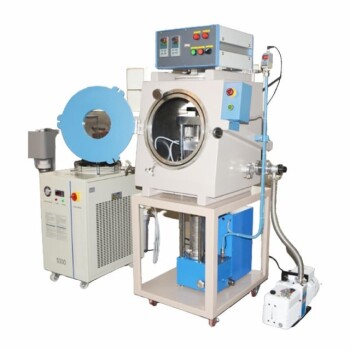
The core reason is gas entrapment. If you apply external high-pressure gas to a compact that still contains interconnected surface pores, the gas will infiltrate the internal pore network. The moment those channels snap shut and isolate, the high-pressure gas becomes permanently trapped inside. This internal pressure counteracts the external isostatic pressure, making it physically impossible to collapse the void and achieve full density.
The entire containerless HIP process hinges on a single transition point: zero apparent porosity. Pre-sintering serves a dual purpose—achieving pore closure is mandatory, but controlling the microstructure during that closure is the real challenge to ensure the isolated pores can still be removed later.
Understanding the Mechanism of Gas Entrapment
The physics here are absolute. The integrity of the HIP cycle is determined entirely by the state of the pore network before pressurization begins.
The Interconnected Network Problem
During the initial stages of sintering, particles bond together but leave a maze of open, three-dimensional pathways. These channels connect the component's interior directly to its surface.
When you pressurize the HIP vessel with argon, the gas molecules don't just push on the outside of the part. If a pathway exists, the gas flows into the compact until the internal pressure equals the external vessel pressure. It fills every cranny of the interconnected network.
The Trapdoor Effect of Pore Closure
As the temperature continues to rise, sintering mechanisms like grain boundary diffusion cause the necks between particles to grow. Eventually, the narrowest points of these channels pinch off, transforming a continuous network into a collection of isolated, discrete bubbles.
If this closure happens after the system is pressurized, each newly formed bubble is sealed at the vessel’s immense operating pressure. These high-pressure inclusions can never be compressed further. They act as rigid, incompressible spheres within the matrix, halting densification permanently.
The Role of the High-Temperature Furnace
This is precisely why the preliminary sintering step is non-negotiable. The high-temperature atmosphere furnace performs the critical job of removing these open channels in an unpressurized or low-pressure environment.
The goal is to drive the process to the pore isolation point (typically around 92-95% theoretical density, or ~5% closed porosity). Once the compact passes this threshold, any remaining voids are sealed capsules. When the pressure is subsequently applied in the HIP, these internal pockets, still at a low pressure, can be mechanically crushed.
The Critical Challenge of Pre-Sintering Control
While preventing gas infiltration is the primary answer to your question, the deeper need is often how to achieve this condition without creating a new set of unsolvable problems. The pre-sintering step is a high-stakes balancing act.
The Danger of Over-Firing
A naive approach would be to simply increase the pre-sintering temperature to ensure every last pore is closed. This is a critical mistake that leads to a different failure mode: pore-boundary separation.
If the grain boundaries move too quickly—often due to excessive thermal energy—they can detach from and leave behind a pore. The pore, now isolated inside a rapidly growing grain, is no longer on a fast diffusion path. This intra-granular porosity is virtually immune to further elimination by HIP.
Inhibiting Abnormal Grain Growth
To prevent this, the pre-sintering thermal profile in the high-temperature furnace must be meticulously programmed. The goal is to keep grain boundary mobility slow enough for pores to act as pinning points and be dragged along. This is often achieved through:
- Solute Drag: Adding specific dopants to the ceramic or metal powder that segregate to grain boundaries, lowering their mobility.
- Controlled Heating Rates: Using precise furnace controllers to provide just enough thermal energy for diffusion without triggering runaway grain coarsening.
Understanding the Trade-offs and Pitfalls
Successfully navigating this process requires acknowledging the material factors that work against you.
The Impact of Powder Agglomeration
The starting powder quality dictates the entire outcome. If nanopowders form hard agglomerates, a two-tier pore structure develops inside the green body. Intragranular pores within the agglomerates require very high temperatures to close, while the larger inter-agglomerate pores act as rapid diffusion paths for grain growth. You cannot "fix" a non-uniform pore distribution with a simple furnace temperature adjustment. The high thermal energy needed to close the stubborn internal pores inevitably triggers abnormal grain coarsening in the surrounding material, trapping the very pores you're trying to eliminate. The solution is upstream: colloidal processing with surfactants to break down agglomerates before the body is formed.
The Containerized Alternative
It's worth noting why one pursues containerless HIP at all. The alternative is to seal the powder in a deformable, gas-tight metal or glass container (a "can").
- Containerized HIP bypasses the pre-sintering requirement entirely. The can physically isolates the powder from the gas medium from the start. However, it adds cost, complexity, and the need to remove the can material post-process.
- Containerless HIP eliminates the can but shifts the risk to the pre-sintering step. It demands absolute certainty that no open porosity—even a single microscopic pinhole—remains connected to the surface.
Making the Right Choice for Your Process Goal
Your approach to the pre-sintering and HIP cycle must directly align with your final performance requirements. There is no single universal recipe.
- If your primary focus is achieving >99.8% theoretical density for optical transparency: You must prioritize a perfectly homogeneous green body via colloidal processing and use a two-step pre-sintering profile to isolate pores without any grain coarsening before a final HIP cycle crushes the last closed voids.
- If your primary focus is high-throughput structural ceramic production: You need to define the exact minimum temperature profile that guarantees zero open porosity but at the fastest possible cycle time. Run exhaustive "bubble tests" downstream to validate that no interconnected channels survived, as even one failure mode from trapped gas destroys batch reliability.
- If your primary focus is avoiding grain growth in a nanocrystalline material: You must favor a containerized HIP approach or a very low-temperature, extremely long-duration pre-sintering step. The thermal cost of closing surface pores in the open atmosphere might be fundamentally incompatible with preserving nano-scale grains; a sealed canister may be the only viable path.
By treating the high-temperature furnace not just as a heating device but as a precision instrument for controlling diffusion pathways, you transform a simple densification problem into a solutions-oriented materials engineering triumph.
Summary Table:
| Process State | Pore Network Condition | Gas Entrapment Risk | HIP Densification Outcome |
|---|---|---|---|
| Initial Pre-Sintering | Interconnected open channels | High (External argon gas infiltrates matrix) | Failure: Trapped gas counteracts pressure; voids remain. |
| Optimal Pore Isolation | Sealed, discrete voids (~92–95% TD) | Zero (Gas remains outside compact body) | Success: High external pressure crushes internal low-pressure voids. |
| Over-Fired Pre-Sintering | Intra-granular pores detached from boundaries | Low gas infiltration, but trapped inside grains | Impaired: Pores become immune to grain boundary diffusion paths. |
Achieving precise pore isolation requires flawless thermal control during the pre-sintering phase. At KINTEK, we specialize in high-performance laboratory equipment and consumables, offering a comprehensive range of high-temperature furnaces—including atmosphere, vacuum, muffle, tube, CVD, and custom high-temp systems tailored to your unique powder processing requirements. Protect your batch reliability and optimize your material density. Contact KINTEK today to discuss your furnace needs!
Related Products
- High Pressure Laboratory Vacuum Tube Furnace
- 600T Vacuum Induction Hot Press Vacuum Heat Treat and Sintering Furnace
- Vacuum Hot Press Furnace Machine Heated Vacuum Press Tube Furnace
- Vacuum Hot Press Furnace Machine Heated Vacuum Press
- Vacuum Hot Press Furnace Machine for Lamination and Heating
People Also Ask
- What role does a high vacuum tube furnace play in Co-Al sintering? Master High-Purity Porous Material Synthesis
- What are the different types of tube furnaces available? Find the Perfect Fit for Your Lab's Needs
- What is the role of a vacuum tube furnace during the final thermal treatment stage of Fe3O4@CSAC catalysts?
- What are the main advantages of vacuum tube furnaces in the market? Achieve Purity and Precision in Material Processing
- Why is a laboratory tube furnace necessary for BiVO4/RGO synthesis? Achieve Precise Nano-Structure Control