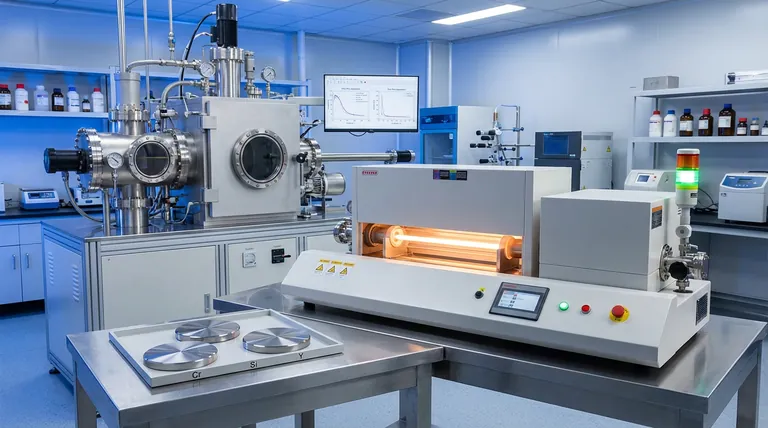
The foundation of any high-performance CrSiN-Y coating lies strictly in the quality of its source materials. The use of high-purity Chromium (Cr), Silicon (Si), and Yttrium (Y) targets is essential because it is the only way to guarantee precise control over the coating's chemical composition. Without high-purity inputs, you compromise the micro-structural integrity required for extreme thermal stability and hardness.
High-purity targets enable accurate chemical control and facilitate the critical micro-alloying process where yttrium inhibits grain growth. By eliminating impurities at the source, you prevent the formation of pinholes and macroscopic defects, ensuring the coating remains stable and hard under extreme working conditions.
Precision in Chemical Composition
Establishing a Stable Baseline
To achieve a high-performance coating, the chemical composition must be rigorously controlled. High-purity targets remove the variables associated with unknown contaminants.
Enabling Accurate Stoichiometry
When target purity is compromised, the ratio of Chromium, Silicon, and Nitrogen can shift unexpectedly. Using high-purity sources ensures the deposited film matches your engineered specifications exactly.
Unlocking the Potential of Micro-Alloying
Facilitating Yttrium Segregation
The addition of Yttrium (Y) is not passive; it is a micro-alloying agent intended to modify the coating's structure. High-purity Y targets ensure that the yttrium can segregate effectively at the grain boundaries.
Inhibiting Grain Growth
Once segregated at the boundaries, Yttrium acts as a stabilizer. It effectively inhibits grain growth, which is a critical mechanism for maintaining the fine nanostructure required for superior mechanical properties.
Structural Integrity and Defect Prevention
Eliminating Pinholes
Impurities within the target material often do not vaporize or react cleanly during deposition. These contaminants are a primary cause of pinholes and macroscopic defects in the final film.
Maximizing Hardness and Thermal Stability
By preventing defect formation, the coating maintains a continuous, dense structure. This defect-free state is what allows the CrSiN-Y coating to retain its hardness and stability, even when subjected to extreme heat and stress.
Understanding the Trade-offs
The Cost vs. Performance Balance
While high-purity targets are technically superior, they represent a significant increase in material cost. For non-critical applications where extreme hardness is not required, this cost may be difficult to justify.
Equipment and Process Hygiene
High-purity targets are ineffective if the deposition chamber itself is contaminated. Investing in these targets requires an equally rigorous commitment to vacuum system cleanliness and process gas purity to avoid re-introducing contaminants.
Making the Right Choice for Your Application
Selecting the right target purity depends on the specific demands of your operating environment.
- If your primary focus is Extreme Thermal Stability: You must prioritize high-purity Yttrium targets to ensure effective grain boundary segregation and inhibition of grain growth.
- If your primary focus is Defect Reduction: You must utilize high-purity Cr and Si targets to eliminate the impurities that cause pinholes and macroscopic failures.
Ultimately, the purity of your targets dictates the reliability of your coating; you cannot build a flawless structure from flawed materials.
Summary Table:
| Feature | Benefit of High-Purity Targets | Impact on Coating Performance |
|---|---|---|
| Chemical Composition | Precise stoichiometric control | Matches engineered specifications exactly |
| Micro-Alloying | Effective Yttrium segregation | Inhibits grain growth & stabilizes nanostructure |
| Structural Density | Elimination of impurities | Prevents pinholes and macroscopic defects |
| Mechanical Property | High material integrity | Maximizes hardness under extreme heat/stress |
Elevate Your Thin-Film Performance with KINTEK
Don't let material impurities compromise your research or production quality. KINTEK provides the ultra-high purity targets and advanced thermal processing equipment necessary to create flawless, high-performance coatings.
Backed by expert R&D and world-class manufacturing, we offer a comprehensive range of lab solutions, including:
- Customizable Muffle, Tube, and Vacuum Furnaces
- High-Purity Sputtering Targets (Cr, Si, Y, and more)
- Advanced CVD & Rotary Systems
Whether you are scaling up industrial CrSiN-Y coatings or developing new nanostructured materials, our team is ready to customize a solution for your unique needs. Contact KINTEK today to discuss your project requirements!
References
- Lishan Dong, Zhifeng Wang. Porous High-Entropy Oxide Anode Materials for Li-Ion Batteries: Preparation, Characterization, and Applications. DOI: 10.3390/ma17071542
This article is also based on technical information from Kintek Furnace Knowledge Base .
Related Products
- HFCVD Machine System Equipment for Drawing Die Nano Diamond Coating
- Inclined Rotary Plasma Enhanced Chemical Deposition PECVD Tube Furnace Machine
- Multi Heating Zones CVD Tube Furnace Machine for Chemical Vapor Deposition Equipment
- Custom Made Versatile CVD Tube Furnace Chemical Vapor Deposition CVD Equipment Machine
- 1400℃ Muffle Oven Furnace for Laboratory
People Also Ask
- What is Hot-filament Chemical Vapor Deposition (HFCVD)? Achieve High-Quality Thin Films with Precision Control
- What are the equipment for chemical vapor deposition? A Guide to the 5 Essential Components
- What is the significance of the vacuum pressure control system in the CVD coating process for powders?
- What is the function of high-purity Argon (Ar) gas during CVD? Optimize Your Thin Film Uniformity and Purity
- What are the advantages of using Chemical Vapor Deposition (CVD) for coating turbine blades? Enhance Life & Performance