The answer lies in preventing a metallurgical paradox. Protective atmosphere preheating is the non-negotiable first step that prevents aluminum powder from reacting with oxygen to form a tenacious ceramic barrier (Al₂O₃) before it has a chance to bond with itself. Without this meticulously controlled thermal soak in an inert gas like argon, the resulting forged part will inevitably harbor internal oxidation defects and porosity, making near-theoretical density impossible to achieve regardless of the forging pressure applied.
The surface need is preventing oxide scale, but the deep need is enabling interparticle bonding at the atomic level. Heating aluminum compacts to a uniform temperature like 520°C in an argon-filled high-temperature furnace does more than just clean the surface; it activates the thermal energy and ductility of the material. This "super-activation" ensures that when closed-die forging finally applies strain, the material deforms as a single, cohesive continuum to completely eliminate internal voids. Near-theoretical density (~0.99 fraction) is the evidence of this unified material flow, not just mechanical compaction.
Understanding the Hidden Enemy: The Aluminum Oxide Barrier
To understand why the preheat atmosphere is critical, you must first understand what happens to aluminum the instant it touches air. Aluminum does not simply "get dirty"; it undergoes an instantaneous chemical reaction to form a surface armor that is incredibly difficult to penetrate later.
The Inescapable Al₂O₃ Skin on Every Particle
Aluminum powder is inherently coated in a stable, resilient oxide film (Al₂O₃). This isn't a flaw; it's a fundamental property of the element.
This nanometer-thick ceramic skin acts as an impermeable barrier, preventing metallic contact between adjacent particles. You cannot achieve a metallic bond through an oxide; the atoms on one side simply cannot share an electron cloud with the atoms on the other.
How Forging Alone Fails to Break the Barrier
A common misconception is that high-pressure forging will simply "crack" the oxide shell and squeeze out pure metal. In reality, the oxide fragments become entrained as planar defects at prior particle boundaries.
Shearing fragments does not create a bond. These microscopic ceramic shards permanently weaken the material’s fracture toughness and fatigue resistance. The part may look dense, but its internal metal-to-metal bonding network is incomplete, a condition known as a "metallurgically unsound" structure.
The Protective Atmosphere as a Thermal Activator
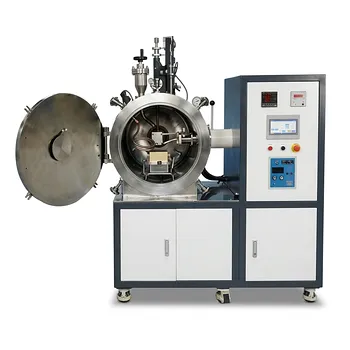
The high-temperature atmosphere furnace is not merely an oven with fancy gas; it is a precise chemical reactor designed to clean metal surfaces at the atomic level before they ever enter a forging die. This is where the transition from a collection of particles to a coherent engineering solid begins.
The Chemical Role of Inert Gas Preheating
By flooding the furnace chamber with argon, you displace the reactive oxygen. The elevated temperature of 520°C serves to accelerate any remaining surface reactions while preventing new ones.
The primary goal is not just to avoid new oxide, but to disrupt the existing one. In alloys containing magnesium, for example, the thermal energy facilitates a solid-state reduction where Mg acts as a getter. It reacts with the Al₂O₃ to form a spinel (MgAl₂O₄) and, critically, dramatically lowers the local oxygen partial pressure to levels impossible to measure in a bulk atmosphere (e.g., 10⁻⁵⁹ Pa). This creates a transient, thermodynamically oxygen-free skin ready for bonding.
Achieving Uniform Thermal Conditioning for Consistent Flow
Beyond chemistry, the preheating step guarantees uniform plasticity. A compact that is 520°C on the outside but cooler in the core will forge unevenly, creating low-density zones and internal shear cracks.
The furnace acts as a thermal equalizer. Uniform temperature ensures every particle achieves the same low flow stress. When the closed-die forging begins, the entire volume deforms homogeneously, allowing the material to flow like a fluid to eliminate macroscopic pores.
The Forging Mechanism: From Thermal Activation to Mechanical Densification
With the oxide barrier chemically neutralized and the material thermally softened, the forging step can do its work effectively. The relationship between the preheat and the deformation is what unlocks full density.
The Synergy Behind 0.99 Fractional Density
The process is a sequence of enabling conditions. First, the clean, activated surfaces created in the furnace are brought into intimate contact under pressure. Then, this promotes atomic diffusion across the particle boundaries.
Strain level is proportional to densification. A single deformation pass (~30% strain) can typically achieve a relative density of about 0.97. However, by using a two-step closed-die forging process that introduces a total strain of around 60%, the pore volume is sequentially collapsed. The final result is a density of up to 0.99 of the theoretical maximum, a value achievable only because the protective preheat prevented the formation of rigid, non-collapsible oxide shells around each particle.
The Critical Role of the Furnace Environment Beyond Oxidation
While preventing oxidation is the headline function, the controlled atmosphere plays a comprehensive role. Synthetic atmospheres facilitate the initial delubrication (binder burnout) phase cleanly, without leaving carbonaceous residues that could embrittle the final part.
The gas also controls interstitial element diffusion. An ultra-dry nitrogen atmosphere, for instance, can promote beneficial nitriding reactions on the surface, while a poorly controlled atmosphere might introduce hydrogen embrittlement. The high-temperature atmosphere furnace ensures that every gas-solid thermochemical interaction during the 0.5-hour soak is predictable and beneficial, from oxide reduction to the controlled cooling phase that sets the final microstructure.
Understanding the Trade-offs
Projecting an image of absolute success without acknowledging nuance erodes trust. The road to near-theoretical density is paved with critical processing decisions.
The Argon vs. Nitrogen Performance Paradox
A key insight often missed in simplified explanations is that the "best" protective atmosphere in the preheating stage may not be the best for final mechanical properties.
While argon provides a purely inert blanket that is undeniably effective at preventing oxidation, extensive dilatometry data shows that high-purity nitrogen atmospheres with an extremely low dew point (-40°C to -51°C) consistently produce the highest tensile strength and ductility in finished sintered aluminum P/M components. Argon is safe and positive, but it can be less effective overall and is often less economical than a meticulously controlled nitrogen process. Hydrogen mixtures, conversely, actually impede the sintering of aluminum, resulting in tensile strengths up to 15% lower. The choice of gas is therefore a strategic compromise between chemical inertness and thermochemical benefit.
The Economic and Equipment Reality
Achieving this level of precision is not trivial. It demands a high-temperature atmosphere furnace with rigorous dew point monitoring, precise gas metering, and exceptional temperature uniformity.
The capital investment is significant. The process is highly sensitive to soak times and temperature gradients; a poorly maintained furnace will produce parts that visually pass inspection but are metallurgically unsound, failing unpredictably in service. The trade-off is between an expensive, perfectly controlled lab environment and the potentially catastrophic cost of field failure from a part that was 97% dense but had no interparticle bonding.
Making the Right Choice for Your Goal
Your specific objective dictates the precise balance you must strike in your process parameters. Base these decisions on a clear-eyed view of your component's end-use requirements.
- If your primary focus is absolute peak density and structural soundness: Prioritize a multi-step closed-die forging process (~60% total strain) on a compact preheated to the target temperature in a high-purity nitrogen atmosphere with a dew point held below -40°C. This combination maximizes both the microstructural evolution during the thermal soak and the subsequent pore closure.
- If your primary goal is a chemically inert and risk-averse bonding environment for a reactive alloy: Select an argon preheat atmosphere in a furnace capable of maintaining ultra-low oxygen partial pressures. This is the definitive choice when any thermochemical reaction with the atmosphere—no matter how beneficial for strength—is unacceptable for the alloy’s phase stability.
- If your focus is on economic scalability without compromising core integrity: Do not default to cheap, low-purity gas. Target an engineering compromise using a controlled industrial nitrogen atmosphere, understanding that your rigorous control of the dew point will be the deciding factor between a component that delivers high mechanical properties and one plagued by unseen secondary oxidation defects.
The key to achieving near-theoretical density is not raw pressure; it is the microscopic cleanliness and thermal uniformity that only a meticulously controlled protective atmosphere preheating step can provide.
Summary Table:
| Process Parameter | Controlled Atmosphere Preheating (Argon / High-Purity N₂) | Conventional / Uncontrolled Heating |
|---|---|---|
| Surface Reaction | Disrupts Al₂O₃ skin; prevents new oxide formation | Forms rigid, impenetrable Al₂O₃ ceramic barrier |
| Interparticle Bonding | Enables atomic-level metal-to-metal bonding | Leaves ceramic shards at prior particle boundaries |
| Achievable Density | Near-theoretical (~0.99 relative density at ~60% strain) | Lower density (<0.97) with persistent micro-voids |
| Deformation Behavior | Uniform plasticity & cohesive material flow at ~520°C | Uneven thermal gradients & internal shear cracking |
| Mechanical Integrity | High fatigue strength and structural soundness | Low fracture toughness; metallurgically unsound |
Ready to eliminate internal oxidation defects and achieve near-theoretical density in your powder metallurgy applications? KINTEK specializes in premium laboratory equipment and consumables, providing a comprehensive range of high-temperature furnaces—including atmosphere, vacuum, muffle, tube, rotary, CVD, and induction melting furnaces—all fully customizable to your exact processing requirements. Whether you require precise gas metering or ultra-low dew point control for reactive metal processing, our advanced solutions deliver unmatched thermal uniformity and repeatability. Contact KINTEK today to consult with our thermal processing experts and optimize your laboratory performance!
Related Products
- 1400℃ High Temperature Laboratory Tube Furnace with Alumina Tube
- 1700℃ High Temperature Laboratory Tube Furnace with Alumina Tube
- 1700℃ Controlled Inert Nitrogen Atmosphere Furnace
- 1400℃ Controlled Inert Nitrogen Atmosphere Furnace
- High Temperature Muffle Oven Furnace for Laboratory Debinding and Pre Sintering
People Also Ask
- How does zone-melting in tube furnaces synthesize bismuth micro-wires? Master Single-Crystal Thermoelectric Growth
- How are high-temperature laboratory tube furnaces applied in long-term vacuum homogenization heat treatments for intermetallic samples?
- How are high-temp tube furnaces used to measure diffusion coefficients per Fick's law? Master Precision Annealing
- How do high-temperature laboratory tube furnaces ensure environmental stability? Precision Thermal Reduction Tips
- How are high-temperature tube furnaces applied in testing ceramic-supported alloy membranes? Insights