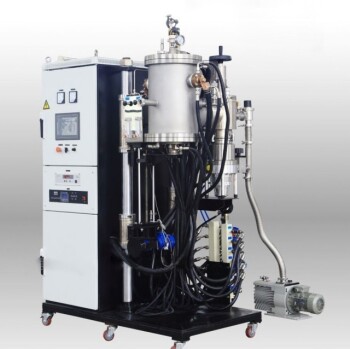
Precise heating rate and atmosphere control are not optional refinements—they are the primary levers that determine whether sintering yields a fully dense, high-performance component or a porous, degraded compact.
In both solid-state and liquid-phase sintering, the heating rate dictates which atomic diffusion mechanisms dominate during ramp-up. A fast ramp bypasses low-temperature surface diffusion that coarsens grains without densifying them, preserving the thermodynamic driving force for pore elimination later. Simultaneously, tight atmosphere control prevents unwanted oxidation, suppresses harmful volatilization of key elements, and stops gas entrapment in closed pores. Together, they allow you to decouple densification from grain growth and lock in the desired phase composition and microstructure.
Sintering is a race between densification and coarsening. Precise control over the time–temperature profile and chemical environment lets you tip the balance toward pore removal while keeping grain size small and the chemistry intact. Without it, you risk premature grain growth, phase decomposition, and residual porosity that no amount of final soak time can fix.
Why Heating Rate Determines Sintering Success
Bypassing Non-Densifying Surface Diffusion
During the initial stages, low temperatures favor surface diffusion—a mechanism that moves atoms along grain surfaces, coarsening the powder compact without any significant shrinkage.
A rapid heating rate pushes the material quickly through this dangerous window, denying surface diffusion the time it needs to act.
The result is that a higher driving force for densification is preserved when the compact reaches the high-temperature regime where grain boundary and volume diffusion can both shrink pores and bond particles.
Rapid Thermal Processing and Initial Densification Bursts
Ultrafine powders often exhibit an explosive initial densification in the first seconds or minutes of heating.
This rapid shrinkage is driven by high surface diffusion, grain boundary sliding, and non-equilibrium vacancy concentrations at particle junctions, which can deliver up to 95 % of total shrinkage almost instantaneously.
Without precise ramp-rate control, localized overheating and trapped porosity become inevitable, ruining reproducibility. A programmable furnace with steep, controlled ramps harnesses this burst while preventing thermal runaway.
Controlling Liquid Phase Volume in Transient Liquid Phase Sintering (TLPS)
In TLPS, the heating rate (dT/dt) directly dictates how much liquid phase is available at the peak sintering temperature.
A slow ramp allows solid-state interdiffusion to form intermediate compounds before the liquid formation temperature is reached. This consumes material and drastically reduces the total volume and duration of the liquid.
The outcome: swollen compacts, large residual pores, and poor mechanical properties. A fast, controlled ramp suppresses solid interdiffusion, ensuring that enough liquid forms to effectively wet grain boundaries, dissolve solid matter, and close pores rapidly.
Grain Morphology Control via Interface-Reaction Kinetics
Faceted grains with ordered interfaces do not grow linearly like spherical, atomically rough grains. Instead, their growth is governed by interface reactions (such as 2D nucleation or screw dislocations) that only activate above a critical driving force.
By precisely regulating the temperature and heating path, you can shift the growth mechanism from interface-reaction-controlled to diffusion-controlled, tailoring the final grain morphology—whether you need a fully faceted polyhedron, a round-edged polyhedron, or a near-spherical shape.
This is how advanced ceramics and metallic compacts achieve a narrow grain size distribution and specific crystallographic textures.
Atmosphere Control: The Chemical Guardian of Sintering
Preventing Surface Oxidation and Oxide Layers
In solid-phase sintering, even trace oxygen can form a resistive oxide layer on powder surfaces. This oxide layer blocks the mass transport needed for neck formation and densification.
Switching to a vacuum, inert gas, or reducing atmosphere strips away oxygen, promoting clean particle-to-particle contact and rapid pore closure.
For non-oxide ceramics like silicon nitride, this is existential: oxygen exposure leads to decomposition and the loss of structural integrity.
Suppressing Elemental Volatilization and Phase Decomposition
Materials such as lead-based ferroelectrics, beta-alumina, and SiC-fiber-reinforced composites contain elements with high vapor pressures at sintering temperatures.
In an open atmosphere, these elements evaporate, destroying stoichiometry. In composites, oxygen can oxidize SiC fibers to form SiO₂, which then reacts with the matrix to create brittle aluminosilicate phases.
A high-purity inert or controlled-pressure atmosphere (or vacuum) suppresses volatilization and stops these parasitic reactions, preserving both the fibers and the matrix composition.
Debinding, Carbon Regulation, and Gas Purging
Polymer binders must be thermally decomposed at lower temperatures before full densification begins.
By doping inert atmospheres with precise amounts of oxygen, hydrogen, or moisture, you form gaseous CO, CO₂, or CH₄ that cleanly evacuates carbon, leaving the exact residual carbon content needed in steel and alloy compacts.
Moreover, for optically transparent ceramics like alumina, only a high-vacuum or pure hydrogen furnace can diffuse insoluble gas out of pores, allowing them to fully close and yielding a crystal-clear solid without light-scattering voids.
Phase Stabilization via Furnace Atmosphere
Nitride ceramics such as Si₃N₄ will dissociate at elevated temperatures unless a nitrogen overpressure is maintained.
The furnace atmosphere becomes a chemical buffer that stabilizes the phase you want, preventing back-reactions that would otherwise destroy the part before densification completes.
Understanding the Trade‑offs
Rapid Heating vs. Thermal Shock
Fast ramps reduce coarsening but can induce thermal gradients that crack large or complex parts.
The art lies in finding the maximum heating rate your component geometry and material can withstand without catastrophic failure.
Atmosphere Purity vs. Cost and Complexity
Ultra‑high‑vacuum or high‑purity hydrogen atmospheres are powerful but expensive and require robust safety systems.
For many oxide ceramics, a simple inert gas or slightly reducing atmosphere may be sufficient, balancing cost against the required final properties.
Program Complexity vs. Process Reproducibility
Multi‑step heating profiles (e.g., a slow debinding segment, a fast densification ramp, and a controlled cooling step) maximize densification while minimizing grain growth.
However, complex programs demand furnaces with excellent temperature uniformity and calibration, or the same recipe will yield different results across batches.
Atmosphere Effects on Liquid Sintering
While a reducing atmosphere can improve liquid wettability and spread, it may also alter the melt’s surface tension and solubility in ways that destabilize the liquid phase.
The atmosphere must be matched to the specific liquid–solid interfacial chemistry, or full densification will remain out of reach.
Making the Right Choice for Your Process Goals
Your final selection of heating profile and atmosphere should be driven by what you value most in the sintered part.
- If your primary focus is maximum density without grain coarsening: Implement a fast ramp through the low‑temperature surface‑diffusion window, then soak at a temperature where grain boundary diffusion dominates. Use vacuum or inert gas to keep surfaces clean.
- If your primary focus is controlling grain size and morphology: Use two‑step sintering or a tailored thermal profile that drops the temperature below a critical threshold immediately after reaching peak density, effectively freezing the microstructure. Couple this with an atmosphere that does not accelerate interface reactions.
- If your primary focus is processing TLPS or liquid‑phase sintered materials: Choose a rapid ramp to suppress solid interdiffusion and maximize liquid volume, then hold just long enough for pore closure. Match the atmosphere to the liquid’s wettability—often a reducing or vacuum environment works best.
- If your primary focus is sintering non‑oxide ceramics or sensitive composites: Select a high‑purity nitrogen overpressure for nitrides, or an inert/vacuum environment for carbide‑based materials, to prevent oxidation, decomposition, and fiber degradation.
- If your primary focus is achieving optical transparency or ultra‑low‑porosity parts: Only a high‑vacuum or hydrogen atmosphere will give you the complete pore closure needed to eliminate light‑scattering voids.
Precise control over heating rate and atmosphere transforms sintering from a crude thermal bake into a predictable, repeatable manufacturing science. Master these two levers, and you control the final performance of every part that leaves your lab furnace.
Summary Table:
| Control Parameter | Thermal / Chemical Mechanism | Impact on Final Microstructure & Performance |
|---|---|---|
| Rapid Heating Rate | Bypasses low-temp surface diffusion | Suppresses grain coarsening; preserves driving force for high density |
| TLPS Ramp Control | Minimizes premature solid interdiffusion | Maximizes liquid phase volume for rapid pore closure and wetting |
| Atmosphere (Vacuum / H₂) | Eliminates surface oxides & evacuates trapped gases | Promotes clean particle bonding; enables optical transparency |
| Atmosphere Overpressure (e.g., N₂) | Prevents element volatilization & phase breakdown | Stabilizes non-oxide ceramics (e.g., Si₃N₄) and maintains stoichiometry |
Master Your Sintering Processes with KINTEK High-Temperature Furnaces
Achieve uncompromised material density, precise phase stability, and repeatable microstructures. KINTEK specializes in advanced laboratory equipment and high-temperature furnace solutions—including atmosphere, vacuum, tube, muffle, CVD, and induction melting furnaces—all customizable to meet your unique heating rate and atmosphere control requirements.
Ready to elevate your material research and manufacturing yield? Contact KINTEK experts today to build the ideal furnace system for your lab!
Related Products
- 1400℃ High Temperature Laboratory Tube Furnace with Alumina Tube
- 1700℃ High Temperature Laboratory Tube Furnace with Alumina Tube
- 1800℃ High Temperature Muffle Oven Furnace for Laboratory
- 1700℃ High Temperature Muffle Oven Furnace for Laboratory
- 1200℃ Muffle Oven Furnace for Laboratory
People Also Ask
- How does zone-melting in tube furnaces synthesize bismuth micro-wires? Master Single-Crystal Thermoelectric Growth
- How are high-temp tube furnaces used to measure diffusion coefficients per Fick's law? Master Precision Annealing
- How do high-temperature laboratory tube furnaces ensure environmental stability? Precision Thermal Reduction Tips
- How are high-temperature laboratory tube furnaces applied in long-term vacuum homogenization heat treatments for intermetallic samples?
- How are high-temperature tube furnaces applied in testing ceramic-supported alloy membranes? Insights