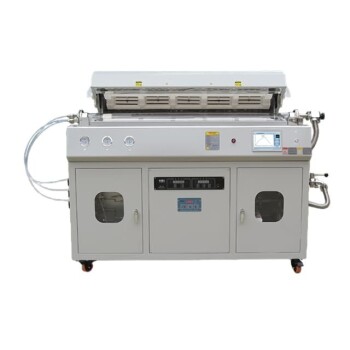
High-temperature controlled-atmosphere heat treatment is not a finishing step—it’s a fundamental transformation that turns fragile, internally stressed metal 3D prints into components you can trust with a human life or a multi-million-dollar mission. It relieves the severe residual stresses locked in by rapid layer-by-layer solidification, closes micro-voids that would otherwise nucleate cracks, and homogenizes a chaotic microstructure into a uniform, predictable one—all while a tightly controlled vacuum or inert gas blanket prevents oxidation and contamination of highly reactive alloys. Only this thermal consolidation process delivers the isotropic mechanical properties and fatigue resistance that aerospace and medical regulators demand.
Additive manufacturing inevitably creates parts with directional weakness, internal stress fields, and microscopic flaws. High-temperature controlled-atmosphere heat treatment systematically erases these defects, restoring the material to a state where properties are consistent, measurable, and certifiable. Without it, you’re not engineering a reliable component—you’re gambling with anisotropic metal.
The Flaws Hidden Inside Every As-Printed Metal Part
Residual Stresses: The Silent Distortion Engine
Every laser or electron beam pulse melts a tiny volume of powder, which then cools and solidifies in milliseconds. This extreme thermal gradient traps intense compressive and tensile stress fields within the part.
If left unrelieved, these residual stresses will manifest as warpage, dimensional inaccuracy, or sudden brittle fracture during service. In an aerospace bracket, that means a component that looks right but fails unexpectedly.
Mechanical Anisotropy: Strength That Depends on Direction
As-printed metal parts inherently exhibit anisotropic mechanical properties. Tensile strength, ductility, and fatigue life can vary significantly depending on whether you pull along or across the build layers.
For a hip implant, this directionality creates weak planes that align with everyday loading. For a turbine component, it introduces failure modes that standard isotropic design models cannot predict.
Micro-Porosity: The Cracks You Don’t See Yet
Laser interaction times as short as 0.5 milliseconds rarely allow complete solid-state diffusion. The result is a network of tiny micro-pores and incomplete bonding between layers.
These voids act as stress concentrators. Under cyclic loading—standard for both orthopedic implants and aircraft structures—they become initiation points for crack propagation, slashing fatigue life far below acceptable thresholds.
How High-Temperature Heat Treatment Repairs the Damage
Stress Relief and Distortion Prevention
Soaking a part in a high-temperature furnace allows atoms to redistribute locally, dismantling the locked-in stress fields without macro-scale melting. The result is a dimensionally stable component.
This step is mandatory before any final machining. Without it, removing even a thin surface layer can release stresses asymmetrically, warping a precision part beyond its geometric tolerance window.
Densification and Void Closure
At temperature, diffusion-driven mass transport actively shrinks micro-pores. Internal surfaces heal as atoms migrate to fill gaps, much like ice cubes fusing in a drink.
The atmosphere plays a direct role here: a reducing environment or high vacuum removes surface oxides, enabling clean metal-to-metal contact and accelerating pore closure. The final density can approach theoretical, transforming a sponge-like microstructure into fully dense material.
Microstructural Homogenization
Selective laser melting often creates non-equilibrium phases and chemical segregation on a microscopic scale. Extended time at soak temperature allows homogenization—a uniform redistribution of alloying elements.
This yields a consistent grain structure and predictable phase distribution. The outcome is isotropic mechanical properties that align with the design allowables used by stress engineers and regulatory bodies.
Why a Controlled Atmosphere Is Non-Negotiable
Oxidation Prevention for Reactive Metals
Aerospace and medical parts rely on reactive alloys—Ti6Al4V, aluminum grades, nickel superalloys—that eagerly grab oxygen, nitrogen, or hydrogen when heated. Even trace oxygen at annealing temperatures creates a brittle alpha-case layer on titanium or depletes alloying elements in superalloys.
A vacuum or inert gas blanket (argon, helium) eliminates this surface degradation. The part emerges chemically clean, ready for further processing or direct implantation.
The Atmosphere as a Chemical Agent
Beyond protection, the furnace atmosphere actively participates in the process. During heating, it can:
- Reduce residual oxides, exposing pristine metal surfaces for better neck formation.
- Control interstitial element content, deliberately managing oxygen or nitrogen levels to fine-tune hardness and ductility.
- Influence heat transfer, promoting uniform temperature distribution throughout the chamber.
In some powder metal workflows, the same atmosphere also handles delubrication—cleanly burning off binders before sintering begins—though this is more critical for binder-based additive methods.
Surface Engineering Possibilities
A controlled atmosphere can also serve as a carrier gas for surface modification. Introducing carbon or nitrogen at temperature enables case hardening or nitriding, tailoring the part’s outer layer for specific wear or fatigue requirements.
This capability expands the design envelope, allowing a single heat treatment cycle to both fix the bulk material and enhance its surface.
Understanding the Trade-offs and Pitfalls
Cost and Cycle Time
High-temperature vacuum furnaces are capital-intensive and slow. Soak times range from hours to days depending on part thickness, and the heating/cooling ramps must be gentle to prevent thermal shock.
You’re trading processing speed for absolute reliability—a non-issue in low-volume, high-value sectors like aerospace and medical, but a potential bottleneck in scaled production.
Risk of Distortion During Treatment
Ironically, the very process that relieves stress can also introduce new distortion if the part isn’t properly supported. Fixture design becomes critical; parts must be held in a way that allows expansion without constraint.
Without proper fixturing, gravity and thermal expansion can warp a near-net-shape component, wasting days of print time and treatment cost.
Atmosphere Selection Is Alloy-Specific
Vacuum isn’t always the answer. Some alloys require a partial pressure of argon to prevent elemental evaporation. Others need a specific reducing atmosphere to achieve the right interstitial chemistry.
Using the wrong atmosphere can lead to decarburization (softening of the surface) or carburization (embrittlement), ruining the part’s mechanical profile. Consult the alloy datasheet and process specifications meticulously.
Making the Right Choice for Your Application
Every metal 3D-printed aerospace or medical component will need some form of thermal post-processing. The key is matching the treatment to the performance goal.
- If your primary focus is maximizing fatigue resistance in a structural aerospace bracket: Specify a vacuum stress-relief and solution anneal, followed by a controlled quench. The isotropic microstructure and closed porosity will directly enhance high-cycle fatigue life.
- If your primary focus is biocompatibility and long-term implant stability: Opt for a high-vacuum treatment for titanium alloys. Elimination of surface oxides and alpha-case ensures the osseointegration and corrosion resistance regulators require.
- If your primary focus is creep and oxidation resistance in a superalloy turbine part: Use an inert-gas atmosphere with precisely managed partial pressures. This preserves grain boundary strengthening elements and avoids surface depletion.
- If your primary focus is managing supply chain costs while meeting certification: Work with an accredited heat treatment partner that provides full atmosphere traceability and batch-specific certifications. The paperwork is as critical as the microstructure.
That final step inside a controlled-atmosphere furnace isn’t just a process checkpoint—it’s where a printed shape becomes a genuine Engineering material, ready for the extreme demands of an aircraft engine or a human body.
Summary Table:
| As-Printed Flaw / Challenge | Heat Treatment & Atmosphere Mechanism | Final Component Benefit |
|---|---|---|
| Residual Stresses & Warpage | High-temp thermal soak allowing local atom redistribution | Dimensional stability & distortion-free machining |
| Mechanical Anisotropy | Extended soak allowing element homogenization | Isotropic strength & predictable failure modeling |
| Micro-Porosity & Voids | Vacuum/reducing environment diffusion-driven closure | Theoretical density & maximized fatigue resistance |
| Surface Oxidation & Embrittlement | Ultra-clean inert gas blanket or high-vacuum shielding | Chemically clean surface & preserved alloy integrity |
Ready to eliminate internal defects and achieve certifiable reliability for your metal additive manufacturing? KINTEK specializes in advanced laboratory equipment and customizable high-temperature furnaces—including vacuum, atmosphere, muffle, tube, rotary, and CVD furnaces tailored to your unique metallurgy requirements. Whether you are producing critical medical implants or aerospace structural components, our precision thermal solutions prevent oxidation, relieve stress, and optimize density. Enhance your lab's thermal processing capabilities—contact KINTEK today to consult with our experts!
Related Products
- 1700℃ Controlled Inert Nitrogen Atmosphere Furnace
- 1400℃ Controlled Inert Nitrogen Atmosphere Furnace
- 1200℃ Controlled Inert Nitrogen Atmosphere Furnace
- Mesh Belt Controlled Atmosphere Furnace Inert Nitrogen Atmosphere Furnace
- Controlled Inert Nitrogen Hydrogen Atmosphere Furnace
People Also Ask
- Why is thorough binder burnout necessary before sintering advanced ceramics? Ensure Peak Density & Zero Defects
- How do controlled-atmosphere furnaces support polymer pyrolysis? Master SiC & Si3N4 Ceramic Conversion
- How does oxygen partial pressure control affect ceramic sintering? Master Defect Chemistry
- How does real-time dilatometric analysis in a controlled-atmosphere furnace optimize PZT ceramic sintering?
- Why is controlled-atmosphere heating required for functional ceramics and sensors? Master Defect Engineering