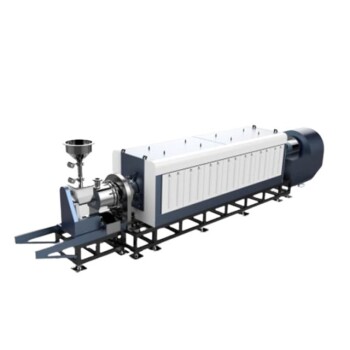
The selection of 575°C for ashing sorghum stalks and solid waste is a deliberate calibration designed to balance complete organic destruction with the preservation of inorganic integrity. Specifically, this temperature ensures the total oxidative combustion of organic matter while preventing the volatilization of volatile alkali metals like sodium (Na) and potassium (K).
Core Takeaway: Maintaining a strict 575°C environment allows for the removal of all carbon-based materials without altering the sample's original inorganic profile, ensuring the resulting ash accurately reflects the raw material's mineral composition.
The Chemistry of the 575°C Threshold
Preventing Alkali Metal Volatilization
One of the primary risks in high-temperature ashing is the loss of critical mineral elements. Alkali metals, particularly potassium and sodium, begin to volatilize at higher temperatures, which would lead to an underestimation of the sample’s mineral content.
By capping the furnace at 575°C, the process stays below the thermal threshold where these elements transition into a gaseous state. This preservation is vital for researchers who need to analyze the exact inorganic ratios of biomass like sorghum.
Ensuring Complete Oxidative Combustion
At the same time, the temperature must be high enough to break all carbon-hydrogen and carbon-oxygen bonds. 575°C provides sufficient thermal energy to ensure that all organic substances are thoroughly oxidized and removed.
The result is a "pure" ash, free from residual carbon or "char" that could skew the weight and chemical analysis of the sample.
The Role of the Muffle Furnace in Ashing
Precision Temperature Control
A standard oven cannot provide the stability required for this delicate balance. A laboratory muffle furnace uses advanced refractory chambers and electronic controllers to maintain a constant temperature within a very narrow margin.
This precision prevents "hot spots" within the chamber that could inadvertently exceed the 575°C limit and ruin the sample's inorganic consistency.
Controlled Oxygen-Rich Environment
The ashing process requires oxygen to convert organic carbon into carbon dioxide gas. The design of the muffle furnace allows for controlled airflow, ensuring that the combustion is aerobic and complete.
Without this consistent oxygen supply, the sample might only partially decompose, leaving behind organic impurities that contaminate the mineral residue.
Understanding the Trade-offs
Accuracy vs. Processing Time
While higher temperatures (such as 750°C or 815°C) can accelerate the combustion process, they are often avoided for biomass. Using a lower temperature like 575°C requires a longer "soak" time, often several hours, to ensure mineralization.
Choosing accuracy over speed is necessary when the goal is a detailed chemical characterization of the ash rather than a simple bulk weight measurement.
Risk of Sintering and Fusion
If temperatures exceed the recommended levels, the ash particles may begin to fuse together, a process known as sintering. This can trap organic matter inside a "glassy" mineral shell, preventing complete combustion.
Keeping the furnace at 575°C keeps the minerals in a powdery, stable state that is easier to handle and dissolve for subsequent laboratory analysis.
How to Apply This to Your Project
Recommendations Based on Material Type
The optimal ashing temperature often depends on the specific goals of your analysis and the nature of the waste material.
- If your primary focus is total mineral quantification (MMr): Use a steady temperature between 550°C and 575°C for at least six hours to ensure all carbon is removed.
- If your primary focus is alkali metal analysis (Na/K): Strictly adhere to the 575°C limit to avoid losing these volatile elements to the atmosphere.
- If your primary focus is analyzing coal or biochar stability: You may need to follow industry-specific standards that require higher temperatures, such as 750°C or 815°C, as these materials have different combustion profiles.
By strictly controlling the thermal environment of the muffle furnace, you ensure that the laboratory ash is a perfect inorganic fingerprint of the original sorghum or solid waste sample.
Summary Table:
| Parameter | Specification | Purpose / Benefit |
|---|---|---|
| Target Temp | 575°C | Balances organic removal with mineral preservation |
| Element Safety | Sodium (Na) & Potassium (K) | Prevents volatilization of critical alkali metals |
| Process | Oxidative Combustion | Ensures total destruction of carbon-based materials |
| Equipment | Muffle Furnace | Eliminates hot spots and provides precise oxygen flow |
| Result | Inorganic Fingerprint | Produces pure ash for accurate chemical profiling |
Achieve Unmatched Precision in Your Ashing Protocols with KINTEK
Accurate mineral analysis starts with reliable thermal control. KINTEK specializes in high-performance laboratory equipment and consumables, offering a comprehensive range of customizable high-temperature furnaces—including muffle, tube, vacuum, and atmosphere models—designed to meet the rigorous demands of biomass and waste research.
Whether you are performing delicate mineral profiling at 575°C or high-temp sintering, our solutions ensure the thermal stability and uniform heating your samples require.
Ready to upgrade your laboratory’s efficiency and accuracy?
Contact KINTEK today for a tailored solution!
References
- Ziqiang Yang, Yitian Fang. Regulation Mechanism of Solid Waste on Ash Fusion Characteristics of Sorghum Straw under O2/CO2 Atmosphere. DOI: 10.3390/en16207052
This article is also based on technical information from Kintek Furnace Knowledge Base .
Related Products
- 1800℃ High Temperature Muffle Oven Furnace for Laboratory
- 1700℃ High Temperature Muffle Oven Furnace for Laboratory
- 1200℃ Muffle Oven Furnace for Laboratory
- 1400℃ Muffle Oven Furnace for Laboratory
- High Temperature Muffle Oven Furnace for Laboratory Debinding and Pre Sintering
People Also Ask
- How does a high-temperature laboratory muffle furnace affect material properties? Transform Anodic Oxide Films Fast
- What is the primary function of a high-temperature laboratory muffle furnace in chemical synthesis? Achieve Precision.
- What is the critical role of a laboratory high-temperature muffle furnace in TiO2/LDH? Unlock Superior Crystallization
- Why is a laboratory high-temperature muffle furnace required for LaNixFe1-xO3 catalysts? Optimize Two-Stage Synthesis
- How does a laboratory muffle furnace modify oyster shell powder? Transform Waste into High-Performance Materials