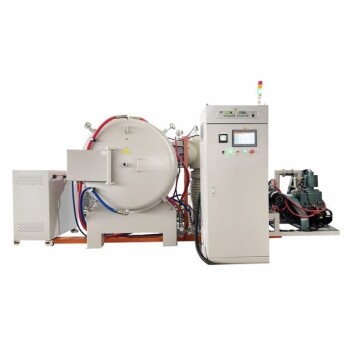
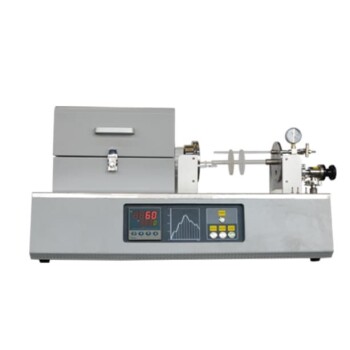
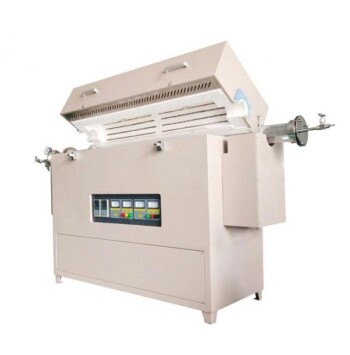
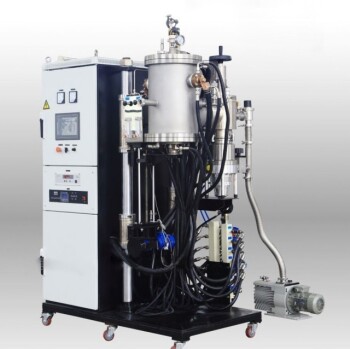
The laboratory high-temperature muffle furnace is the cornerstone of photoanode fabrication because it provides the precise, programmable thermal environment required for phase transformation and organic decomposition. By strictly controlling heating rates and sintering durations, the furnace converts amorphous precursors into highly crystalline, photoelectrically active semiconductors while simultaneously removing structural impurities.
A muffle furnace acts as a precision reactor that transforms thin-film precursors into stable, high-performance crystalline structures. It is essential for optimizing charge transport efficiency, ensuring mechanical adhesion to substrates, and achieving the chemical purity necessary for electrochemical stability.
Driving Phase Transformation and Crystallinity
Converting Amorphous Precursors
Photoanode materials, such as Bismuth Vanadate (BiVO4) or Tungsten Trioxide (WO3), often begin as amorphous precursor films. The muffle furnace provides the high-energy environment (often 450°C to 700°C) required to facilitate the solid-phase reaction and phase transformation into stable crystalline forms, such as monoclinic clinobisvanite.
Reducing Bulk Defects
Precise temperature management allows for controlled crystal growth, which is critical for reducing internal defects. By minimizing these defects, the furnace enhances the charge transport efficiency within the material, preventing the premature recombination of photo-generated electrons and holes.
Optimizing Grain Size
Using multi-stage, programmable heating rates (e.g., 0.67 °C/min) ensures that the grain size of the photoanode is uniform. This level of control in the muffle furnace helps define the nanostructure of the film, which directly impacts the material's light-harvesting capabilities and photoelectric activity.
Eliminating Impurities and Enhancing Surface Area
Removal of Organic Additives
During the preparation of photoanode slurries, organic binders and surfactants like polyethylene glycol (PEG) or Triton X-100 are added to improve film consistency. The muffle furnace effectively burns off these organic substances through high-temperature oxidation, leaving behind a pure semiconductor layer.
Maximizing Surface Area for Dye Loading
For dye-sensitized solar cells, the thermal removal of organic binders increases the specific surface area of the film. This porous structure allows for a higher loading capacity of dye molecules, which significantly improves the overall charge collection efficiency of the device.
Ensuring Chemical Purity
High-temperature air environments within the furnace facilitate the evaporation of solvents and the decomposition of impurities introduced during spin-coating or printing. This results in a chemically stable electrode that can withstand long-term operation in corrosive electrochemical cells.
Strengthening Mechanical and Electrical Contacts
Interfacial Adhesion to Substrates
Photoanodes are typically deposited on conductive glass, such as FTO (Fluorine-doped Tin Oxide). The sintering process in a muffle furnace promotes thermal fusion between the semiconductor layer and the substrate, creating the robust mechanical adhesion required for durable electrodes.
Establishing Electrical Contact Networks
Sintering causes the individual nanoparticles within the film to fuse slightly at their boundaries. This creates a robust electrical contact network, which drastically reduces interfacial resistance and allows for the efficient flow of electrons through the semiconductor to the external circuit.
Eliminating Internal Stresses
Controlled cooling rates within the furnace are just as vital as the heating phases. Gradual cooling helps to eliminate internal stresses that develop during the expansion and contraction of the thin film, preventing cracks or delamination from the conductive substrate.
Understanding the Trade-offs and Pitfalls
Substrate Thermal Limits
While high temperatures improve crystallinity, they can also damage the substrate. For instance, FTO glass can begin to lose conductivity or warp if exposed to temperatures exceeding 550°C-600°C for extended periods, requiring a careful balance between material activation and substrate integrity.
Risks of Rapid Thermal Cycling
If the muffle furnace is not programmed for gradual temperature changes, the resulting thermal shock can cause the photoanode film to peel or crack. These microscopic fractures create traps for charge carriers, which significantly degrades the performance of the photoanode.
Phase Over-Stabilization
Excessive sintering can lead to undesired phase changes or excessive grain growth, which reduces the active surface area. Finding the "sweet spot" in temperature is essential to prevent the loss of the nanostructured properties that make photoanodes efficient.
Making the Right Choice for Your Research
- If your primary focus is Phase Purity: Use multi-stage, slow heating rates to facilitate the solid-phase reaction between precursors without forming secondary, inactive phases.
- If your primary focus is Interfacial Conductivity: Prioritize the sintering duration at peak temperature (e.g., 450°C for 2 hours) to ensure the semiconductor particles fuse effectively with the FTO substrate.
- If your primary focus is High Surface Area: Ensure the temperature is high enough to completely decompose organic binders (typically above 400°C) but low enough to prevent excessive grain coarsening.
By mastering the thermal gradients of a high-temperature muffle furnace, researchers can unlock the full catalytic and electronic potential of advanced photoanode materials.
Summary Table:
| Thermal Process | Impact on Photoanode | Target Outcome |
|---|---|---|
| Phase Transformation | Converts precursors to crystalline semiconductors | Optimized Charge Transport |
| Organic Oxidation | Burns off binders (PEG, surfactants) | High Specific Surface Area |
| Particle Sintering | Bonds nanoparticles to FTO substrates | Reduced Interfacial Resistance |
| Controlled Cooling | Eliminates internal stresses and fractures | Mechanical Stability & Durability |
Elevate Your Semiconductor Research with KINTEK
Precision thermal processing is the key to unlocking the full potential of your photoanode materials. KINTEK specializes in high-performance laboratory equipment, offering a comprehensive range of high-temperature furnaces, including muffle, tube, vacuum, CVD, and atmosphere furnaces.
Whether you are optimizing grain size or protecting delicate FTO substrates, our customizable solutions provide the uniform heating and programmable control essential for cutting-edge research. Don't let thermal inconsistency compromise your results.
Contact KINTEK today to find the perfect furnace for your unique lab requirements!
References
- Liangcheng Xu, Wei Huang. Nitrogen incorporated oxygen vacancy enriched MnCo2Ox/BiVO4 photoanodes for efficient and stable photoelectrochemical water splitting. DOI: 10.1007/s12274-023-5939-9
This article is also based on technical information from Kintek Furnace Knowledge Base .
Related Products
- 1800℃ High Temperature Muffle Oven Furnace for Laboratory
- 1700℃ High Temperature Muffle Oven Furnace for Laboratory
- 1200℃ Muffle Oven Furnace for Laboratory
- 1400℃ Muffle Oven Furnace for Laboratory
- High Temperature Muffle Oven Furnace for Laboratory Debinding and Pre Sintering
People Also Ask
- How does a high-temperature laboratory muffle furnace affect material properties? Transform Anodic Oxide Films Fast
- What is the primary function of a high-temperature laboratory muffle furnace in chemical synthesis? Achieve Precision.
- What is the role of a laboratory high-temperature muffle furnace in iron analysis? Key to Precise Sample Mineralization
- What role does a muffle furnace play in plant bark mineral analysis? Essential for Precise Dry Ashing & Trace Extraction
- Why is a laboratory high-temperature muffle furnace required for LaNixFe1-xO3 catalysts? Optimize Two-Stage Synthesis