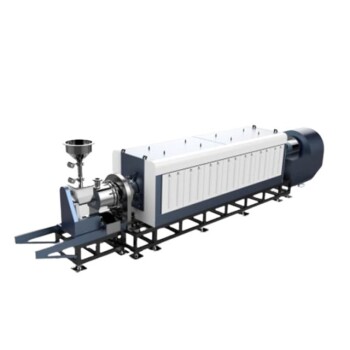
The synthesis of high-performance nano-catalysts from biomass requires a high-temperature muffle furnace to drive the chemical "calcination" process. This specialized equipment provides the intense, uniform heat—often exceeding 800°C—necessary to decompose inert compounds like calcium carbonate in eggshells into active calcium oxide (CaO). It also facilitates the integration of biometals, such as potassium from banana peels, into the catalyst's crystalline framework.
Core Takeaway: A muffle furnace is indispensable because it facilitates the solid-phase transformation of organic waste into inorganic active sites, precisely controlling the catalyst's pore structure, crystallinity, and chemical reactivity.
Driving Chemical Metamorphosis
Converting Eggshells into Active Calcium Oxide
Eggshells are primarily composed of calcium carbonate ($CaCO_3$), which is catalytically inactive in its raw form. The muffle furnace provides the thermal energy required for calcination, a process that strips away carbon dioxide to leave behind highly active calcium oxide (CaO) nanostructures.
Doping Biometals for Enhanced Activity
Banana peels and other biomass sources contain natural biometals like potassium, which can act as promoters for catalytic reactions. The high-temperature environment enables these metals to "dope" or integrate into the catalyst framework, significantly increasing the density of strong basic active sites.
Engineering the Nanostructure
Crystallization and Phase Formation
For a catalyst to be effective, its atoms must be arranged in a specific crystalline structure, such as the cubic fluorite structure found in certain metal oxides. The furnace allows for the dehydration of amorphous precursors and the subsequent rearrangement of atoms into the stable, crystalline phases required for long-term catalytic performance.
Maximizing Surface Area and Porosity
The high-temperature treatment does more than just change chemistry; it physically shapes the material. Controlled heating reduces particle size and increases the specific surface area, creating a porous "nanoscaffold" that allows more reactants to contact the active sites simultaneously.
Purification and Organic Removal
Eliminating Unstable Impurities
Biomass contains a complex mix of moisture, proteins, and fibers that can interfere with chemical reactions. The muffle furnace ensures complete combustion of these organic components, leaving behind high-purity ash or carbon structures that serve as a clean foundation for the catalyst.
Pre-carbonization and Support Building
At lower temperatures (around 200°C), the furnace can be used for pre-carbonization, converting complex organic structures into black carbon particles. This provides a stable material foundation that can later be treated at higher temperatures to form advanced nanoparticle supports.
Understanding the Trade-offs
The Risk of Thermal Sintering
While high heat is necessary for activation, excessive temperatures or prolonged exposure can lead to sintering. This occurs when nanoparticles fuse together, drastically reducing the surface area and "burying" the active sites you worked to create.
Balancing Energy and Purity
Achieving high crystallinity often requires temperatures near 900°C for several hours, which is energy-intensive. Researchers must balance the need for high-purity, high-activity catalysts with the operational costs and potential degradation of the furnace heating elements over time.
Making the Right Choice for Your Goal
How to Apply This to Your Project
- If your primary focus is maximizing basicity (e.g., for biodiesel): Use temperatures between 850°C and 900°C to ensure the complete conversion of eggshell $CaCO_3$ into active $CaO$.
- If your primary focus is creating a carbon-based support: Utilize a two-stage heating process, starting with a lower-temperature pre-carbonization at 200°C before moving to higher activation temperatures.
- If your primary focus is high crystallinity: Extend the duration of the calcination (up to 6-8 hours) at a stable, slightly lower temperature (approx. 600°C) to allow atoms time to rearrange without fusing.
By mastering the thermal environment of the muffle furnace, you transform simple agricultural waste into a sophisticated tool for modern green chemistry.
Summary Table:
| Process Step | Temperature Range | Primary Objective | Key Outcome |
|---|---|---|---|
| Calcination | 850°C – 900°C | Decompose $CaCO_3$ in eggshells | Highly active CaO nanostructures |
| Biometal Doping | High (>800°C) | Integrate K from banana peels | Increased density of basic active sites |
| Crystallization | ~600°C (Extended) | Atomic rearrangement | Stable, high-performance crystal phases |
| Pre-carbonization | ~200°C | Remove moisture/proteins | Stable black carbon nanoparticle supports |
| Purification | High Heat | Complete organic combustion | High-purity ash/inorganic foundation |
Transform Waste into High-Performance Catalysts with KINTEK
Ready to elevate your green chemistry research? KINTEK specializes in laboratory equipment and consumables, offering a comprehensive range of high-temperature furnaces—including muffle, tube, rotary, vacuum, CVD, atmosphere, dental, and induction melting models.
Whether you are converting eggshells into active CaO or engineering complex biomass-derived nanostructures, our furnaces provide the precise temperature control and uniform heating necessary to prevent sintering and maximize surface area. All our equipment is fully customizable to meet your unique synthesis requirements.
Maximize your lab's efficiency and catalyst purity today. Contact our specialists now to find your perfect furnace solution!
References
- Anietie Okon Etim, Paul Musonge. Sustainable Biodiesel Production via Biogenic Catalyzed Transesterification of Baobab Oil Methyl Ester and Optimization Process. DOI: 10.3390/en17174418
This article is also based on technical information from Kintek Furnace Knowledge Base .
Related Products
- 1700℃ High Temperature Muffle Oven Furnace for Laboratory
- 1800℃ High Temperature Muffle Oven Furnace for Laboratory
- 1200℃ Muffle Oven Furnace for Laboratory
- 1400℃ Muffle Oven Furnace for Laboratory
- Laboratory Muffle Oven Furnace with Bottom Lifting
People Also Ask
- What is the primary function of a high-temperature laboratory muffle furnace in chemical synthesis? Achieve Precision.
- How does a high-temperature laboratory muffle furnace affect material properties? Transform Anodic Oxide Films Fast
- What role does a muffle furnace play in BCZY712 electrolyte powder production? Achieve Perfect Phase Purity
- How does the two-stage sintering process contribute to the synthesis of MeCuFeO3 perovskite? Optimize crystal purity.
- Why must a high-temperature muffle furnace be used to evaluate the mineral density of tigernut composite flour?