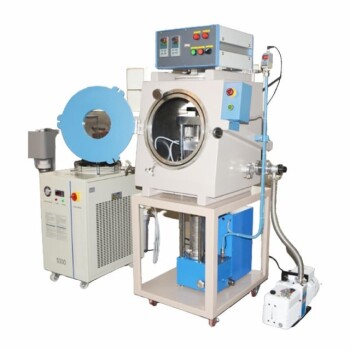
Hot pressing achieves full density at lower temperatures because it adds a powerful, externally applied mechanical stress that dramatically amplifies the inherent thermodynamic driving force for mass transport. In pressureless sintering, densification relies solely on capillary forces from particle surface curvature—a relatively weak driver that demands high temperatures and long hold times. By superimposing uniaxial pressure during heating, hot pressing introduces additional driving forces—including enhanced diffusional creep and localized plastic deformation—that accelerate pore elimination. This allows full densification at significantly reduced furnace temperatures while suppressing unwanted grain growth.
The core insight: External pressure transforms sintering from a purely curvature-driven process into one where mechanical work actively pumps vacancies away from pores, intensifying densification kinetics without proportionally accelerating grain coarsening. This shifts the temperature–time requirements downward, enabling dense, fine-grained microstructures in materials that would otherwise require extreme thermal cycles.
The Limits of Pressureless Sintering
A Weak and Passive Driving Force
In conventional pressureless sintering inside a laboratory high-temperature furnace, densification is driven exclusively by capillary pressure arising from surface curvature. For typical ceramic powders with particle sizes around 40 µm, this inherent sintering stress is only about 0.2 MPa—a fraction of what advanced materials often need for pore closure. The sole knob you can turn is temperature, which accelerates diffusion but also fuels grain growth.
Densifying vs. Non-Densifying Mechanisms Compete
At high temperatures, multiple atomic transport pathways activate simultaneously. Densifying mechanisms—like lattice diffusion and grain boundary diffusion—move matter from grain boundaries into pores, shrinking them. But non-densifying mechanisms such as surface diffusion and evaporation–condensation coarsen the microstructure without eliminating porosity. The weak capillary driving force gives no advantage to the desired pathways, so achieving near‑theoretical density often requires pushing temperature and time to levels where grain size balloons.
How Applied Pressure Changes the Game
Adding a Mechanical Driving Force to the Equation
Hot pressing introduces a uniaxial mechanical pressure (typically 20–50 MPa in graphite dies) that adds directly to the capillary stress. The total driving force for densification becomes ( \gamma_{sv}K + p_a ), where ( p_a ) is the applied pressure. This stress is orders of magnitude larger than the inherent sintering stress, effectively shifting the rate-limiting step. The external pressure steepens the vacancy concentration gradient between grain boundaries and pore surfaces, pulling atoms toward pores far more aggressively than temperature alone can.
Selective Amplification of Densification Pathways
External stress does not equally enhance all diffusion mechanisms. It dramatically boosts densifying creep processes—Nabarro–Herring and Coble creep—and grain boundary sliding, while leaving non-densifying surface diffusion essentially unaffected. This selectivity closes the gap between densification and coarsening rates, so the furnace can be operated at lower temperatures where grain boundary mobility is inherently sluggish.
Early‑Stage Plastic Flow and Particle Rearrangement
The applied pressure is not uniform across a powder compact. At localized particle contacts, the contact stresses can be orders of magnitude higher than the nominal applied pressure. This induces plastic deformation and particle rearrangement during initial heating, rapidly collapsing large interparticle voids. By the time diffusional mechanisms dominate, much of the porosity has already been eliminated, further reducing the thermal load required to reach full density.
The Mechanisms Behind the Lower Temperature
Creep‑Driven Mass Transport Under External Stress
Once a relative density high enough to establish grain boundaries is reached, the external pressure drives diffusional creep. In Nabarro–Herring creep, atoms diffuse through the lattice from boundaries under compression to those under tension (pore surfaces), while Coble creep does the same along grain boundaries. The applied stress sets up a chemical potential gradient that moves vacancies efficiently, even at temperatures where thermal diffusion alone would be too sluggish for pore closure.
Suppression of Grain Growth by Lower Thermal Budget
Grain growth is thermally activated and depends primarily on time and temperature. Because hot pressing reaches full density at lower peak temperatures and shorter hold times, the total thermal energy available for grain boundary migration is reduced. The result is a dense body with a fine, uniform grain size, directly translating into better mechanical strength and toughness. Pressure itself can also reduce grain boundary mobility by pinning boundaries through enhanced segregation or second-phase effects, though the thermal reduction is the dominant factor.
Thermodynamic Threshold for Pressure‑Driven Sintering
Research shows that external pressure must exceed an empirical threshold to shift densification into a regime where mechanical work dominates over capillary effects. Once that threshold is surpassed, the required furnace temperature can drop by hundreds of degrees compared to pressureless sintering. This is especially critical for hard-to-sinter covalent ceramics (like SiC, Si₃N₄, B₄C) and ultra‑high‑temperature composites, where decomposition or extreme grain growth would otherwise make full densification impractical.
Understanding the Trade-offs
Equipment Complexity and Cost
Hot pressing furnaces with uniaxial press systems and high‑temperature capable dies (graphite, refractory metals) are significantly more expensive than standard atmosphere or vacuum sintering furnaces. The dies are consumable and limit sample dimensions and geometries—typically simple discs or plates—making complex net‑shape parts difficult.
Process Limitations and Contamination Risks
The unidirectional nature of the pressure can create anisotropic microstructures if not managed carefully, although the isotropic properties of many hot‑pressed ceramics can still be excellent. Reaction with graphite dies at extreme temperatures, especially for reactive melts or carbides, can introduce carbon contamination that affects composition and properties. Hot Isostatic Pressing (HIP) overcomes some of these limits but at even higher capital cost.
Not a Universal Replacement
Materials with high vapor pressure components, like some silicon‑based ceramics, can suffer from selective evaporation under low‑pressure hot pressing atmospheres unless protective gas overpressures (as in Gas Pressure Sintering) are combined. Similarly, extremely reactive metals may require canning or specialized atmospheres that complicate the hot pressing process. The choice depends on the material system and the final application.
Making the Right Choice for Your Sintering Process
The decision to use pressure‑assisted sintering over conventional pressureless routes hinges on what you prioritize most. Here is how to navigate the options based on your goals:
- If your primary focus is achieving a fine, uniform grain size: Prioritize hot pressing to lower sintering temperature and time, dramatically limiting grain coarsening while reaching full density.
- If your primary focus is densifying hard-to-sinter covalent ceramics or ultra‑high‑temperature materials: Leverage the amplified mechanical driving force to overcome their inherently slow diffusion and high decomposition tendencies.
- If your primary focus is eliminating residual porosity and microstructural defects for isotropic, high‑reliability properties: Consider Hot Isostatic Pressing (HIP) for the ultimate densification, or hot pressing with careful die design where simpler geometries suffice.
- If your primary focus is minimizing capital and tooling costs for simple shape production: Pressureless sintering remains viable for materials with adequate sinterability; only adopt hot pressing when the performance gains outweigh its higher equipment and die expenses.
By aligning your material’s densification challenges with the unique stress‑enhanced mechanisms of hot pressing, you can unlock full density at significantly lower furnace temperatures and create components that truly outperform their conventionally sintered counterparts.
Summary Table:
| Feature / Metric | Pressureless Sintering | Hot Pressing (Pressure-Assisted) |
|---|---|---|
| Primary Driving Force | Capillary pressure (~0.2 MPa) | Applied mechanical stress + Capillary pressure (20–50+ MPa) |
| Sintering Temperature | Higher (promotes grain coarsening) | Significantly lower (preserves fine grain structure) |
| Mass Transport Mechanism | Thermal diffusion | Diffusional creep (Coble/Nabarro-Herring) & plastic flow |
| Microstructure | Coarsened grains, potential residual pores | Near theoretical density, fine & uniform grain size |
| Geometric Flexibility | Complex, net-shape capabilities | Simple shapes (discs, plates, cylinders) |
Unlock Superior Densification with KINTEK Laboratory Furnaces
Take your material performance to the next level with precision thermal solutions from KINTEK. Specializing in advanced laboratory equipment and consumables, KINTEK offers a full spectrum of high-temperature furnaces—including muffle, tube, vacuum, atmosphere, CVD, rotary, and custom pressure-assisted systems—engineered to satisfy the most demanding research and production requirements.
Whether you are processing hard-to-sinter covalent ceramics or seeking fine-grained microstructures without excessive thermal exposure, our technical experts are here to deliver the perfect tailored system. Contact KINTEK today to discuss your custom furnace solution!
Related Products
- Vacuum Hot Press Furnace Machine Heated Vacuum Press
- 600T Vacuum Induction Hot Press Vacuum Heat Treat and Sintering Furnace
- Vacuum Hot Press Furnace Machine for Lamination and Heating
- Vacuum Hot Press Furnace Machine Heated Vacuum Press Tube Furnace
- High Pressure Laboratory Vacuum Tube Furnace
People Also Ask
- What are the primary components of a vacuum hot press furnace? Master the Core Systems for Precise Material Processing
- What are the benefits of the vacuum environment system in a vacuum hot press furnace? Unlock High-Density Sintering
- What safety features are incorporated in vacuum hot press furnaces? Ensure Operator and Equipment Protection
- What types of heating elements are used in vacuum hot press furnaces? Optimize for High-Temp Performance
- What are the core advantages of using a vacuum hot press furnace? Achieve Near-Forged Density for Ti-6Al-4V Alloys