
In the long term, induction gold melting furnaces prove highly cost-effective by fundamentally changing the economics of the melting process. Their cost efficiency stems from a powerful combination of drastically reduced energy consumption, lower daily operational expenses, and superior material yield. This transforms the high initial purchase price from a simple cost into a strategic investment with a measurable return.
While the upfront cost of an induction furnace is higher than traditional methods, its long-term value is realized through significant and compounding savings in three key areas: energy, operational consumables, and metal preservation.
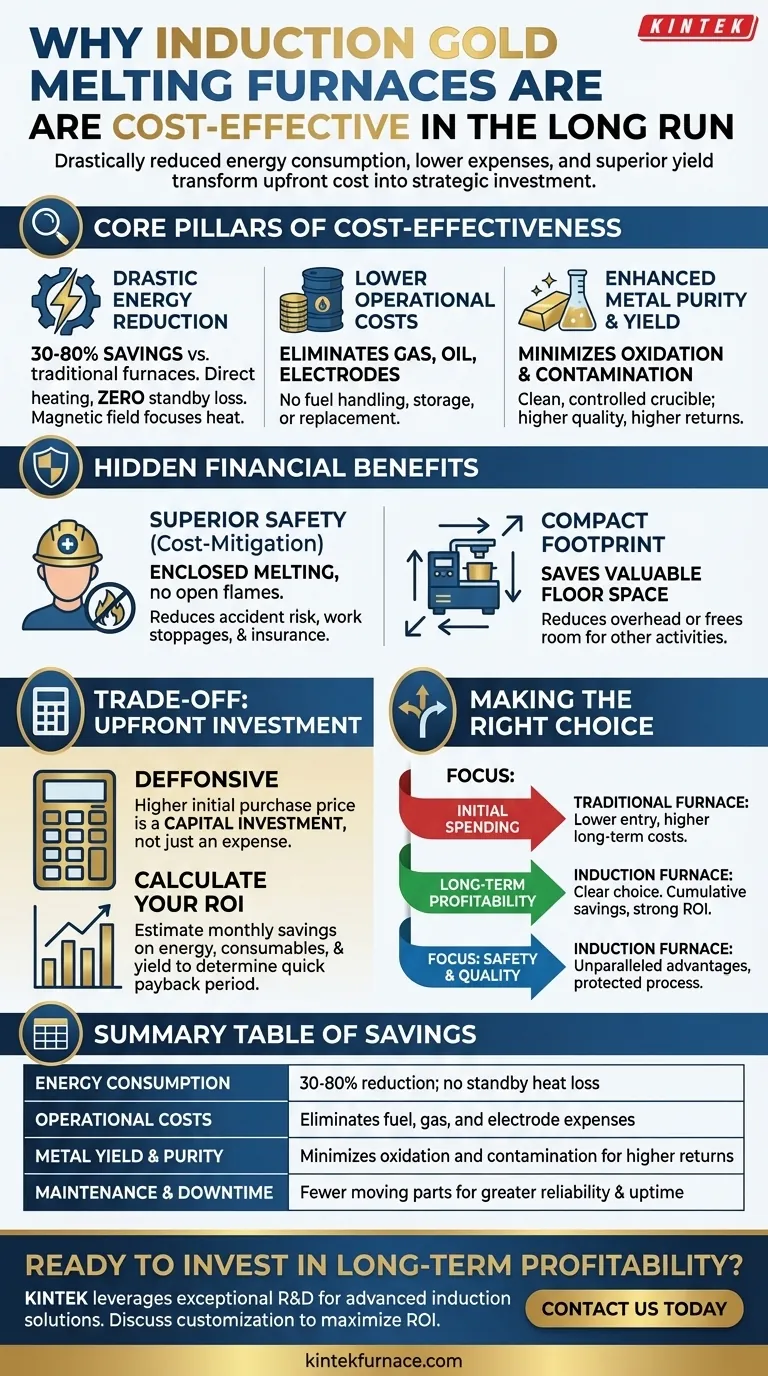
Analyzing the Core Pillars of Cost-Effectiveness
To understand the return on investment, we must look beyond the initial purchase price and analyze the daily, monthly, and yearly operational costs that an induction furnace minimizes or eliminates.
Drastic Reduction in Energy Consumption
Induction technology is fundamentally more efficient at converting electricity into heat within the metal itself. This results in energy savings reported to be between 30% and 80% compared to traditional fuel-fired or resistance furnaces.
This efficiency comes from two primary factors. First, the magnetic field directly heats the gold, minimizing energy lost to the surrounding environment. Second, there is zero standby heat loss, as the furnace consumes power only when actively melting.
Lower Operational and Consumable Costs
Traditional furnaces often rely on a constant supply of consumables like gas, oil, or graphite electrodes, which represent a significant and recurring operational expense.
Induction furnaces eliminate these costs entirely. They run on electricity and do not require fuel handling, storage, or replacement electrodes, simplifying operations and removing an entire category of recurring expenses from your budget.
Enhanced Metal Purity and Yield
In gold melting, every fraction of a gram matters. Induction melting occurs in a clean, contained crucible, which significantly reduces the risk of contamination from combustion byproducts.
This controlled environment also minimizes oxidation, a process where metal is lost to the air. The result is a higher-quality, purer final product and, most importantly, a higher yield from your raw material, directly protecting your bottom line.
Reduced Maintenance and Increased Durability
Induction furnaces are built with fewer moving parts compared to many conventional systems. The solid-state design means less mechanical wear and tear over time.
This inherent durability leads to lower maintenance requirements and less downtime. For any production environment, maximizing uptime is critical for profitability, and the reliability of induction systems is a key financial benefit.
Understanding the Hidden Financial Benefits
Beyond the direct savings, induction furnaces offer secondary benefits that contribute to their long-term cost-effectiveness.
Superior Safety as a Cost-Mitigation Strategy
The enclosed nature of induction melting, with no open flames or exposed ultra-hot elements, creates a significantly safer workplace. This reduces the risk of severe burns, fires, and exposure to toxic fumes.
A safer operation mitigates the risk of costly accidents, work stoppages, and potentially lower insurance premiums, representing a form of financial protection.
A Compact Footprint That Saves Space
Induction melting units are typically more compact than their traditional counterparts. In a workshop or factory where floor space is a valuable and costly asset, this smaller footprint can reduce overhead or free up room for other revenue-generating activities.
The Primary Trade-off: Upfront Investment
The most significant consideration when evaluating an induction furnace is its higher initial purchase price. It is critical to view this not as a simple expense but as a capital investment.
Calculating Your Return on Investment (ROI)
A proper financial evaluation involves calculating the payback period. By estimating your monthly savings on energy, consumables, and improved metal yield, you can determine how quickly those savings will cover the initial capital outlay. For many high-volume operations, this payback period is surprisingly short.
Making the Right Choice for Your Operation
Your decision should be guided by your primary business goals and your operational timeline.
- If your primary focus is minimizing initial spending: A traditional furnace may have a lower entry cost, but you must be prepared for consistently higher long-term operational expenses.
- If your primary focus is long-term profitability and efficiency: The induction furnace is the clear choice, as its cumulative savings on energy, consumables, and maintenance deliver a strong return on investment.
- If your primary focus is operational safety and product quality: The enclosed, controlled process of an induction furnace offers unparalleled advantages in protecting both your employees and your final product.
Ultimately, choosing an induction furnace is an investment in a more efficient, profitable, and sustainable future for your operation.
Summary Table:
| Key Area of Savings | Benefit of Induction Furnace |
|---|---|
| Energy Consumption | 30-80% reduction; no standby heat loss |
| Operational Costs | Eliminates fuel, gas, and electrode expenses |
| Metal Yield & Purity | Minimizes oxidation and contamination for higher returns |
| Maintenance & Downtime | Fewer moving parts for greater reliability and uptime |
Ready to invest in long-term profitability for your gold operation?
At KINTEK, we leverage our exceptional R&D and in-house manufacturing to provide advanced induction melting solutions. Our furnaces are engineered to deliver the precise control, energy efficiency, and material purity your business needs to maximize ROI.
Contact us today to discuss how a KINTEK induction furnace can be customized to meet your unique production requirements and start saving.
Visual Guide
Related Products
- Vacuum Induction Melting Furnace
- 600T Vacuum Induction Hot Press Vacuum Heat Treat and Sintering Furnace
- Small Vacuum Heat Treat and Tungsten Wire Sintering Furnace
- 2200 ℃ Graphite Vacuum Heat Treat Furnace
- High Temperature Muffle Oven Furnace for Laboratory Debinding and Pre Sintering
People Also Ask
- What are the core functions of the High Vacuum Induction Melting (VIM) furnace? Optimize DD5 Superalloy Purification
- What are the technical advantages of using a Vacuum Induction Melting furnace in the development of advanced packaging steel?
- Why is a Vacuum Induction Melting furnace (VIM) used for Cu-Zn-Al-Sn alloys? Achieve Precision Composition Control
- What is the role of VIM and directional solidification in aero-engine blade substrates? Engineering Extreme Durability
- What role does a Vacuum Induction Melting furnace play in the production of high-aluminum nickel-based superalloys?











