
At their core, rotary retort furnaces are designed for the continuous heat treatment of large quantities of small, individual parts. They are most commonly used for processing items like screws, nuts, bolts, nails, and washers. The rotating chamber ensures that each part is uniformly exposed to the controlled atmosphere and temperature, making it an efficient solution for bulk processing.
The suitability of a part for a rotary retort furnace is defined not by its function, but by its physical characteristics. The essential requirement is that the material must be able to tumble and flow freely at high temperatures without sticking, clumping, or breaking.
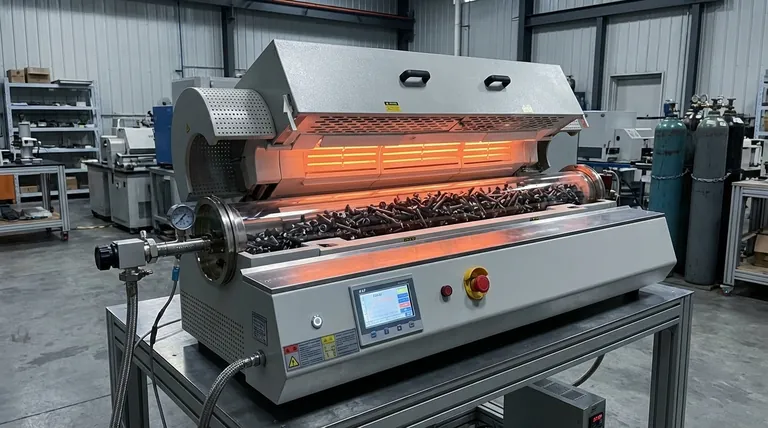
The Principle of "Tumble and Flow"
The defining feature of a rotary retort furnace is its rotating, cylindrical chamber (the retort). This constant tumbling motion is the key to achieving uniform heat treatment across a large batch of parts.
Suitable Part Geometries
Parts must be robust enough to withstand this tumbling action. The ideal candidates are small, simple, and durable. This includes most standard fasteners, bearings, clips, and other similar hardware.
Suitable Material Forms
Beyond discrete parts, these furnaces excel at processing granular materials. This includes metal powders, ceramic powders, nanomaterials, and other particulates that need to be roasted, calcined, or sintered.
The Importance of Uniformity
For best results, the parts within a single batch should be of a relatively consistent size and shape. This ensures they all tumble and heat at a similar rate, leading to a highly consistent final product.
Common Heat Treatment Processes
Rotary retort furnaces are versatile and used across metallurgy, ceramics, and chemical processing. The controlled environment allows for a wide range of thermal treatments.
For Metal Parts
The most frequent application is the heat treatment of steel components. Common processes include:
- Hardening: Heating and rapidly quenching to increase strength and wear resistance.
- Annealing: Heating and slowly cooling to soften the material and improve ductility.
- Sintering: Heating powdered materials below their melting point to fuse them into a solid mass.
- Brazing: Joining two pieces of metal using a filler metal.
For Powders and Chemicals
The furnace's ability to mix materials while heating makes it ideal for processes that induce chemical or physical changes.
- Calcination: Thermally decomposing a material, often to remove impurities or create a new compound.
- Oxidation: A chemical reaction used to create specific oxide layers on materials.
- Powder Roasting: Heating powders in a controlled atmosphere to achieve a desired chemical change.
Understanding the Critical Limitations
A rotary retort is a specialized tool, and it is not suitable for every application. Understanding its limitations is crucial to avoid costly processing failures.
The Problem of Sticking or "Agglomeration"
This is the single most important constraint. Any material that becomes soft, tacky, or sticky at the processing temperature is unsuitable. Such materials will clump together, preventing uniform heating and potentially damaging the furnace retort.
Risk of Damage to Delicate Parts
The tumbling action is not gentle. Parts with fine threads, delicate features, or a high aspect ratio (long and thin) can be easily bent, broken, or otherwise damaged during processing.
Unsuitability for Large or Complex Parts
Large components cannot be processed in a rotary retort furnace. They will not tumble correctly, leading to uneven heating and potential damage to both the part and the furnace interior.
Making the Right Choice for Your Application
Selecting the correct heat treatment technology depends entirely on the physical properties of your parts and your desired outcome.
- If your primary focus is high-volume hardening of standard fasteners: A rotary retort furnace is the industry-standard solution for its efficiency and uniformity.
- If your primary focus is processing free-flowing powders or granular materials: A rotary retort is an excellent choice for processes like calcination or sintering.
- If your primary focus is treating delicate parts, large components, or materials that become sticky: You must consider alternatives like a batch furnace, mesh belt furnace, or vacuum furnace.
Ultimately, success depends on matching the material's behavior at high temperatures to the mechanical action of the furnace.
Summary Table:
| Category | Examples | Key Characteristics |
|---|---|---|
| Metal Parts | Screws, nuts, bolts, nails, washers | Small, durable, withstand tumbling |
| Granular Materials | Metal powders, ceramic powders, nanomaterials | Free-flowing, no sticking or clumping |
| Heat Treatments | Hardening, annealing, sintering, brazing | Uniform exposure to temperature and atmosphere |
Optimize your bulk heat treatment processes with KINTEK's advanced furnace solutions! Leveraging exceptional R&D and in-house manufacturing, we provide diverse laboratories with high-temperature furnaces like Rotary Furnaces, Muffle, Tube, Vacuum & Atmosphere Furnaces, and CVD/PECVD Systems. Our strong deep customization capability ensures precise solutions for your unique experimental needs, whether you're processing fasteners, powders, or other materials. Contact us today to enhance efficiency and achieve superior results!
Visual Guide

Related Products
- Electric Rotary Kiln Continuous Working Small Rotary Furnace Kiln for Pyrolysis Plant Heating
- Electric Rotary Kiln Small Rotary Furnace for Activated Carbon Regeneration
- Electric Rotary Kiln Small Rotary Furnace Biomass Pyrolysis Plant Rotating Furnace
- Electric Rotary Kiln Pyrolysis Furnace Plant Machine Small Rotary Kiln Calciner
- Laboratory Vacuum Tilt Rotary Tube Furnace Rotating Tube Furnace
People Also Ask
- What are the advantages of electric rotary kilns compared to fuel-fired ones? Boost Precision and Efficiency in Your Process
- What materials can be processed in an electric rotary kiln? Versatile Solutions for Advanced Materials
- What advantages do electric rotary kilns offer over fuel-based kilns? Boost Efficiency and Purity in Your Process
- What are the primary applications of electric rotary kilns? Precision Thermal Processing for High-Value Materials
- How do electric rotary kilns achieve high thermal efficiency? Unlock Over 95% Thermal Efficiency



















