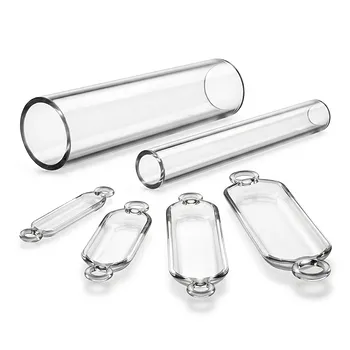
For immediate clarification, let’s get straight to the numbers. Alumina (Al₂O₃) process tubes are the standard for high-temperature work, rated for a maximum service temperature of 1600°C to 1800°C. If your application never exceeds 1100°C, fused silica (quartz) offers a more forgiving alternative.
The core challenge in material selection isn’t just the maximum heat a tube can survive—it’s whether it can handle the thermal shock of getting there. High-purity alumina delivers unmatched temperature extremes but demands a price: absolute discipline in your heating and cooling ramp rates. The hard limit for survival is generally 10°C to 20°C per minute, depending on the tube's wall thickness and diameter.
The Two Burnout Modes: Heat Limit vs. Thermal Shock
Understanding why tubes fail is the first step to preventing it. Failure rarely comes from simply hitting a magic temperature number. It comes from stress, time, and operator error.
The Temperature Ceiling: Material Limits
Every material has a point where it begins to soften, deform, or chemically break down.
- Fused Silica (Quartz): This material is excellent for optical access and purity but hits a hard chemical and physical wall. Above 1100°C, it begins to devitrify—transforming from its glassy state into a brittle crystalline structure that is prone to immediate failure.
- High-Purity Alumina (Al₂O₃): This is the workhorse for serious thermal budgets. It maintains structural integrity far beyond quartz, comfortably operating between 1600°C and 1800°C. However, "operating" at 1800°C is not the same as surviving the journey up and down.
The Silent Killer: Thermal Shock Resistance
This is where your primary selection risk lies. Thermal shock failure has nothing to do with a material's melting point. It is the result of differential expansion causing catastrophic internal stress.
- The Ceramic Paradox: Alumina is incredibly hard and refractory, but these properties make it inherently brittle with low thermal shock resistance. When one part of the tube heats up faster than another, the expanding zone pushes against the cooler, inert zone. The tube cannot stretch to accommodate the strain, so it snaps.
- The Quartz Advantage: Silica excels in thermal shock scenarios, which is why it can survive aggressive heating cycles. The trade-off is its lower absolute temperature ceiling.
Mastering the Ramp Rate: The 10-20°C/min Rule
The most critical specification isn't the furnace's maximum temperature; it's the programmable ramp rate. Disobeying this destroys tubes.
Why Wall Thickness Dictates Speed
A thicker tube wall acts as a natural insulator, creating a severe temperature gradient between the outer skin exposed to the heating elements and the inner surface.
- Always restrict your ramp rate to 10°C to 20°C per minute.
- Thicker walls demand the slower end of this range. A heavy-duty tube ramped at 20°C/min will experience a temperature lag that generates immense hoop stress.
- Smaller diameters are innately better. A tight internal space reduces thermal inertia and allows the heat to soak through the wall more uniformly, minimizing the destructive gradient.
The Cooling Cycle Danger
Operators frequently program a perfect heating ramp and then let the furnace "free cool." This is a mistake.
- Alumina is just as sensitive to thermal shock on the way down as on the way up.
- Unless your furnace manufacturer specifies a physically separate cooling limit, you must restrict the cooling ramp to the same 10°C to 20°C/min rate until the tube drops below its glass transition range and the risk of shock passes.
Understanding the Trade-offs
Selecting the right tube is an exercise in managing tension between temperature performance, longevity, and daily usability.
- Contamination Risk: High-purity alumina (>99.8%) offers peak temperature performance but is porous. At extreme high heat, it can begin to react with caustic sample vapors or metal catalysts, reducing its service life.
- Genetic Flaws: Alumina tubes rely on a smooth surface to maintain strength. Microscopic surface scratches from rodding or cleaning become stress concentrators. A thermal cycle that would be safe for a new, flawless tube can easily propagate a crack from a score mark in a well-used tube.
- The Cost of Safety: While you can purchase mullite or lower-grade ceramic tubes, they sacrifice maximum temperature (~1400-1600°C) and purity for marginal gains in thermal shock resistance. If you need 1700°C, your only safe option is high-purity alumina, making strict ramp rate adherence a non-negotiable operational cost.
Making the Right Choice for Your Goal
Your specific thermal roadmap dictates whether you prioritize absolute heat or survivability. Choose your material based on the stress you will inflict.
- If your primary focus is reaching 1700°C+: You have no alternative but high-purity alumina. Calculate your total cycle time assuming a strict 10°C/min limit. Do not risk 20°C/min unless the tube is extremely thin-walled and small-diameter.
- If your primary focus is rapid thermal cycling (RTA) below 1100°C: Always select fused silica. It will tolerate the aggressive ramp rates that would instantly destroy an alumina tube, providing far greater productivity and a lower failure rate.
- If your primary focus is longevity and cost-efficiency: Ignore the absolute maximum rating of the alumina. Derate your operating temperature by 100°C and cut your ramp rate in half. A tube operated at 1500°C with a 5°C/min ramp will outlast a tube constantly pushed to its physical limits by a factor of ten.
Selecting the tube isn't just about buying a consumable; it's about defining the operational tempo of your entire experiment. Treat the ramp rate as a hard physical constraint, not a suggestion, and your furnace will deliver years of reliable service.
Summary Table:
| Feature / Material | Fused Silica (Quartz) | High-Purity Alumina (Al₂O₃) |
|---|---|---|
| Max Operating Temp | Up to 1100°C | 1600°C to 1800°C |
| Thermal Shock Resistance | High (Tolerates rapid heating) | Low (Brittle, highly sensitive) |
| Recommended Ramp Rate | >20°C/min (Flexible) | Strict 10°C to 20°C/min |
| Primary Risk | Devitrification above 1100°C | Catastrophic crack propagation |
| Ideal Application | Rapid thermal cycling <1100°C | Extreme high-temp processes >1100°C |
Maximize Lab Efficiency and Equipment Lifespan with KINTEK
Navigating thermal limits and material selection is critical to avoiding costly tube failures and research downtime. KINTEK specializes in high-performance laboratory equipment and consumables, offering a comprehensive lineup of customizable high-temperature furnaces—including tube, muffle, rotary, vacuum, CVD, and dental furnaces—along with high-purity alumina and quartz process tubes tailored to your exact specifications.
Ready to enhance your heat treatment reliability? Contact KINTEK experts today for tailored guidance and robust high-temp lab solutions!
Related Products
- 1400℃ High Temperature Laboratory Tube Furnace with Alumina Tube
- 1700℃ High Temperature Laboratory Tube Furnace with Alumina Tube
- 1200℃ Split Tube Furnace Laboratory Quartz Tube Furnace with Quartz Tube
- High Purity Quartz Tube and Quartz Boat for Laboratory Furnaces
- Vertical Laboratory Quartz Tube Furnace Tubular Furnace
People Also Ask
- How does zone-melting in tube furnaces synthesize bismuth micro-wires? Master Single-Crystal Thermoelectric Growth
- How are high-temp tube furnaces used to measure diffusion coefficients per Fick's law? Master Precision Annealing
- How are high-temperature laboratory tube furnaces applied in long-term vacuum homogenization heat treatments for intermetallic samples?
- How do high-temperature laboratory tube furnaces ensure environmental stability? Precision Thermal Reduction Tips
- How are high-temperature tube furnaces applied in testing ceramic-supported alloy membranes? Insights