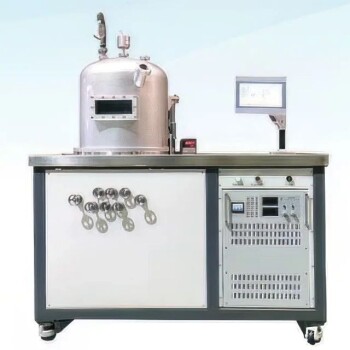
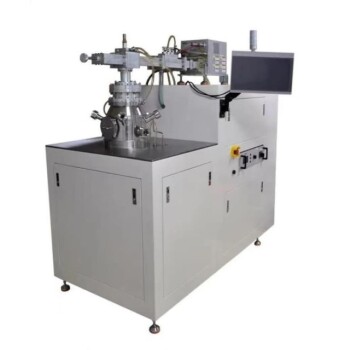
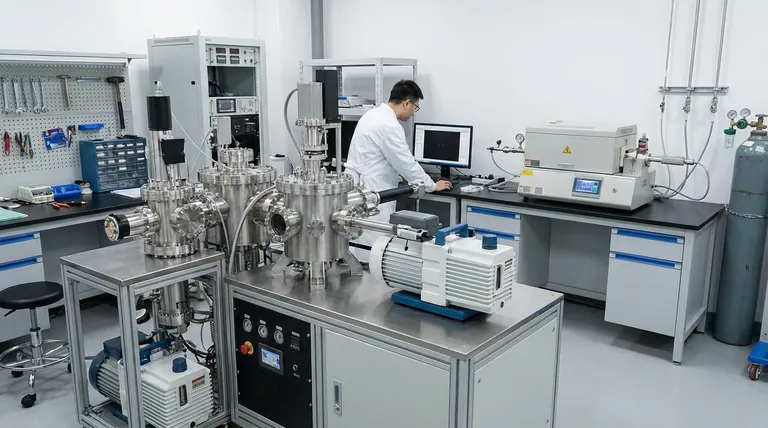
The fundamental role of ultra-high vacuum physical vapor deposition (UHV-PVD) is to construct the precise "stacked" precursors required for the synthesis process. By alternately depositing elemental layers—such as bismuth and selenium—onto flexible substrates, this equipment creates the specific architectural layout needed before pulsed irradiation can begin.
The UHV-PVD process serves as the critical "preparation stage," ensuring that the raw materials are arranged with the purity and structural integrity necessary for a successful solid-state reaction.
Creating the Material Foundation
To understand why this equipment is essential, one must look at how the reaction precursors are built. The UHV-PVD system does not perform the final synthesis but rather prepares the "ingredients" in a highly controlled manner.
Formation of Stacked Precursors
The equipment is utilized to deposit distinct layers of elements. By alternating these depositions, it builds a multi-layered structure on the substrate.
Substrate Compatibility
This deposition method is specifically noted for its compatibility with flexible substrates. This allows for the creation of versatile thin films that can be integrated into flexible electronics or similar applications.
Ensuring Chemical Integrity
The "Ultra-High Vacuum" (UHV) aspect of the equipment is not merely a feature; it is a necessity for the quality of the final material.
Minimizing Impurities
The UHV environment drastically reduces the presence of background gases and contaminants. This effectively minimizes the introduction of impurities into the film during the deposition phase.
Preserving Interface Quality
In a stacked structure, the interfaces between layers are vulnerable points. UHV conditions ensure the purity of the deposition interfaces, preventing oxidation or contamination between the alternating elemental layers.
Facilitating Solid-State Reactions
The pulsed irradiation process relies on a solid-state reaction to transform the layers into the final metal chalcogenide. The high-quality foundation provided by UHV-PVD ensures this subsequent reaction proceeds efficiently and results in a superior material.
Operational Considerations and Trade-offs
While UHV-PVD provides exceptional quality, it introduces specific constraints that must be managed.
Complexity and Cost
Achieving an ultra-high vacuum environment requires sophisticated and expensive hardware. This increases the initial capital investment compared to non-vacuum deposition methods.
Process Speed
The requirement to pump down to ultra-high vacuum levels can extend cycle times. This focus on purity often comes at the expense of rapid throughput.
Maximizing Synthesis Success
When integrating UHV-PVD into your workflow, align your process parameters with your specific material goals.
- If your primary focus is Film Purity: Prioritize the vacuum levels and interface cleanliness to ensure the subsequent solid-state reaction is not hindered by contaminants.
- If your primary focus is Flexible Applications: Leverage the equipment’s ability to deposit on flexible substrates to create adaptable, high-performance precursors.
By securing a pure and precisely stacked foundation, you ensure the pulsed irradiation step can deliver its full potential.
Summary Table:
| Feature | Role in Pulsed Irradiation Synthesis | Impact on Final Material |
|---|---|---|
| Stacked Precursor Deposition | Alternates elemental layers (e.g., Bi and Se) | Creates the architectural layout for solid-state reactions |
| Ultra-High Vacuum (UHV) | Minimizes background gases and contaminants | Ensures high film purity and prevents interface oxidation |
| Flexible Substrate Support | Facilitates deposition on non-rigid materials | Enables the creation of thin films for flexible electronics |
| Interface Control | Preserves clean boundaries between layers | Optimizes reaction efficiency during pulsed irradiation |
Elevate Your Thin Film Synthesis with KINTEK Precision
Unlock the full potential of your material research with high-performance deposition solutions. KINTEK provides industry-leading UHV-PVD systems and high-temperature laboratory furnaces designed to meet the rigorous demands of metal chalcogenide synthesis and pulsed irradiation workflows.
Backed by expert R&D and world-class manufacturing, we offer:
- Customizable Vacuum & CVD Systems tailored to your specific thin film architectures.
- Advanced Muffle, Tube, and Rotary Furnaces for precise thermal processing.
- Unmatched Material Purity to ensure your solid-state reactions are free from contaminants.
Ready to optimize your lab's efficiency and achieve superior material integrity? Contact KINTEK today to discuss your custom equipment needs!
Visual Guide

References
- Yuxuan Zhang, Johnny C. Ho. Pulse irradiation synthesis of metal chalcogenides on flexible substrates for enhanced photothermoelectric performance. DOI: 10.1038/s41467-024-44970-4
This article is also based on technical information from Kintek Furnace Knowledge Base .
Related Products
- HFCVD Machine System Equipment for Drawing Die Nano Diamond Coating
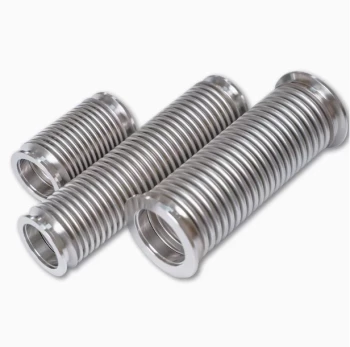
- High Performance Vacuum Bellows for Efficient Connection and Stable Vacuum in Systems
- MPCVD Machine System Reactor Bell-jar Resonator for Lab and Diamond Growth
- Custom Made Versatile CVD Tube Furnace Chemical Vapor Deposition CVD Equipment Machine
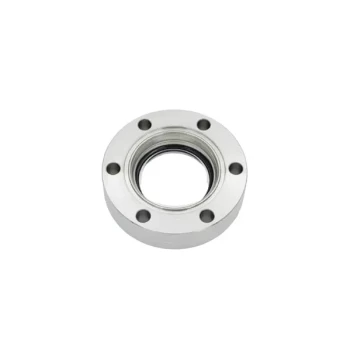
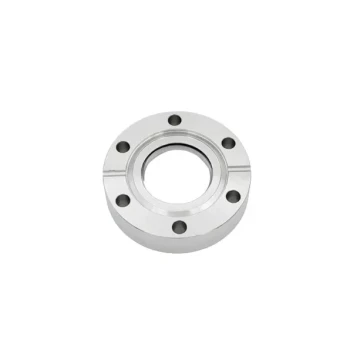
- Ultra High Vacuum CF Observation Window Flange with High Borosilicate Glass Sight Glass
People Also Ask
- What is Hot-filament Chemical Vapor Deposition (HFCVD)? Achieve High-Quality Thin Films with Precision Control
- What are the equipment for chemical vapor deposition? A Guide to the 5 Essential Components
- What is the significance of the vacuum pressure control system in the CVD coating process for powders?
- What is the function of high-purity Argon (Ar) gas during CVD? Optimize Your Thin Film Uniformity and Purity
- What are the advantages of using Chemical Vapor Deposition (CVD) for coating turbine blades? Enhance Life & Performance