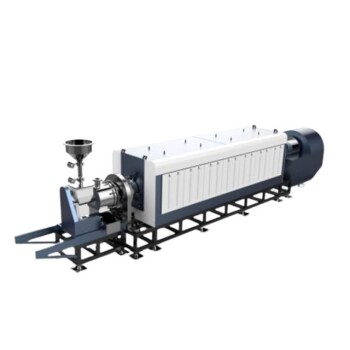
The high-precision muffle furnace is the primary reactor used to simulate the thermal degradation of pine resin. It provides a strictly controlled environment that allows researchers to manage heating rates and dwell times, enabling the precise conversion of raw resin into tar or carbonized char through regulated pyrolysis.
A high-precision muffle furnace serves as a controlled thermal laboratory, isolating temperature as a manageable variable to observe the physical and chemical transitions of pine resin. By delivering uniform thermal energy, it ensures the repeatable removal of volatiles and the formation of stable carbon structures.
Facilitating Precise Pyrolysis and Combustion
Simulating Thermal Processing Intensities
A muffle furnace allows for the application of specific heating rates, such as 26 °C/min, to mimic various industrial or environmental thermal conditions. This precision is vital for determining how different intensities of heat affect the yield and quality of the resulting tar.
Observing Phase Transitions
By establishing precise temperature gradients, researchers can accurately document the physical and chemical transitions of pine resin. This control is necessary to identify the exact moments when the resin degrades, volatilizes, or stabilizes into a carbonaceous solid.
Managing Dwell and Residence Times
Precise dwell times at specific temperatures ensure that the thermal energy penetrates the sample completely. This consistency is required to achieve complete thermochemical decomposition, preventing the presence of unreacted resin in the final sample.
Creating the Necessary Chemical Environment
Establishing Oxygen-Limited Conditions
For effective carbonization, the furnace must often operate under oxygen-deficient or anaerobic conditions. This prevents the complete combustion of the resin into ash and instead promotes pyrolysis, which preserves the carbon skeleton.
Driving Volatile Removal
The high-temperature environment (often ranging from 400 °C to 800 °C) facilitates the release of volatile substances. This process is the foundational step in increasing the fixed carbon content and developing the initial pore structure of the resulting material.
Promoting Structural Development
The uniform application of heat allows for the formation of a stable carbon skeleton. This structural integrity is critical for downstream applications, such as the creation of activated carbon or bio-enhancers with specific adsorption properties.
Understanding the Trade-offs and Limitations
Precision vs. Throughput
While a high-precision muffle furnace offers unmatched control over the thermal environment, it is typically a batch process. This limits the volume of material that can be processed at once compared to continuous industrial kilns.
Atmospheric Control Challenges
Standard muffle furnaces require external gas integration (like nitrogen) to maintain a truly inert atmosphere. Without proper sealing or gas flow, residual oxygen can lead to unintended oxidation, altering the chemical profile of the pine resin tar.
Thermal Lag in Samples
Even with a high-precision furnace, the core temperature of a large resin sample may lag behind the furnace’s set point. Researchers must calibrate dwell times to account for the material's thermal mass to ensure uniform carbonization.
Applying Furnace Precision to Your Research Goals
How to Apply This to Your Project
To maximize the utility of a muffle furnace in your experiments, align your heating protocols with your specific material objectives.
- If your primary focus is kinetic mapping: Utilize the furnace’s ability to maintain strict heating rates (e.g., 26 °C/min) to identify specific transition temperatures for pine resin.
- If your primary focus is pore structure development: Prioritize high-temperature stability (above 500 °C) and extended dwell times to ensure the complete removal of volatiles and the stabilization of the carbon skeleton.
- If your primary focus is byproduct collection: Focus on the lower temperature gradients of the pyrolysis range to maximize the yield of pine resin tar before it fully carbonizes.
The high-precision muffle furnace is the essential tool for transforming pine resin from a raw organic substance into a sophisticated, carbon-rich material through disciplined thermal management.
Summary Table:
| Feature | Role in Pine Resin Pyrolysis | Research Benefit |
|---|---|---|
| Heating Rate Control | Simulates specific thermal intensities (e.g., 26°C/min) | Accurate kinetic mapping and tar yield optimization |
| Dwell Time Management | Ensures complete thermochemical decomposition | Prevents unreacted resin; ensures sample uniformity |
| Thermal Uniformity | Promotes stable carbon skeleton development | High-quality structure for activated carbon or bio-enhancers |
| Atmosphere Regulation | Facilitates oxygen-limited or anaerobic conditions | Prevents combustion to ash; maximizes fixed carbon content |
Elevate Your Carbonization Research with KINTEK
Precision is the difference between raw resin and high-performance carbon materials. KINTEK specializes in advanced laboratory equipment, providing the high-precision environment necessary for complex pyrolysis and carbonization experiments.
Whether you require a standard muffle furnace, or specialized tube, rotary, vacuum, CVD, or atmosphere furnaces, our solutions are fully customizable to meet your unique thermal processing needs. We help researchers and industrial labs achieve repeatable results with superior temperature control and uniform heating.
Ready to optimize your thermal experiments? Contact KINTEK today to consult with our experts and find the perfect high-temperature furnace for your laboratory.
References
- Javier Davara, Carolina Mallol. Pyrotechnology and lipid biomarker variability in pine tar production. DOI: 10.1007/s12520-023-01829-x
This article is also based on technical information from Kintek Furnace Knowledge Base .
Related Products
- 1400℃ Muffle Oven Furnace for Laboratory
- High Temperature Muffle Oven Furnace for Laboratory Debinding and Pre Sintering
- 1700℃ High Temperature Muffle Oven Furnace for Laboratory
- 1800℃ High Temperature Muffle Oven Furnace for Laboratory
- 1200℃ Muffle Oven Furnace for Laboratory
People Also Ask
- What is the primary function of a high-temperature laboratory muffle furnace in chemical synthesis? Achieve Precision.
- How does a high-temperature laboratory muffle furnace affect material properties? Transform Anodic Oxide Films Fast
- What is the role of a laboratory high-temperature muffle furnace in H13 steel treatment? Optimize Tool Performance
- What role does a laboratory high-temperature muffle furnace play in the treatment of highly contaminated waste glass?
- How does a laboratory high-temperature muffle furnace contribute to the final formation of Bismuth Oxide nanosheets?