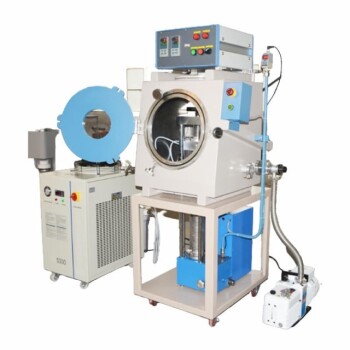
The core advantage of vacuum hot pressing is its ability to apply mechanical pressure, supercharging densification while keeping temperatures low enough to avoid grain growth and decomposition. Vacuum hot pressing provides a fundamentally more effective densification process for ultra-high-temperature and non-oxide ceramics by combining uniaxial pressure with precise heating under vacuum. This allows materials like SiC, Si₃N₄, and h-BN to reach near-theoretical density at significantly lower temperatures and in shorter holding times than conventional pressureless sintering—effectively restricting grain coarsening, eliminating residual porosity, and preventing thermal decomposition.
Pressureless sintering relies solely on capillary forces, leading to a trade-off between temperature‑driven densification and damaging grain growth or decomposition. Vacuum hot pressing overcomes this by using mechanical pressure to selectively enhance densification mechanisms, making it the definitive route for hard‑to‑sinter covalent ceramics where structural integrity and fine grain size are non‑negotiable.
The Limitations of Pressureless Sintering for Non-Oxide Ceramics
Why Capillary Forces Alone Create a Trap
Conventional pressureless sintering uses only surface energy and capillary pressure to drive mass transport. For strongly covalent non-oxide ceramics, this demand forces extremely high temperatures—often so high that grain boundaries migrate rapidly, causing severe grain growth.
The Competition Between Densifying and Non-Densifying Mechanisms
At such temperatures, both densifying (lattice diffusion, grain boundary diffusion) and non-densifying (surface diffusion, evaporation-condensation) mechanisms operate simultaneously. Non-densifying mechanisms coarsen the microstructure without closing pores, making full density unattainable while degrading mechanical properties.
Thermal Decomposition in Ultra-High-Temperature Materials
Many non-oxide ceramics, such as uranium nitride (UN) or silicon nitride, begin to decompose or dissociate at temperatures below those required for full pressureless densification. You face an impossible choice: densify with decomposition, or stop short with residual porosity.
The Core Mechanism: Pressure as a Selective Densification Driver
How Uniaxial Pressure Multiplies the Driving Force
Vacuum hot pressing introduces an externally applied uniaxial mechanical pressure ((p_a)), which adds directly to the capillary driving force from surface curvature ((\gamma_{sv} K)). This combined stress dramatically accelerates grain boundary sliding, plastic deformation, and stress‑induced diffusion.
Selective Enhancement of Densification Mechanisms
Crucially, the applied pressure selectively enhances densifying processes—such as lattice and grain boundary diffusion—while leaving non-densifying mechanisms like surface diffusion virtually unaffected. This changes the kinetic balance, allowing pores to collapse before grain coarsening can take hold.
Lower Temperatures, Shorter Dwell Times
Because the extra driving force is so potent, full densification occurs at temperatures often 100–300°C lower and in hold times as short as 0.5–2 hours. This temperature window stays safely below the decomposition threshold for sensitive materials like UN, enabling relative densities above 95% without dissociation.
Locking in a Fine‑Grained Microstructure
The lower thermal budget directly suppresses rapid grain growth. As a result, vacuum hot pressing produces fine‑grained microstructures that translate directly into superior mechanical strength, hardness, toughness, and wear resistance—properties that coarse pressureless‑sintered ceramics cannot match.
Vacuum’s Critical Role Beyond Just Atmosphere
Eliminating Trapped Gases and Volatile Impurities
Operating under vacuum does more than prevent oxidation. It actively evacuates insoluble gases trapped in residual pores and removes volatile carbonaceous impurities from graphite tooling. Without this step, ceramics can swell or blister during subsequent high‑temperature service, negating the densification gains.
Enabling True Plastic Flow in Covalent Crystals
For materials with low self‑diffusion coefficients and strong covalent bonds—such as hexagonal boron nitride (h‑BN)—the combination of heat, pressure, and vacuum enhances particle rearrangement and plastic flow far beyond what temperature alone can achieve, pushing density close to the theoretical limit.
Understanding the Trade-offs of Vacuum Hot Pressing
Shape Complexity and Anisotropy
The uniaxial nature of the applied pressure makes vacuum hot pressing ideal for simple disc, brick, or cylinder shapes. Complex geometries are difficult or impossible. Moreover, the directional force can induce anisotropic mechanical and thermal properties—a factor that must be designed into the final component rather than engineered out.
Batch Production and Cost per Part
Unlike pressureless sintering, which can process large batches simultaneously, vacuum hot pressing is inherently a single‑die or small‑batch operation. Tooling costs, longer cycle‑to‑cycle turnaround, and the capital expense of high‑temperature vacuum presses increase the per‑part cost, making it best suited for high‑value applications where performance is paramount.
Pressure and Die Material Limitations
Practical pressure is limited by the high‑temperature strength of the graphite or refractory metal dies, typically to around 10–50 MPa. This caps the maximum component size and means ultra‑large parts may still fall back on pressureless or alternative pressure‑assisted methods.
How to Decide Between Pressureless Sintering and Vacuum Hot Pressing
Your choice should be driven by the material’s intrinsic sinterability and the final component’s performance requirements. Vacuum hot pressing is not a universal upgrade—it is a specialized tool for specific challenges.
- If your primary focus is achieving near‑theoretical density in covalent non‑oxide ceramics: Choose vacuum hot pressing. It provides the essential extra driving force to overcome low self‑diffusion and eliminate porosity that pressureless cycles leave behind.
- If your primary focus is preserving a sub‑micron grain size for maximum mechanical performance: Opt for vacuum hot pressing. Its lower‑temperature, shorter‑dwell profile effectively freezes the microstructure before coarsening begins.
- If your primary focus is processing thermally unstable materials like uranium nitride: Vacuum hot pressing is the clear path. It enables full densification safely below the decomposition temperature, resolving the density‑stability conflict.
- If your primary focus is high‑volume, cost‑sensitive production of simple‑geometry parts: Pressureless sintering may be sufficient if the material can tolerate the thermal cycle. Reserve vacuum hot pressing for materials that truly cannot be densified otherwise.
- If your primary focus is a complex near‑net‑shape component: You will need to either accept the limitations of uniaxial pressing or explore isostatic methods like HIP, understanding that vacuum hot pressing is best suited to shape‑simple, high‑value ceramic bodies.
Ultimately, vacuum hot pressing transforms the densification of difficult ceramics from a thermally aggressive gamble into a controlled, low‑temperature, high‑yield process—delivering the reliable fine‑grained microstructure your high‑performance application demands.
Summary Table:
| Feature / Metric | Pressureless Sintering | Vacuum Hot Pressing |
|---|---|---|
| Primary Driving Force | Capillary surface energy only | Applied uniaxial pressure + capillary forces |
| Sintering Temperature | Higher (high risk of decomposition/grain growth) | 100–300°C lower (prevents thermal decomposition) |
| Microstructure & Density | Coarser grains, persistent porosity | Fine-grained, near-theoretical density (>95%+) |
| Trapped Gas & Impurities | Pores can retain gas and swell | Vacuum evacuates trapped gas & volatile impurities |
| Suitable Geometries | Complex, near-net-shape components | Simple shapes (discs, plates, cylinders) |
| Best Used For | High-volume, cost-sensitive oxide parts | High-performance covalent non-oxides (SiC, Si₃N₄, h-BN, UN) |
Upgrade Your Advanced Ceramic Processing with KINTEK
Struggling to achieve theoretical density or eliminate porosity in hard-to-sinter ceramics? KINTEK specializes in advanced laboratory equipment and high-temperature furnaces designed to give you precise control over your thermal processes. From vacuum hot pressing and atmosphere furnaces to muffle, tube, CVD, and induction melting systems, our high-performance solutions are fully customizable to meet your exact material engineering needs.
Take your non-oxide ceramic densification and research to the next level. Contact KINTEK experts today to discuss customized furnace options for your laboratory!
Related Products
- Vacuum Hot Press Furnace Machine for Lamination and Heating
- 600T Vacuum Induction Hot Press Vacuum Heat Treat and Sintering Furnace
- Vacuum Hot Press Furnace Machine Heated Vacuum Press Tube Furnace
- Vacuum Hot Press Furnace Machine Heated Vacuum Press
- Vacuum Heat Treat Sintering Furnace with Pressure for Vacuum Sintering
People Also Ask
- What are the primary components of a vacuum hot press furnace? Master the Core Systems for Precise Material Processing
- What safety features are incorporated in vacuum hot press furnaces? Ensure Operator and Equipment Protection
- What are the benefits of the vacuum environment system in a vacuum hot press furnace? Unlock High-Density Sintering
- What industries benefit from the use of vacuum hot press furnaces? Unlock High-Performance Materials for Your Industry
- What is a vacuum hot press furnace? Unlock Superior Material Performance