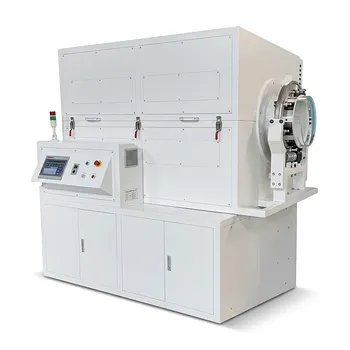
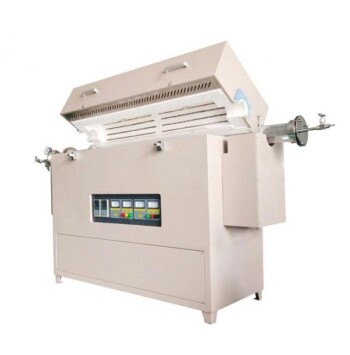
Powder compact densification is tracked through precise physical metrics—fractional density, linear shrinkage, surface area reduction, and the evolving neck size ratio between particles. These indicators collectively quantify how effectively void space is eliminated as a green compact transforms into a dense solid. A controlled-atmosphere laboratory furnace fundamentally elevates every one of these outcomes by preventing surface oxidation, purging binder residues, and averting the gas entrapment that otherwise permanently stalls densification.
The real power of a controlled atmosphere is not just protecting the powder—it is actively enabling the diffusion‑driven mass transport that turns discrete particles into a near‑pore‑free body. Without precise gas management, even optimal temperature cycles leave behind porosity that no amount of time or heat can close.
The Core Metrics That Define Densification
Densification is not a single number; it is a multi‑faceted progression from loosely packed powder to an engineered solid. The four standard metrics provide a complete picture.
Fractional Density: The Gold Standard
Fractional density is the ratio of the measured bulk density to the theoretical density of a completely pore‑free material. It directly captures how close a sintered part is to its physical limit. A starting green compact might have a fractional density of 50–60 %, while a fully optimized cycle can push this above 99 %, meeting the “near‑theoretical” threshold.
Linear Shrinkage: Tracking Dimension Change
Linear shrinkage measures the proportional change in the compact’s external dimensions during sintering. As pores close and mass flows into void spaces, the part undergoes systematic dimensional reduction. For uniform densification, shrinkage must be isotropic; any deviation signals temperature gradients or non‑uniform packing.
Surface Area Reduction: The Microscopic View
A green compact has an enormous internal surface area because of the intricate network of pores and particle contacts. Surface area reduction quantifies how this internal interface diminishes as sintering progresses. It is a sensitive early‑stage indicator of neck growth and pore rounding long before bulk density changes dramatically.
Neck Size Ratio: The Bridge Between Particles
The neck size ratio compares the diameter of the sintered bridge between two adjacent particles to the particle diameter itself. In the initial stage of sintering, surface diffusion widens these necks without significantly shrinking the part. A growing neck‑to‑particle ratio correlates with increasing mechanical integrity and the setting of the stage for later‑stage densification.
How a Controlled Atmosphere Laboratory Furnace Elevates These Metrics
Transferring a powder compact from the die to a furnace introduces the very risk that controlled atmospheres are designed to eliminate. Every percent of density gain—and every fraction of retained strength—depends on what happens at the powder surface before and during peak temperature.
Eliminating Surface Oxidation to Enable Direct Metal Contact
Surface oxide films are among the most insidious barriers to densification. On metallic powders, even a thin oxide layer acts as a physical barrier that impedes diffusion and prevents the formation of clean metal‑to‑metal necks. Operating under a reducing atmosphere (such as hydrogen) or high‑purity inert gas strips these films away, allowing true metallic contact. The result is a ductile fracture surface, higher ultimate tensile strength (UTS), and neck size ratios that grow without restriction.
Purging Binder Residues and Preventing Trapped Impurities
Almost all green compacts contain organic binders or lubricants that must be removed before densification can begin. A controlled‑atmosphere furnace (inert gas or vacuum) provides the means to outgas these residues during a deliberate intermediate‑temperature hold. Without this purge, decomposition products would remain trapped, creating internal gas pockets that inflate into closed porosity later. Fractional density suffers, and surface area reduction hits a premature ceiling.
Taming Final‑Stage Pore Closure: The Gas‑Entrapment Problem
The most decisive influence of atmosphere control occurs during final‑stage sintering, when interconnected pore channels pinch off into isolated voids. At this point, the gas inside the pores becomes trapped.
- When using a fast‑diffusing gas—such as hydrogen in certain oxide systems—the gas readily diffuses out through the lattice or grain boundaries. The pore can collapse completely, pushing fractional density towards the theoretical maximum.
- If a slow‑diffusing or inert gas (like argon or nitrogen) is trapped, it creates an internal pressure ( P_i ) that rises as the pore shrinks. Shrinkage stops when ( P_i ) equals the capillary driving force (( 2\gamma_s / r_f )), permanently arresting densification. For fine powders (initial pore radius under a few microns) processed at 1 atm, this effect is limited, and densities above 99.8 % are still obtainable. But for larger pores or higher ambient pressure, density drops catastrophically.
Vacuum or pressure‑assisted systems thus become essential to eliminate residual porosity. By evacuating the gas before pore closure, a high‑temperature vacuum furnace removes the opposing pressure entirely, allowing capillary forces to drive full collapse.
Enhancing Diffusion Through Stoichiometric and Defect Control
The furnace atmosphere dictates the material’s defect chemistry. For oxide ceramics, the oxygen partial pressure adjust the concentration of vacancies that mediate diffusion. For non‑oxide ceramics and metals, an inert environment prevents decomposition or unwanted phase changes that would create low‑density secondary phases. Maintaining the correct stoichiometry—through a precisely regulated atmosphere—keeps the dominant mass transport mechanisms (grain‑boundary diffusion, lattice diffusion) operating at maximum efficiency, which is reflected directly in linear shrinkage and surface area reduction rates.
Understanding the Trade‑offs and Limitations
A controlled atmosphere is a powerful enabler, but it is not a silver bullet. Several practical constraints must be acknowledged.
- Gas choice matters just as much as gas purity. An inert atmosphere that prevents oxidation may still become trapped in large pores. For coarser powders or thick sections, a vacuum or reducing gas is often required to avoid the gas‑entrapment limit.
- Vacuum is not always the answer. Some compounds are prone to decomposition or preferential evaporation of volatile species under high vacuum. A partial pressure of inert gas may be necessary to suppress such losses, even if it introduces a slight risk of trapped gas.
- Temperature–atmosphere synergy is essential. A perfect atmosphere cannot compensate for an incorrect heating profile. Without a controlled multi‑stage ramp and soak, thermal gradients create localized hoop stresses that distort the part and produce non‑uniform shrinkage, regardless of gas purity.
- Cost and complexity rise with control level. High‑purity gas handling, vacuum pumping systems, and precise mass‑flow controllers demand investment and maintenance. For some applications—like sintering low‑performance structural parts in large volumes—the incremental density gain may not justify the added process cost.
Making the Right Choice for Your Densification Goal
Your specific densification objective will dictate how aggressively you need to manage the furnace environment. Use these guidelines to align atmosphere strategy with outcomes.
- If your primary focus is achieving high density in metallic compacts: Choose a reducing atmosphere (e.g., hydrogen) or high‑purity inert gas with vacuum capability to eliminate surface oxides and enable robust neck formation.
- If your primary focus is eliminating trapped gas porosity in coarse powders or thick sections: Operate under high vacuum during the final stage of sintering, or use a fast‑diffusing gas species that can escape through the solid before pores seal.
- If your primary focus is maintaining stoichiometry in sensitive ceramics: Use a controlled partial pressure of the relevant gas (e.g., oxygen for oxides) and avoid high vacuum that could drive off critical elements.
- If your primary focus is process consistency and minimal warpage: Prioritize precise multi‑stage temperature control and uniform gas flow; the atmosphere itself should be a stable background that never fluctuates during the soak.
A laboratory furnace with full atmospheric control turns the art of sintering into a reproducible science—provided you match the gas environment to the specific densification metric you need to push to its limit.
Summary Table:
| Densification Metric | Focus & Measurement | Controlled Atmosphere Furnace Impact |
|---|---|---|
| Fractional Density | Ratio of bulk to theoretical density | Outgases trapped gases and eliminates oxides to achieve >99% density |
| Linear Shrinkage | Proportional dimensional reduction | Ensures uniform thermal profile and isotropic mass transport |
| Surface Area Reduction | Decrease in internal pore interface | Purges binder residues to allow uninterrupted early-stage neck growth |
| Neck Size Ratio | Ratio of inter-particle bridge to particle diameter | Prevents surface oxidation for clean, unrestricted metal-to-metal bonding |
Ready to eliminate trapped porosity and achieve near-theoretical density? KINTEK specializes in high-performance laboratory equipment and high-temperature furnaces—including controlled atmosphere, vacuum, muffle, tube, CVD, rotary, and customizable systems tailored to your unique research and production needs. Contact KINTEK today to consult with our experts and elevate your material sintering outcomes!
Related Products
- 1400℃ Controlled Inert Nitrogen Atmosphere Furnace
- 1200℃ Controlled Inert Nitrogen Atmosphere Furnace
- 1700℃ Controlled Inert Nitrogen Atmosphere Furnace
- Mesh Belt Controlled Atmosphere Furnace Inert Nitrogen Atmosphere Furnace
- Controlled Inert Nitrogen Hydrogen Atmosphere Furnace
People Also Ask
- How does nitrogen atmosphere control in high-temperature furnaces prevent the decomposition of silicon nitride during sintering?
- How does oxygen partial pressure control affect ceramic sintering? Master Defect Chemistry
- Why is thorough binder burnout necessary before sintering advanced ceramics? Ensure Peak Density & Zero Defects
- Why is controlled-atmosphere heating required for functional ceramics and sensors? Master Defect Engineering
- How do controlled-atmosphere furnaces support polymer pyrolysis? Master SiC & Si3N4 Ceramic Conversion