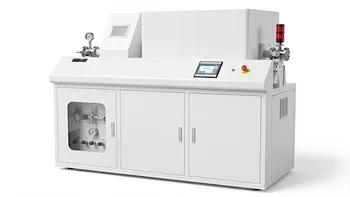
The use of a tubular furnace is critical for establishing a precise, oxygen-free environment required to isolate and measure volatile matter. This controlled setting allows researchers to heat municipal sludge or hydrochar to specific temperatures, triggering the release of organic components without premature oxidation. By quantifying this mass loss, analysts can determine the fuel's ignition characteristics and the effectiveness of previous thermal treatments.
The tubular furnace provides the high-temperature stability and atmospheric control necessary to accurately evaluate the devolatilization process. This measurement is fundamental to assessing the energy potential, chemical stability, and combustion quality of sludge-derived hydrochar.
The Role of Controlled Environments in Volatile Matter Analysis
Achieving Precise Thermochemical Decomposition
Tubular furnaces provide a strictly controlled thermal zone that ensures uniform heating of the sludge or hydrochar sample. This stability is vital for determining the exact temperature at which organic components transition into a gaseous state.
Oxygen-Free Isolation for Accuracy
Accurate volatile matter (VM) determination requires a non-oxidative atmosphere to prevent the sample from burning into ash. The tubular design allows for the introduction of inert gases or a vacuum, ensuring that mass loss is strictly due to volatilization rather than combustion.
Uniform Heat Treatment
The quartz tube structure often found in industrial tubular furnaces ensures that heat is distributed evenly across the sample. This uniformity is essential for investigating the kinetics of moisture evaporation and the specific patterns of pollutant release.
Evaluating Hydrothermal Carbonization (HTC) Success
Measuring the Extent of Devolatilization
Researchers use the tubular furnace to compare the VM content of raw municipal sludge against its hydrochar product. This comparison reveals the "extent of devolatilization," which indicates how much organic matter was successfully transformed during the hydrothermal carbonization process.
Assessing Fuel Quality and Combustion Performance
Volatile matter content directly influences the ignition performance of solid fuels. By using a tubular furnace, technicians can predict how hydrochar will behave in a commercial boiler, allowing them to evaluate its viability as a sustainable alternative to coal.
Monitoring Pollutant Release
The controlled environment of a tubular furnace allows for the study of pollutant release patterns. This data is critical for designing post-combustion treatment systems that can handle the specific gases released by treated municipal waste.
Understanding the Trade-offs and Equipment Selection
Tubular vs. Muffle Furnaces
While muffle furnaces are widely used for determining ash content through complete oxidation, they may lack the atmospheric precision of a tubular furnace. Tubular furnaces are preferred when the goal is to analyze the gases released during decomposition or when a strictly inert environment is required.
Temperature Range Limitations
Standard volatile matter tests are often performed at specific temperatures, such as 925°C or 600°C, depending on the material and standard protocol. However, if the furnace is not calibrated for the specific moisture kinetics of sludge, the results may misrepresent the true organic composition.
Sample Size and Throughput
Tubular furnaces often accommodate smaller sample sizes compared to large industrial muffle furnaces. This makes them ideal for high-precision laboratory research but may require multiple runs to ensure a representative sample of heterogeneous municipal waste.
How to Apply This to Your Project
When determining the volatile matter of sludge-based products, the choice of equipment and atmosphere will define the reliability of your data.
- If your primary focus is process efficiency: Use a tubular furnace to quantify the degree of devolatilization achieved during hydrothermal treatment to optimize your carbonization parameters.
- If your primary focus is fuel performance: Utilize the controlled heating of a tubular furnace to establish the ignition profile and volatile-to-fixed-carbon ratio of your hydrochar.
- If your primary focus is inorganic residue analysis: Use a high-temperature muffle furnace to achieve complete oxidation, allowing for a clear distinction between volatile solids and mineral ash.
Mastering the controlled environment of a tubular furnace ensures that the chemical potential of municipal waste is measured with scientific rigor and technical accuracy.
Summary Table:
| Feature | Role in Sludge & Hydrochar Analysis | Benefit to Researchers |
|---|---|---|
| Atmospheric Control | Provides an inert or vacuum environment | Prevents sample oxidation for accurate VM measurement. |
| Thermal Stability | Maintains a strictly controlled thermal zone | Ensures uniform heating and precise devolatilization data. |
| Process Evaluation | Compares raw sludge vs. hydrochar product | Quantifies the extent of hydrothermal carbonization (HTC). |
| Fuel Characterization | Simulates ignition and combustion profiles | Predicts hydrochar performance as a sustainable coal alternative. |
| Pollutant Monitoring | Captures gases in a controlled setting | Enables the study of specific pollutant release patterns. |
Optimize Your Sludge Research with KINTEK Laboratory Furnaces
Precise data depends on precise equipment. KINTEK specializes in high-performance laboratory equipment and consumables, offering a comprehensive range of high-temperature furnaces—including muffle, tube, rotary, vacuum, CVD, atmosphere, and dental furnaces—all fully customizable to meet your specific research parameters.
Whether you are quantifying devolatilization in a tubular furnace or performing ash analysis in a muffle furnace, KINTEK provides the thermal stability and atmospheric control required for rigorous scientific inquiry.
Ready to enhance your lab's capabilities? Contact our experts today to find the perfect, customized heating solution for your municipal waste and hydrochar projects!
References
- Małgorzata Hejna, Andrzej Białowiec. Study on the Effect of Hydrothermal Carbonization Parameters on Fuel Properties of Sewage Sludge Hydrochar. DOI: 10.3390/ma16216903
This article is also based on technical information from Kintek Furnace Knowledge Base .
Related Products
- Custom Made Versatile CVD Tube Furnace Chemical Vapor Deposition CVD Equipment Machine
- Vertical Laboratory Quartz Tube Furnace Tubular Furnace
- Multi Zone Laboratory Quartz Tube Furnace Tubular Furnace
- Magnesium Extraction and Purification Condensing Tube Furnace
- Laboratory Quartz Tube Furnace RTP Heating Tubular Furnace
People Also Ask
- What is a CVD tube furnace and what is its primary function? Discover Precision Thin-Film Deposition
- Why are CVD tube furnace sintering systems indispensable for 2D material research and production? Unlock Atomic-Scale Precision
- Which industries and research fields benefit from CVD tube furnace sintering systems for 2D materials? Unlock Next-Gen Tech Innovations
- How does CVD tube furnace sintering enhance graphene growth? Achieve Superior Crystallinity and High Electron Mobility
- What future trends are expected in the development of CVD tube furnaces? Discover Smarter, More Versatile Systems