
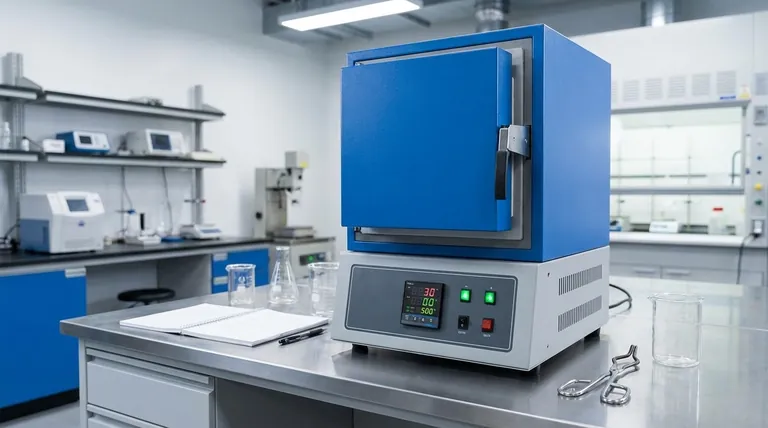
The primary significance of a muffle furnace lies in its ability to create a precisely controlled, high-temperature environment to fundamentally alter or analyze a material's composition. It is an indispensable laboratory tool for processes requiring thermal treatment, such as ashing, heat-treating metals, or firing ceramics, where uniformity and isolation from contaminants are critical for accurate and repeatable results.
A muffle furnace is more than just a high-temperature oven; its core value lies in isolating a sample from direct heating elements and combustion byproducts. This separation provides exceptionally uniform, precisely controlled heat, enabling repeatable analysis and material synthesis that would be impossible with other heating methods.
The Core Function: Transformation Through Heat
The fundamental purpose of a muffle furnace is to apply controlled thermal energy to a sample. This capability serves three primary functions across research and industry: sample preparation, material synthesis, and quality assessment.
Achieving Purity Through Ashing
In many analytical procedures, the organic components of a sample must be removed to analyze the inorganic residue. This process is known as ashing.
A muffle furnace excels at this by heating a sample in the presence of air, causing the organic matter to combust and turn into gas, leaving behind only non-combustible inorganic materials for subsequent analysis via techniques like spectroscopy.
Synthesizing and Modifying Advanced Materials
The creation of alloys, composites, and technical ceramics often depends on subjecting materials to a precise temperature profile.
Muffle furnaces provide the necessary control to execute these heat-treatment processes, altering a material's microstructure to achieve desired properties like hardness, strength, or conductivity.
Simulating Extreme Conditions for Quality Control
For industries like aerospace and ceramics, it is vital to understand how a material will behave under extreme thermal stress.
A muffle furnace replicates these high-temperature environments in a controlled setting, allowing researchers and manufacturers to test the durability, integrity, and characteristics of their products to ensure they meet stringent quality standards.
Key Design Principles That Enable Precision
A muffle furnace is not simply a box that gets hot. Its design is specifically engineered to deliver stable, uniform, and clean heat, which is what makes it so valuable for technical applications.
The "Muffle": Uniform Heating and Isolation
The name "muffle furnace" comes from the muffle, an inner chamber that separates the sample from the heating elements.
This design prevents contamination from combustion byproducts of the fuel source (in older or fuel-fired models) and ensures the sample is heated uniformly through convection and radiation, rather than direct, uneven contact with hot elements.
Advanced Insulation for Stability and Efficiency
Modern furnaces are constructed with thick, multi-layered insulation, typically made of advanced ceramic fibers.
This high-performance insulation is crucial for minimizing heat loss, which allows the furnace to maintain a stable internal temperature with less energy consumption. It also keeps the external housing cool and safe to the touch.
Atmospheric Control for Sensitive Materials
While standard models operate in air, many advanced muffle furnaces allow for the introduction of an inert gas atmosphere, such as nitrogen or argon.
This capability is critical for heat-treating materials that readily oxidize or react with air at high temperatures, preserving the integrity and purity of the final product.
Understanding the Trade-offs and Limitations
While powerful, muffle furnaces have operational characteristics that must be considered. Understanding these trade-offs is key to using them effectively.
Slower Heating and Cooling Cycles
The same heavy insulation that makes a furnace efficient and stable also gives it significant thermal mass.
Consequently, muffle furnaces take longer to heat up and cool down compared to other heating methods. This can be a bottleneck in high-throughput workflows.
Energy Consumption
Despite efficiency-improving features like intelligent power controllers and quality insulation, achieving and maintaining temperatures of 1000°C or higher is an energy-intensive process.
Atmosphere and Sample Constraints
A standard muffle furnace is not a universal solution. It is unsuitable for processes requiring a vacuum or highly reactive gases unless it is a specialized and significantly more expensive model. Furthermore, volatile materials can be lost during the heating process.
Making the Right Choice for Your Goal
Integrating a muffle furnace into your workflow requires aligning its capabilities with your specific objective.
- If your primary focus is quantitative analysis: The furnace is essential for complete ashing of samples to accurately determine their inorganic or mineral content.
- If your primary focus is materials synthesis: Its precise and uniform temperature control is critical for creating new alloys, ceramics, or composites with specific, repeatable properties.
- If your primary focus is quality control: The furnace allows you to test material stability and performance under repeatable high-temperature stress, ensuring product reliability.
Ultimately, the muffle furnace empowers researchers and engineers to reliably control one of the most fundamental variables in materials science: temperature.
Summary Table:
| Key Aspect | Significance |
|---|---|
| Primary Function | Provides controlled high-temperature environment for material transformation and analysis |
| Core Applications | Ashing, heat-treating metals, firing ceramics, quality control, and material synthesis |
| Design Features | Muffle chamber for isolation, advanced insulation, and optional atmospheric control |
| Benefits | Uniform heating, contamination-free results, precise temperature control, and repeatability |
| Limitations | Slower heating/cooling cycles, high energy consumption, and constraints on atmosphere/sample types |
Ready to enhance your lab's capabilities with a high-temperature furnace? At KINTEK, we leverage exceptional R&D and in-house manufacturing to provide advanced solutions like Muffle, Tube, Rotary Furnaces, Vacuum & Atmosphere Furnaces, and CVD/PECVD Systems. Our strong deep customization capability ensures we meet your unique experimental needs precisely. Contact us today to discuss how our furnaces can drive your research forward!
Visual Guide

Related Products
- 1400℃ Muffle Oven Furnace for Laboratory
- 1700℃ High Temperature Muffle Oven Furnace for Laboratory
- 1800℃ High Temperature Muffle Oven Furnace for Laboratory
- 1200℃ Muffle Oven Furnace for Laboratory
- High Temperature Muffle Oven Furnace for Laboratory Debinding and Pre Sintering
People Also Ask
- What is the primary function of a high-temperature laboratory muffle furnace in chemical synthesis? Achieve Precision.
- How does a high-temperature laboratory muffle furnace affect material properties? Transform Anodic Oxide Films Fast
- What is the muffle furnace function in ilmenite oxidative roasting? Enhance Phase Change & Magnetic Separation
- What is the purpose of using a laboratory high-temperature muffle furnace for drying Fe-Ni-Co catalysts? Boost Purity
- How is a laboratory high-temperature muffle furnace utilized in g-C3N4 synthesis? Optimize Your Thermal Polycondensation



















