
Precision heat treatment acts as the master control for material properties. The purpose of using a high-precision box furnace is to create a perfectly stable isothermal environment that eliminates initial casting stresses in medium-entropy brass. When paired with specific cooling media—such as furnace cooling, air cooling, or water quenching—this process allows you to dictate the alloy's final microstructure and hardness by strictly regulating how secondary phases precipitate.
The core value lies in the transition from stress relief to microstructural engineering. By manipulating cooling rates after a stable heat soak, you control the kinetics of strengthening phases, effectively tailoring the brass for specific mechanical requirements.
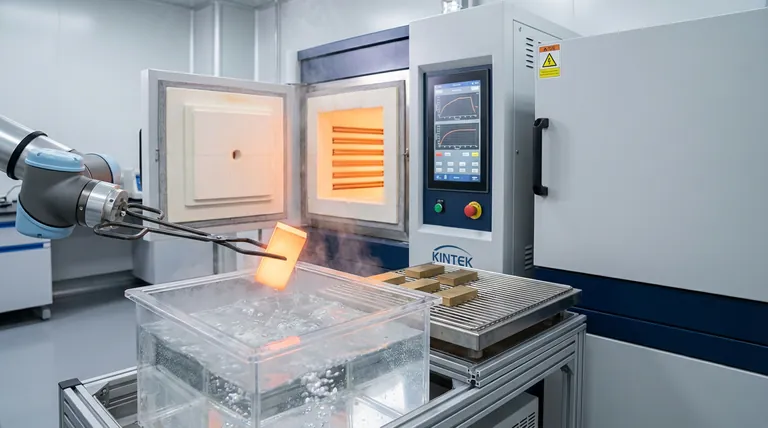
The Role of Thermal Stability
Establishing an Isothermal Environment
High-precision box furnaces are essential because they maintain a uniform temperature throughout the chamber. This stability ensures that every part of the medium-entropy brass sample experiences the exact same thermal history.
Eliminating Casting Defects
Raw cast alloys often contain residual stresses from the solidification process. The furnace provides the necessary heat to relax the material lattice, effectively removing these casting stresses before further modification occurs.
Facilitating Phase Transformations
Beyond stress relief, the furnace heat drives the material toward thermodynamic equilibrium. This creates the optimal starting point for phase transformations, setting the stage for the specific microstructural changes you intend to induce during cooling.
Controlling Microstructure via Cooling Media
Regulating Precipitation Kinetics
The choice of cooling medium is the variable that determines how the alloy behaves as it returns to room temperature. By selecting a specific cooling rate, you directly influence the speed and extent of precipitation for secondary strengthening phases.
Targeting Specific Intermetallics
The primary reference highlights the importance of phases like gamma-AlCu and gamma-CuZn. The cooling rate dictates whether these intermetallic compounds precipitate fully, partially, or are suppressed entirely.
Modifying Hardness
Because the microstructure changes based on the cooling rate, the mechanical properties shift as well. Varying the cooling media allows you to tune the hardness of the medium-entropy brass to meet specific application needs.
Understanding the Trade-offs
Cooling Rate vs. Equilibrium
There is an inherent trade-off between achieving thermodynamic equilibrium and retaining high-temperature phases.
Furnace Cooling (FC)
Furnace Cooling represents the slowest rate. It generally allows the material to reach a state closer to equilibrium, promoting the fullest precipitation of secondary phases but requiring the most processing time.
Water Quenching (WQ)
Water Quenching provides the most rapid cooling. This method often "freezes" the high-temperature microstructure in place, halting precipitation kinetics abruptly. While this can lock in desirable hardness traits, it may induce new thermal stresses compared to slower methods.
Making the Right Choice for Your Goal
To optimize your heat treatment process, you must align the cooling medium with your desired material outcome.
- If your primary focus is stress elimination: Rely on the high-precision furnace to standardize the internal structure before applying any cooling.
- If your primary focus is manipulating hardness: Utilize rapid cooling media like Water Quenching (WQ) or moderate media like Air Cooling (AC) to alter the precipitation density of gamma phases.
- If your primary focus is phase stability: Use Furnace Cooling (FC) to allow the precipitation kinetics of gamma-AlCu and gamma-CuZn to run their natural course.
Success in treating medium-entropy brass comes down to balancing the stress-relieving heat of the furnace with the property-defining speed of the cool.
Summary Table:
| Cooling Medium | Cooling Rate | Primary Effect on Brass | Microstructural Outcome |
|---|---|---|---|
| Furnace Cooling (FC) | Slowest | High Phase Stability | Full precipitation of secondary phases (e.g., gamma-AlCu) |
| Air Cooling (AC) | Moderate | Balanced Properties | Controlled precipitation for moderate hardness |
| Water Quenching (WQ) | Rapid | Hardness Maximization | Suppresses precipitation; "freezes" high-temp microstructure |
Elevate Your Material Research with KINTEK Precision
Precision heat treatment is the foundation of material science excellence. KINTEK provides high-performance heating solutions—including Muffle, Tube, Rotary, Vacuum, and CVD systems—engineered to deliver the isothermal stability required for complex alloys like medium-entropy brass.
Backed by expert R&D and world-class manufacturing, our laboratory high-temp furnaces are fully customizable to meet your unique research or production needs. Don't leave your microstructure to chance; partner with KINTEK for unparalleled thermal control.
Ready to optimize your alloy properties? Contact KINTEK today to discuss your custom furnace solution.
References
- Spyridon Chaskis, Spyros Papaefthymiou. Compositional Design and Thermal Processing of a Novel Lead-Free Cu–Zn–Al–Sn Medium Entropy Brass Alloy. DOI: 10.3390/met14060620
This article is also based on technical information from Kintek Furnace Knowledge Base .
Related Products
- High Pressure Laboratory Vacuum Tube Furnace
- 1700℃ High Temperature Laboratory Tube Furnace with Alumina Tube
- 1400℃ High Temperature Laboratory Tube Furnace with Alumina Tube
- High Temperature Muffle Oven Furnace for Laboratory Debinding and Pre Sintering
- Vertical Laboratory Quartz Tube Furnace Tubular Furnace
People Also Ask
- What role does a high vacuum tube furnace play in Co-Al sintering? Master High-Purity Porous Material Synthesis
- What are the different types of tube furnaces available? Find the Perfect Fit for Your Lab's Needs
- What are the main advantages of vacuum tube furnaces in the market? Achieve Purity and Precision in Material Processing
- What is the role of a vacuum tube furnace during the final thermal treatment stage of Fe3O4@CSAC catalysts?
- What conditions do tube furnaces provide for Au-Seeded TiO2 nanowires? Master Precision Thermal Synthesis



















