
At its core, the firing chamber of a porcelain furnace is the insulated, high-temperature compartment where dental restorations are placed to be fired. It is the principal unit of the machine, meticulously engineered to contain and control the extreme heat necessary to transform ceramic materials into a final, durable prosthetic.
The firing chamber is not merely a box that gets hot. It is a precision instrument designed to create a perfectly uniform thermal environment, which is the single most critical factor in achieving the desired strength, density, and aesthetic properties of a dental ceramic restoration.
The Chamber's Role in Ceramic Transformation
The firing chamber is the active stage where the science of dental ceramics unfolds. Its design directly dictates the quality and consistency of the final restoration.
Housing the Restoration
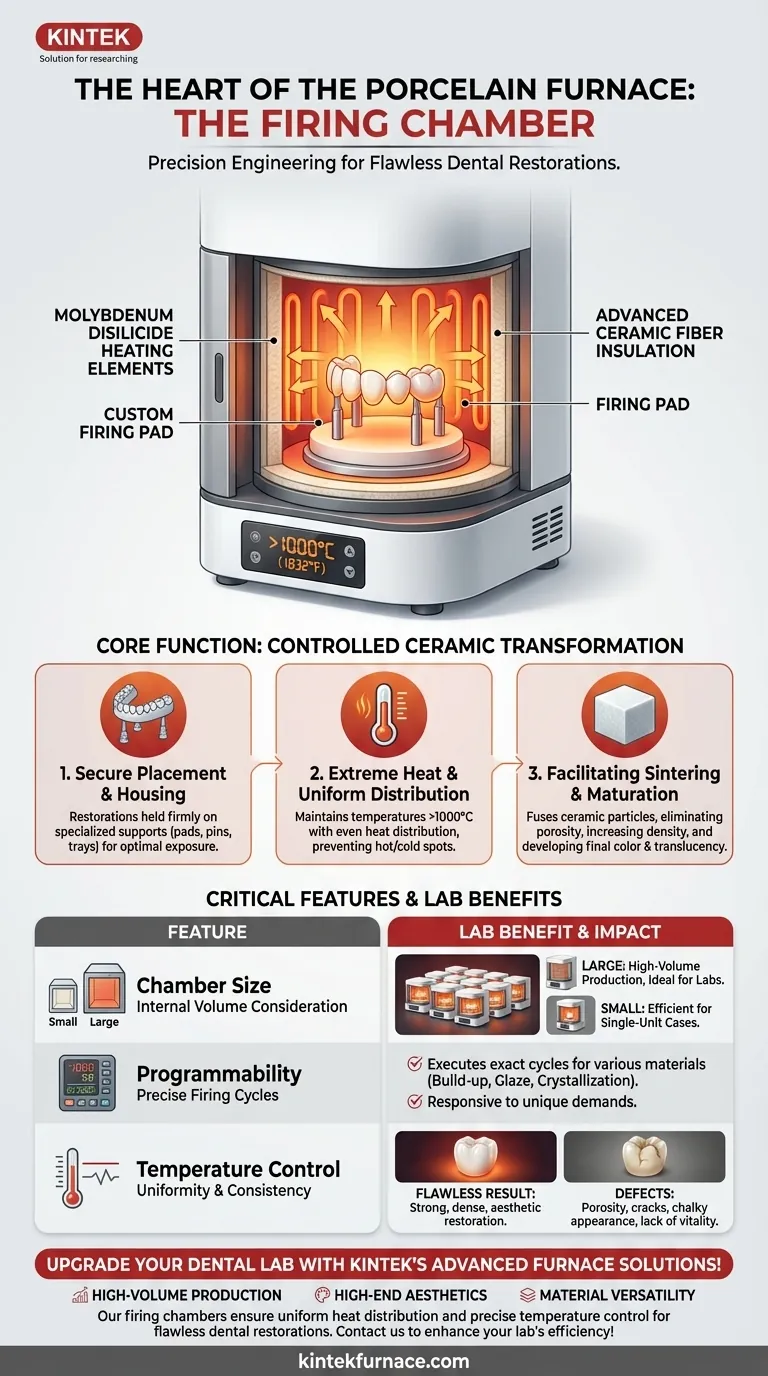
The most fundamental purpose of the chamber is to securely hold the dental restoration during the firing cycle. Restorations are placed on specialized, heat-proof supports like firing pads, pins, or mesh trays to ensure they are positioned optimally for heat exposure.
Creating a Controlled Thermal Environment
The chamber is lined with advanced insulation, such as ceramic fiber, to withstand and maintain temperatures that can exceed 1000°C (1832°F). This thermal integrity allows the heating elements, often made of molybdenum disilicide, to raise and hold the temperature with extreme precision.
Ensuring Uniform Heat Distribution
Perhaps the most crucial function is providing even temperature distribution. Any "hot spots" or "cold spots" within the chamber will cause the ceramic to fire unevenly, leading to internal stress, cracks, poor fit, or inconsistent shades. A well-designed chamber guarantees that every surface of the restoration receives the exact same thermal treatment.
Facilitating Sintering and Maturation
This controlled environment enables sintering, the process where individual ceramic particles fuse together under heat. This process eliminates porosity, increases the material's density and hardness, and develops its final, stable color and translucency, turning a fragile powder build-up into a strong, monolithic restoration.
Understanding the Critical Trade-offs
The specifications of the firing chamber are not arbitrary. They represent a series of engineering decisions that impact a dental lab's workflow, efficiency, and final quality.
The Impact of Chamber Size
The internal volume of the firing chamber is a key consideration. A larger chamber can process more units simultaneously, which is ideal for high-production labs. However, it may consume more energy and take longer to heat and cool for a single restoration. A smaller chamber is more efficient for single-unit cases but limits throughput.
The Need for Programmability
Modern furnaces have programmable controllers that execute precise firing cycles for different materials (e.g., build-up, glaze, crystallization). The firing chamber must be able to respond rapidly and accurately to these commands, holding specific temperatures for exact durations to meet the unique demands of each ceramic system.
The Consequence of Poor Temperature Control
A failure in the chamber's ability to maintain precise and uniform temperature is the primary cause of defects. This can manifest as unwanted porosity, a chalky appearance, or a lack of vitality in the final crown or veneer. The quality of the chamber's insulation and heating elements directly correlates to the quality of your work.
Applying This to Your Lab's Goals
Understanding the firing chamber helps you evaluate a furnace based on its ability to meet your specific clinical or business objectives.
- If your primary focus is high-volume production: Prioritize a furnace with a large, durable firing chamber and proven temperature consistency across its entire volume.
- If your primary focus is high-end aesthetics: Seek a furnace renowned for its exceptional temperature uniformity and precise programmability to perfectly match complex firing schedules for advanced ceramic systems.
- If your primary focus is material versatility: Choose a furnace with a responsive firing chamber and a wide range of pre-set, manufacturer-certified programs to ensure optimal results across different brands of porcelain.
Mastering your equipment begins with understanding its core components, and the firing chamber is the heart of your furnace's performance.
Summary Table:
| Function | Key Details |
|---|---|
| Housing the Restoration | Secures restorations on heat-proof supports like firing pads or pins. |
| Controlled Thermal Environment | Uses ceramic fiber insulation and molybdenum disilicide heating elements for temperatures >1000°C. |
| Uniform Heat Distribution | Prevents hot/cold spots to avoid defects like cracks and inconsistent shades. |
| Facilitating Sintering | Fuses ceramic particles to increase density, hardness, and aesthetic properties. |
| Impact of Chamber Size | Larger chambers boost production but use more energy; smaller ones are efficient for single units. |
| Programmability | Allows precise firing cycles for different materials via programmable controllers. |
Upgrade Your Dental Lab with KINTEK's Advanced Furnace Solutions! Leveraging exceptional R&D and in-house manufacturing, we provide diverse laboratories with high-temperature furnace systems tailored to your needs. Our product line includes Muffle, Tube, Rotary Furnaces, Vacuum & Atmosphere Furnaces, and CVD/PECVD Systems, all backed by strong deep customization capabilities to precisely meet your unique experimental requirements. Whether you focus on high-volume production, high-end aesthetics, or material versatility, our firing chambers ensure uniform heat distribution and precise temperature control for flawless dental restorations. Contact us today to discuss how we can enhance your lab's efficiency and quality!
Visual Guide
Related Products
- Dental Porcelain Zirconia Sintering Ceramic Vacuum Press Furnace
- Vacuum Dental Porcelain Sintering Furnace for Dental Laboratories
- Chairside Dental Porcelain Zirconia Sintering Furnace with Transformer for Ceramic Restorations
- Split Chamber CVD Tube Furnace with Vacuum Station CVD Machine
People Also Ask
- What factors determine the quality of sintered zirconia restorations? Master Material, Equipment, and Technique
- How do conventional vs rapid sintering in dental furnaces affect zirconia? Optimize Efficiency Without Sacrificing Strength
- What is the purpose of dental sintering furnaces? Transform Zirconia into Durable, High-Quality Dental Restorations
- What precautions should be taken when sintering zirconia in the Fast Slow Dental Sintering Furnace? Master Key Steps for Perfect Results
- What temperature range is used for sintering zirconia ceramics? Achieve Optimal Strength and Translucency



