
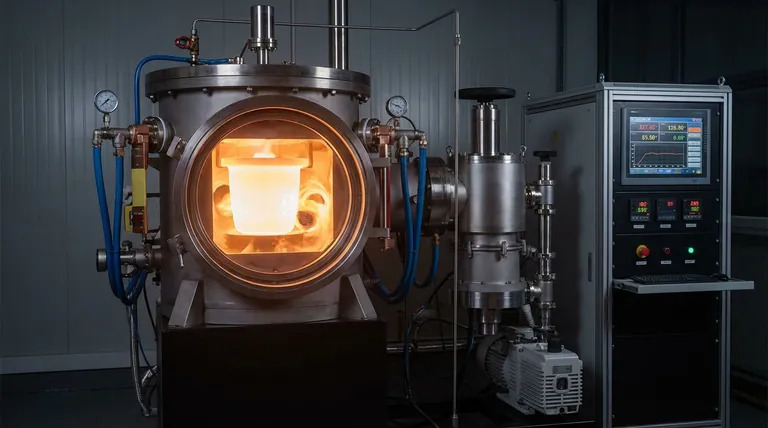
The primary role of a vacuum melting furnace in this context is to create a controlled, high-energy environment that simultaneously protects reactive elements and fuses refractory metals. It specifically prevents the oxidation of Titanium (Ti) and Zirconium (Zr) while generating the extreme heat necessary to melt Tungsten (W) and Molybdenum (Mo).
Core Takeaway The vacuum melting furnace solves three distinct physical challenges: it eliminates oxygen to preserve reactive Ti and Zr, provides the thermal energy to liquefy refractory W and Mo, and utilizes melt pool stirring to homogenize elements with vastly different densities.
Preventing Chemical Degradation
The most immediate function of the furnace is to act as a protective barrier against atmospheric contamination.
Protecting Reactive Elements
Titanium and Zirconium are classified as "active elements." At high temperatures, they possess a high affinity for oxygen. Without a vacuum environment, these metals would rapidly oxidize, compromising the integrity of the alloy.
Ensuring Compositional Accuracy
By removing air and maintaining a high vacuum, the furnace ensures that the final chemical composition of the ingot matches the intended design. This prevents the loss of active material to slag or oxides, resulting in high-purity alloy ingots.
Overcoming Thermal and Physical Barriers
Beyond protection, the furnace serves as a mechanical engine for fusion, addressing the disparate physical properties of the component metals.
Melting Refractory Metals
The alloy includes Molybdenum and Tungsten, both of which are refractory metals with exceptionally high melting points. The furnace is engineered to generate the extreme temperatures required to fully liquefy these components, a feat standard furnaces cannot achieve.
Managing Density Disparities
There is a significant density difference between the heavy refractory metals (like Tungsten) and the lighter active metals (like Titanium).
- The Challenge: Left alone, these elements would separate, leading to an inconsistent alloy.
- The Solution: The furnace utilizes melt pool stirring. This mechanism forces the preliminary mixing of these heavy and light components, ensuring the elements are distributed evenly throughout the ingot.
Understanding the Trade-offs
While essential, reliance on vacuum melting introduces specific operational complexities that must be managed.
The Necessity of Multi-Cycle Melting
While the furnace provides the capability to mix, a single melt is rarely sufficient for perfect homogeneity. As noted in broader applications, achieving atomic-level uniform distribution often requires multiple re-melting cycles to fully resolve the density differences between W/Mo and Ti/Zr.
System Complexity and Cooling
High-vacuum melting is not a passive process. It requires rigorous management of sub-systems, including water-cooled crucibles to prevent furnace damage and complex vacuum pumps to maintain the environment. Failure in the cooling or vacuum seal immediately compromises the purity of the Ti and Zr components.
Making the Right Choice for Your Goal
To maximize the effectiveness of a vacuum melting furnace for Ti-Zr-Mo-W alloys, consider your specific priorities:
- If your primary focus is Purity: Prioritize the integrity of the vacuum system to absolutely minimize oxygen content, as Ti and Zr are unforgiving of leaks.
- If your primary focus is Homogeneity: Focus on the "melt pool stirring" capability and plan for multiple re-melting cycles to overcome the density drag of Tungsten.
The vacuum melting furnace is not just a heating vessel; it is a compositional enforcement tool that bridges the gap between highly reactive and highly refractory materials.
Summary Table:
| Key Function | Role in Ti-Zr-Mo-W Preparation | Primary Benefit |
|---|---|---|
| Atmospheric Control | Eliminates oxygen and nitrogen to protect active Ti and Zr | Prevents oxidation and ensures high chemical purity |
| Thermal Capacity | Generates extreme heat required to liquefy refractory W and Mo | Enables fusion of metals with exceptionally high melting points |
| Melt Pool Stirring | Mechanically mixes elements with vastly different densities | Overcomes gravity-induced segregation for uniform distribution |
| Multiple Re-melting | Subjecting the ingot to several vacuum melting cycles | Achieves atomic-level homogeneity across the alloy structure |
Elevate Your Material Science with KINTEK
Precision in high-entropy alloy preparation starts with the right environment. Backed by expert R&D and world-class manufacturing, KINTEK offers high-performance Vacuum, CVD, and Muffle systems specifically engineered to handle the challenges of reactive and refractory metals.
Whether you need custom vacuum melting solutions for Ti-Zr-Mo-W alloys or specialized lab furnaces for high-temp research, our equipment provides the stability and control your innovations demand. Contact us today to discuss your unique project requirements and discover how KINTEK’s customizable thermal technology can optimize your results.
References
- Yuxian Cao, Chunxu Wang. The Microstructures, Mechanical Properties, and Energetic Characteristics of a Novel Dual-Phase Ti40Zr40W10Mo10 High-Entropy Alloy. DOI: 10.3390/ma18020366
This article is also based on technical information from Kintek Furnace Knowledge Base .
Related Products
- Vacuum Induction Melting Furnace
- Small Vacuum Heat Treat and Tungsten Wire Sintering Furnace
- Vacuum Heat Treat Sintering Furnace Molybdenum Wire Vacuum Sintering Furnace
- Vacuum Heat Treat Sintering and Brazing Furnace
- 2200 ℃ Tungsten Vacuum Heat Treat and Sintering Furnace
People Also Ask
- What are the core functions of the High Vacuum Induction Melting (VIM) furnace? Optimize DD5 Superalloy Purification
- Why is a Vacuum Induction Melting furnace (VIM) used for Cu-Zn-Al-Sn alloys? Achieve Precision Composition Control
- What is the role of VIM and directional solidification in aero-engine blade substrates? Engineering Extreme Durability
- What role does a Vacuum Induction Melting furnace play in the production of high-aluminum nickel-based superalloys?
- What are the advantages of using a VIM furnace to control residual oxygen pressure? Achieve Superior Metal Uniformity



















