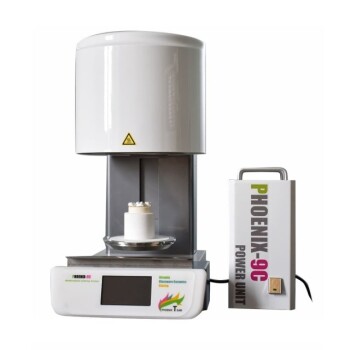
The essential sintering condition for iron-based powder compacts (Fe-P, Fe-Si, Fe-Ni) to maximize density and soft magnetic performance is a closely controlled high-temperature thermal cycle at 0.7–0.8 of the absolute melting point of iron—roughly 1075–1175°C (1965–2145°F)—in a protective or reducing atmosphere.
This temperature range supplies the thermal activation needed for solid-state diffusion of alloying elements, healing of microcracks, and elimination of residual microporosity. When paired with the correct atmosphere, hold time, and cooling profile, the result is a coarse-grained, chemically homogeneous ferritic microstructure with exceptionally high magnetic permeability and minimal coercivity.
The core takeaway: High density alone isn’t enough—soft magnetic performance depends on a uniform large-grain microstructure free of interstitial impurities and non-metallic inclusions. Achieving that requires sintering at the upper end of the safe solid‑state temperature window (typically 1120–1200°C for most iron‑based systems) in a hydrogen or high‑vacuum atmosphere, with a sufficient soak to allow full diffusion and pore rounding, followed by controlled cooling to lock in a clean, stress‑free ferrite.
Why Sintering Conditions Make or Break Soft Magnetic Performance
Soft magnetic materials like Fe‑P, Fe‑Si, and Fe‑Ni work by rapidly magnetizing and demagnetizing with minimal energy loss.
Every pore, grain boundary, impurity, and internal stress acts like a tiny obstacle to domain wall motion—increasing coercivity and reducing permeability.
Density is a prerequisite, but magnetic quality is a microstructural problem.
You need grains large enough that domain walls can sweep across them unimpeded, yet you must avoid the kind of uncontrolled grain growth that traps pores and introduces stress.
The Role of Temperature: Atomic Mobility Within the Safe Zone
The primary reference anchors the safe range at 0.7–0.8 of the absolute melting point of the base metal.
For pure iron (melting point ~1538°C / 1811 K), that translates to ~995°C to 1175°C.
In this temperature window, three critical densification and purification mechanisms accelerate simultaneously:
- Volume diffusion of alloying elements like phosphorus, silicon, and nickel into the iron lattice—homogenizing the chemistry and removing concentration gradients that pin domain walls.
- Grain boundary migration that sweeps pores to the surface and coalesces residual oxides, carbides, and nitrides into harmless, spheroidized inclusions.
- Microcrack healing through diffusion of atoms into narrow fissures, restoring full metallic continuity.
For Fe‑P, the phosphorus content depresses the solidus temperature.
You must keep the sintering temperature safely below the first liquid formation temperature—often around 1050–1100°C for higher phosphorus grades—to avoid liquid‑phase sintering that introduces brittle Fe₃P networks and disrupts magnetic performance.
For Fe‑Si and Fe‑Ni, the wider solid‑state window lets you push toward 1150–1200°C without risking incipient melting.
This near‑maximum temperature yields the fastest diffusion and the cleanest grain boundaries—directly translating to higher permeability.
Atmosphere: The Invisible Shield That Dictates Chemistry
Soft magnetic iron alloys are ruthlessly sensitive to carbon, oxygen, and nitrogen contamination.
Even trace interstitials dramatically raise coercivity. The atmosphere must therefore be both protective and actively reducing.
- Dry hydrogen (H₂) is the gold standard. It reduces residual iron oxides at temperature and prevents re‑oxidation during cooling, leaving behind a chemically clean metal surface. Hydrogen also decarburizes the compact, a critical advantage since even 0.01 wt% carbon can spike coercivity.
- High vacuum (10⁻⁴ mbar or better) works well for alloys with volatile elements that might be stripped by flowing gas. Vacuum promotes pore elimination by keeping internal pore pressure low, enabling full closure.
- Inert atmospheres (argon, nitrogen) can protect against oxidation but do not actively reduce existing oxides. Nitrogen may also form unwanted nitrides, so inert gases are best reserved for pre‑alloyed powders that are already oxide‑free.
The furnace atmosphere must flow steadily during the entire high‑temperature dwell and the initial cooling phase to sweep away any outgassed species.
For binder‑processed compacts, a stepwise thermal debinding under hydrogen up to 700°C removes organics completely before entering the sintering ramp—avoiding carbon residues that would otherwise contaminate the final part.
Hold Time: Where Pores Shrink and Grains Grow
Sintering is a time‑dependent diffusion process.
At peak temperature, the hold time must be long enough to:
- Reduce the interconnected pore network to isolated, spherical voids (pore rounding).
- Allow grain growth to consume these isolated pores, further pushing them toward the surface.
- Coarsen the grain structure into large, strain‑free ferrite grains.
Typically, 30–90 minutes at peak temperature is sufficient for small to medium‑sized compacts.
Excessive hold time, however, can trigger a secondary exaggerated grain growth—especially in the gamma‑phase temperature region above ~910°C for pure iron. Uncontrolled grain growth can trap pores inside grains, making them impossible to eliminate, and can actually reduce density and magnetic performance.
Heating and Cooling Rates: Shaping the Final Microstructure
Heating rate must balance binder burnout, thermal stress relief, and the brief phase transformation window.
A moderate ramp (5–10°C/min) through the alpha‑to‑gamma transition avoids cracking and allows alloying elements to pre‑diffuse before the main soak.
Cooling rate is perhaps the most underappreciated parameter.
Slow cooling from the sintering temperature through the Curie point and final phase transformations achieves three goals:
- Allows the gamma‑to‑alpha (austenite‑to‑ferrite) transformation to proceed fully, yielding the magnetically soft body‑centered cubic ferrite structure.
- Relieves thermal stresses that would otherwise pin domain walls.
- Prevents quenching‑induced martensite or retained austenite, which are magnetically hard phases that ruin permeability.
For Fe‑Ni alloys in particular, the transformation temperature is depressed, so an equally slow and controlled cooling is still needed.
A common industrial practice is a furnace cool under protective gas, equivalent to 1–5°C/min down to at least 600°C.
Understanding the Trade-offs: When High Temperature Works Against You
Pushing the sintering temperature too close to the melting point introduces several risks that can backfire on density and magnetic quality.
The Exaggerated Grain Growth Trap
Above ~1200°C for plain iron, grain boundaries become so mobile that a few grains can swallow their neighbours rapidly—trapping isolated pores inside them.
Once a pore is inside a grain, it can only shrink by the extremely slow mechanism of lattice diffusion. The result is a coarse, yet porous, microstructure with poor soft magnetic properties.
Liquid Phase Formation in Fe‑P
Phosphorus is a powerful melting‑point depressor.
At just 0.3–0.8 wt% P, an iron‑phosphorus compact may begin to form a transient liquid phase at temperatures as low as 1050°C.
While that liquid can temporarily accelerate densification, it often solidifies into brittle grain‑boundary films that degrade both strength and coercivity. The safe peak temperature must be calibrated to the specific phosphorus level.
Evaporation and Alloy Loss
Elements like silicon and nickel have lower vapour pressures than iron, but in a high vacuum, preferential evaporation can alter the surface composition.
A slight positive pressure of argon or a flowing hydrogen atmosphere suppresses this, preserving the target alloy chemistry.
Making the Right Choice for Your Goal
The optimal sintering recipe depends on the specific alloy and your final magnetic property targets. Use these decision points to define your thermal profile.
- If your primary focus is maximum permeability in Fe‑Ni or Fe‑Si: Sinter at 1150–1200°C in dry hydrogen for 60 minutes, followed by a slow furnace cool. This yields large, clean ferrite grains with minimal interstitial contamination.
- If your primary focus is high density in Fe‑P without brittle grain‑boundary phases: Keep peak temperature between 1050–1120°C (depending on phosphorus content) and strictly avoid the liquid‑phase onset temperature. Use hydrogen to reduce oxides and decarburize simultaneously.
- If your green part contains organic binder residues: Pre‑debind stepwise under hydrogen up to 700°C, then ramp directly into the sintering soak to prevent carbon pickup and ensure complete porosity connectivity for later pore elimination.
- If your furnace can apply pressure: Hot pressing or pressure‑assisted sintering lets you achieve near‑full density at 50–100°C lower temperatures, dramatically reducing the risk of exaggerated grain growth while preserving the clean grain boundaries essential for soft magnetic response.
A controlled atmosphere furnace programmed with the right combination of temperature, time, gas, and cooling rate turns a fragile powder compact into a dense, magnetically soft engineering component—unlocking the full potential of iron‑based soft magnetic alloys.
Summary Table:
| Parameter | Recommended Range | Microstructural & Magnetic Impact |
|---|---|---|
| Temperature | 1075–1175°C (0.7–0.8 T_m) | Accelerates volume diffusion, microcrack healing, and pore rounding |
| Atmosphere | Dry H₂ or Vacuum (<10⁻⁴ mbar) | Prevents oxidation and removes interstitial impurities (C, O, N) |
| Hold Time | 30–90 minutes | Promotes coarse grain growth while avoiding trapped intracrystalline pores |
| Cooling Rate | Slow (1–5°C/min down to 600°C) | Relieves stress and guarantees full BCC ferrite phase transformation |
Maximize Your Magnetic Alloy Performance with KINTEK
Achieving full density and superior magnetic permeability requires absolute control over atmosphere purity, heating uniformity, and cooling profiles. KINTEK specializes in high-performance laboratory equipment, offering a comprehensive range of customizable high-temperature furnaces—including high-vacuum, controlled atmosphere, tube, muffle, and CVD systems—tailored to your exact metallurgy requirements.
Ready to eliminate microstructural defects and optimize your sintering process? Contact KINTEK today to consult with our furnace experts and design the ideal thermal solution for your lab!
Related Products
- 2200 ℃ Tungsten Vacuum Heat Treat and Sintering Furnace
- High Temperature Muffle Oven Furnace for Laboratory Debinding and Pre Sintering
- 2200 ℃ Graphite Vacuum Heat Treat Furnace
- 1400℃ High Temperature Laboratory Tube Furnace with Alumina Tube
- 1700℃ High Temperature Laboratory Tube Furnace with Alumina Tube
People Also Ask
- How does a tungsten-heated vacuum sintering furnace prepare (TbxY1-x)2O3 ceramics? Achieve 99%+ Density & Purity
- How do compaction pressure and vacuum sintering optimize porous ceramics? Maximize Density & Toughness
- What wear-resistance enhancements are achieved by powder coating? The Role of Vacuum Sintering Furnaces
- What role does a high-temperature vacuum sintering furnace play in the densification of WC-10(Ni, Ni/Co) alloys?
- How does high-temp vacuum sintering influence Y-TZP mechanical properties? Achieve Max Toughness