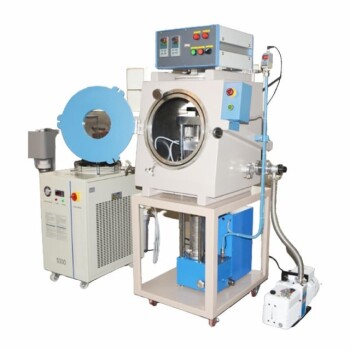
Most advanced material consolidation comes down to a single question of how pressure is delivered. Hot Isostatic Pressing (HIP) furnaces replace the uniaxial mechanical ram and rigid die of a traditional hot press with a cold-wall pressure vessel housing an internal resistance furnace. By pressurizing an inert gas—usually argon or helium—HIP applies uniform, omnidirectional pressure up to 200 MPa at temperatures reaching 2000 °C, completely bypassing the 20–50 MPa die-strength limit of conventional hot presses.
The structural leap from a die‑based ram to a gas‑pressurized cold‑wall vessel gives HIP an order‑of‑magnitude advantage in pressure, enabling full densification of complex shapes. That leap also demands encapsulation or pre‑sintering, making the economics and workflow fundamentally different from the simpler, uniaxial approach.
The Structural Architecture of HIP vs. Hot Press Furnaces
Cold-Wall Pressure Vessel vs. Rigid Die Assembly
A traditional hot press relies on a hydraulic ram that pushes two halves of a graphite die together, confining powder inside a rigid cavity. The die itself must withstand the applied load, which limits practical pressures to roughly 20–50 MPa before the die material fails.
A HIP furnace, by contrast, separates the load‑bearing function from the forming function. Its outer shell is a thick‑walled, water‑cooled pressure vessel that contains the high‑pressure gas. Inside, an electrical resistance furnace (graphite or molybdenum heating elements) sits behind layers of thermal insulation, completely independent of the pressure envelope.
Heating Elements and Insulation Layout
Both furnace types use resistance heating, but the physical arrangement differs dramatically. In a HIP vessel, the heating zone is suspended inside the cold wall, with robust insulation isolating the hot core from the water‑cooled shell. This cold‑wall design allows the vessel steel to remain below about 100 °C even as the internal workspace exceeds 2000 °C.
A conventional hot press mounts its die and heaters within an open‑frame or vacuum chamber, where the die itself acts as both heater (via direct current) and structural press member. Thermal insulation is far simpler, but the intimate contact between die and powder puts severe thermal‑mechanical stress on the graphite tooling.
Pressure Generation: Inert Gas vs. Hydraulic Ram
The most fundamental operational divergence is the pressure medium. Hot presses use uniaxial mechanical loading from a servo‑hydraulic ram. The pressure is directional, and the stress field inside the powder is inherently non‑uniform, with friction at the die walls creating gradients.
HIP furnaces replace the ram with a gas‑compression system. High‑purity argon or helium is pumped into the sealed vessel, applying isostatic pressure that is equal in all directions. No die is involved; the component is simply surrounded by gas. This yields a purely hydrostatic stress state that eliminates the shear strains and density gradients typical of uniaxial pressing.
Operational Capabilities and Resulting Material Outcomes
Pressure and Temperature Envelopes
Typical hot press ceilings sit at 50 MPa and 1800–2000 °C, constrained by the graphite die. HIP systems comfortably reach 150–200 MPa (some research units up to 250 MPa) at temperatures as high as 2000 °C, with specialist furnaces extending to 2200 °C. This combined pressure–temperature window allows HIP to suppress non‑densifying diffusion mechanisms and drive the material to theoretical density at lower temperatures or shorter cycles than a hot press could achieve.
Shape Complexity and Densification Homogeneity
Because HIP pressure is omnidirectional, it can consolidate complex, near‑net‑shape geometries—turbine blades, hip‑joint implants, or intricate ceramic cores—without the tooling limitations of a rigid die. The uniform hydrostatic pressure eliminates the density gradients and preferential grain orientation that uniaxial pressing often produces.
A hot press, applying force along a single axis, inevitably introduces shear strains and friction effects. This restricts it to simpler shapes, typically flat discs or rectangular blocks, and can leave microstructural anisotropy unless secondary deformation mechanisms like grain‑boundary sliding are carefully managed.
Encapsulation and Pre‑Processing Requirements
The HIP process cannot just pour powder into a chamber and pressurize. The high‑pressure gas would penetrate any interconnected porosity, locking in gas pockets and preventing full densification. Therefore, parts must either be sealed in a gas‑tight can (glass or metal) or pre‑sintered to closed porosity (typically >90–92% relative density). This encapsulation step adds cost, time, and the risk of can failure.
Hot pressing inherently solves this because the powder is directly loaded into a die, and pressing occurs under vacuum or controlled atmosphere. No canning is needed, which streamlines the workflow and removes a major failure mode.
Understanding the Trade‑offs
Cost and Productivity
HIP facilities carry a significant capital and operating expense. The pressure vessel, gas‑handling system, and safety infrastructure push equipment costs far above a comparable hot press. Process cycles run 1–8 hours, and the need for encapsulation or pre‑sintering extends the overall manufacturing chain. Consequently, HIP is almost always more expensive per part and less productive for simple shapes.
Process Simplicity and Risk of Encapsulation Failure
A vacuum hot press lets you load powder directly into a die, apply pressure and heat, and extract a finished billet. That simplicity eliminates the tedious canning and de‑canning steps, as well as the scrap risk if a can leaks. For many research labs and low‑volume producers, the direct powder‑to‑part workflow of a hot press is a decisive advantage.
When Uniaxial Pressing is Sufficient
If your target is a simple cylindrical pellet or rectangular plate, and you do not require absolute theoretical density or perfectly isotropic properties, a uniaxial hot press is often the more economical and logistically simpler choice. The densification at 50 MPa can achieve fully dense metals and high‑performance ceramics for many applications, especially if grain orientation is not a concern.
Making the Right Choice for Your Consolidation Goal
- If your primary focus is achieving absolute theoretical density with perfect microstructural homogeneity in a complex shape: Choose HIP. Its isostatic pressure eliminates density gradients and enables near‑net‑shape manufacturing that a uniaxial die cannot replicate.
- If your primary focus is minimizing processing cost and workflow complexity for simple geometries: A traditional vacuum hot press offers a direct powder‑to‑part route without the burden of encapsulation or high‑pressure gas handling.
- If your primary focus is balancing performance with scalability for ceramic or metal billets: Consider sinter‑forging or advanced multi‑die schemes first, reserving HIP for cases where full density cannot be achieved uniaxially.
- If your primary focus is fundamental research on a new material where encapsulation might contaminate samples: A hot press provides cleaner containment and easier atmosphere control, letting you focus on the material itself rather than the canning chemistry.
Every system’s design shapes what it can deliver. By mapping your part complexity, property demands, and pain tolerance for cost and process steps onto the structural differences described here, you will arrive at the right consolidation path—not simply a press, but a solution engineered for your specific densification challenge.
Summary Table:
| Feature / Parameter | Hot Isostatic Pressing (HIP) | Traditional Vacuum Hot Press |
|---|---|---|
| Pressure Medium | Inert Gas (Argon/Helium) | Hydraulic Ram & Graphite Die |
| Pressure Limit | High (150–200+ MPa) | Moderate (20–50 MPa) |
| Pressure Direction | Isostatic (Omnidirectional) | Uniaxial (Single axis) |
| Shape Complexity | Complex, near-net-shape geometries | Simple shapes (discs, plates, blocks) |
| Encapsulation | Required (canning or pre-sintering) | None (direct powder-to-part) |
| Core Advantage | 100% theoretical density, zero gradients | Lower cost, simpler workflow & fast turnarounds |
Looking to upgrade your lab's thermal processing capabilities? At KINTEK, we specialize in premium laboratory equipment and consumables, offering a comprehensive range of customizable high-temperature furnaces—including vacuum, atmosphere, muffle, tube, CVD, and induction melting systems. Whether you are researching advanced materials or scaling production, our team is ready to engineer a solution tailored to your exact specifications. Contact us today to consult with our experts!
Related Products
- High Pressure Laboratory Vacuum Tube Furnace
- 600T Vacuum Induction Hot Press Vacuum Heat Treat and Sintering Furnace
- Vacuum Hot Press Furnace Machine Heated Vacuum Press Tube Furnace
- Vacuum Hot Press Furnace Machine Heated Vacuum Press
- 9MPa Air Pressure Vacuum Heat Treat and Sintering Furnace
People Also Ask
- What role does a high vacuum tube furnace play in Co-Al sintering? Master High-Purity Porous Material Synthesis
- What are the different types of tube furnaces available? Find the Perfect Fit for Your Lab's Needs
- What are the main advantages of vacuum tube furnaces in the market? Achieve Purity and Precision in Material Processing
- What is the role of a vacuum tube furnace during the final thermal treatment stage of Fe3O4@CSAC catalysts?
- Why is a laboratory tube furnace necessary for BiVO4/RGO synthesis? Achieve Precise Nano-Structure Control