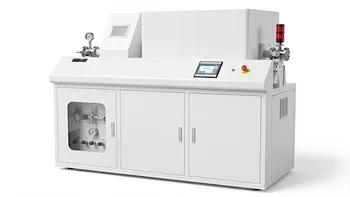
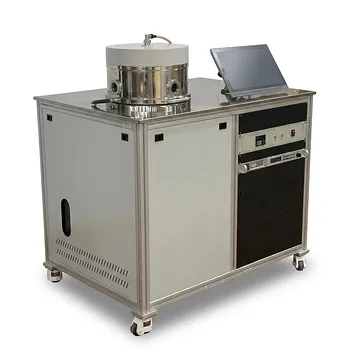
A vacuum tube furnace equipped with a rapid transfer rod is specifically designed for high-precision, short-duration heat treatments where the heating-up phase must be minimized. This specialized configuration allows researchers and engineers to perform accurate diffusion experiments, capture early-stage phase transformations, and study interface evolution on a scale of mere minutes.
This technology solves the problem of "thermal lag" by allowing samples to enter a preheated hot zone instantly, ensuring that the material experiences the target temperature for a precise, controlled duration.
The Mechanics of Rapid Thermal Exposure
Eliminating the Heating Ramp
In standard furnaces, the time taken to ramp up to temperatures like 1100°C can take hours, which obscures the results of short-term experiments. The rapid transfer rod bypasses this by moving the sample into the hot zone only after the furnace has reached a stable target temperature.
Precise Temporal Control
Because the transfer is near-instantaneous, the duration of the heat treatment is measured from the moment of insertion to the moment of extraction. This level of control is essential for experiments where the desired reaction or change occurs within a few minutes.
Controlled Vacuum Environment
Operating under vacuum or a specific atmosphere prevents oxidation and contamination during these high-temperature bursts. This ensures that the observed changes in the material are purely the result of thermal energy and time, not environmental interference.
High-Precision Research Applications
Short-Duration Diffusion Experiments
This setup is the gold standard for studying how atoms move through solids over very short intervals. It allows researchers to accurately map diffusion coefficients and observe how different materials begin to intermix at high temperatures.
Capturing Phase Transformations
Many materials undergo rapid structural changes (phase transformations) when exposed to heat. The rapid transfer rod allows scientists to "quench" or stop the process at a specific point, making it possible to see the early stages of transformation that would otherwise be lost during a slow heating ramp.
Interface Evolution Studies
When two different materials are joined, the boundary between them (the interface) changes rapidly at high temperatures. Using a transfer rod allows for the precise study of interface evolution, which is critical for developing better semiconductors and composite materials.
Advanced Material Synthesis and Processing
Graphene and Nanomaterial Growth
The production of advanced materials like graphene and carbon nanotubes often requires precise pulses of heat combined with Chemical Vapor Deposition (CVD). Short-term high-temperature treatments facilitate the growth of these thin films without damaging the underlying substrate.
Semiconductor Wafer Processing
In the electronics industry, rapid heat treatments are used for annealing silicon wafers and coating wires. The ability to apply heat quickly and then remove it prevents the "over-processing" of delicate micro-components.
Specialist Ceramic Sintering
Manufacturing components like silicon carbide rings and bearings requires extreme heat. A transfer rod can be used to test how these ceramics react to sudden thermal shocks, simulating real-world conditions in high-performance engines or aerospace applications.
Understanding the Trade-offs
Thermal Shock Risks
The most significant risk of using a rapid transfer rod is thermal shock to the sample or the sample holder. Moving a cold material instantly into an 1100°C environment can cause brittle materials, such as certain ceramics, to crack or shatter.
Sample Size Limitations
Rapid transfer rods are typically designed for smaller research samples rather than bulk industrial parts. The mechanical constraints of the rod and the tube diameter mean that this precision is often traded for limited throughput compared to large-scale vacuum furnaces.
Mechanical Complexity
Adding a moving transfer rod to a vacuum system introduces more potential leak points and mechanical failure risks. Maintaining the vacuum seal while moving a physical rod into a high-heat zone requires more frequent maintenance and more sophisticated hardware than a static furnace.
How to Apply This to Your Project
Making the Right Choice for Your Goal
- If your primary focus is fundamental materials research: Use the rapid transfer rod to isolate the exact moment phase transformations begin during short-term exposure.
- If your primary focus is industrial metal hardening: Stick to standard vacuum furnaces for processes like tempering or carburizing, where the bulk mass of the parts requires a slower, more uniform heating ramp.
- If your primary focus is semiconductor or thin-film development: Leverage the quick-insertion capability to minimize the "thermal budget" of your substrate and prevent unwanted diffusion.
- If your primary focus is high-temperature synthesis: Use the vacuum environment and rapid movement to precisely control chemical reactions like CVD for nanomaterial growth.
By eliminating the variables introduced by slow heating cycles, the rapid transfer rod transforms a standard furnace into a high-precision instrument for temporal material science.
Summary Table:
| Application Area | Key Use Case | Core Advantage |
|---|---|---|
| Materials Research | Diffusion & Interface Evolution | Eliminates thermal lag for accurate temporal data |
| Phase Transformation | Capturing early-stage changes | Near-instantaneous heating and quenching capability |
| Nanotechnology | Graphene & CNT Growth (CVD) | Minimizes thermal budget to protect substrates |
| Semiconductors | Wafer Annealing & Coating | Prevents over-processing of delicate micro-components |
| Ceramics | Thermal Shock Testing | Simulates extreme real-world high-performance conditions |
Elevate Your Research Precision with KINTEK
Ready to achieve unprecedented control in your thermal processing? KINTEK specializes in high-performance laboratory equipment, offering a comprehensive range of high-temperature furnaces—including muffle, tube, rotary, vacuum, CVD, and dental systems.
Whether you need a vacuum tube furnace with a rapid transfer rod for precise diffusion studies or a custom-built solution for unique atmospheric needs, we provide the reliability and expertise your project demands. Our furnaces are fully customizable to ensure they meet your exact experimental parameters.
Contact KINTEK Today to Find Your Perfect Heating Solution
References
- Aurélie Vande Put, Daniel Monceau. Pt Effect on the Bond-Coating/Superalloy Interdiffusion: Case of a Pt-Modified NiCoCrAlYTa Coating. DOI: 10.1007/s11085-024-10314-2
This article is also based on technical information from Kintek Furnace Knowledge Base .
Related Products
- Vacuum Sealed Continuous Working Rotary Tube Furnace Rotating Tube Furnace
- Split Chamber CVD Tube Furnace with Vacuum Station CVD Machine
- Laboratory Quartz Tube Furnace RTP Heating Tubular Furnace
- Laboratory Vacuum Tilt Rotary Tube Furnace Rotating Tube Furnace
- High Pressure Laboratory Vacuum Tube Furnace
People Also Ask
- What is the purpose of rotary tube furnaces? Achieve Uniform Heat Treatment for Powders and Granules
- What are the key advantages of using a rotary tube furnace? Achieve Dynamic, Uniform Heating for Powders
- How does the amount of material processed vary between batch and continuous rotary tube furnaces? Scale Your Production Efficiently
- What are the advantages of rotary tube furnaces in fuel compatibility? Boost Efficiency and Cut Costs
- What is the temperature range of some rotary tube furnaces? Achieve Uniform Heating Up to 1200°C