
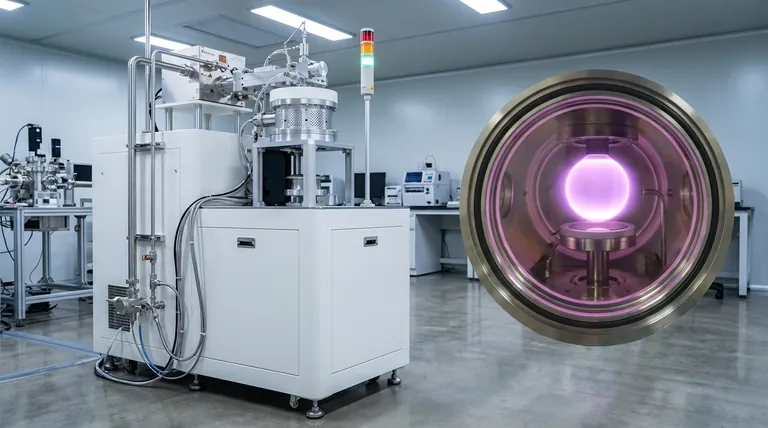
The essential components of a Microwave Plasma Chemical Vapor Deposition (MPCVD) reactor work together as a highly controlled system to create diamond from gas. At its core, the system uses a microwave generator to create plasma in a vacuum chamber, a gas delivery system to supply precursor gases like methane and hydrogen, a substrate stage to hold the material, and a vacuum system to maintain purity and pressure. Supporting these are critical control elements like temperature sensors, power tuners, and cooling circuits.
An MPCVD reactor is not just a collection of hardware; it is an integrated environment engineered for one purpose: to use focused microwave energy to create a pure, high-density plasma cloud, allowing carbon atoms to meticulously arrange themselves into a high-quality diamond film on a substrate.
The Core Principle: From Gas to Diamond
The fundamental goal of an MPCVD reactor is to create an environment where carbon-containing gas can be broken down efficiently and then deposited as a crystalline diamond structure. This is a process of controlled deconstruction and reconstruction at the atomic level.
Generating the Plasma
The process begins with microwave energy. A microwave generator, typically a magnetron, produces high-frequency electromagnetic waves. These waves are channeled through a waveguide into the deposition chamber.
This energy excites the electrons within the precursor gases (e.g., hydrogen and methane), causing them to oscillate and collide violently. This chain reaction strips electrons from the gas molecules, transforming the gas into an energized, reactive state known as plasma.
Containing the Reaction
The deposition chamber is the heart of the system. It is a sealed, high-vacuum vessel designed to contain the plasma and the deposition process.
Inside, a substrate stage holds the material (the substrate) where the diamond will grow. The chamber must be kept impeccably clean, as any impurities can disrupt the diamond's crystal structure. Viewports are included to allow for observation and measurement.
Delivering the Fuel
A gas delivery system, consisting of mass flow controllers and tubing, precisely injects the precursor gases into the chamber.
The ratio of these gases—typically a small amount of methane (the carbon source) in a large amount of hydrogen—is a critical parameter. The hydrogen plasma is essential for selectively etching away any non-diamond carbon (like graphite), ensuring a pure diamond film grows.
The Critical Control Systems
The quality of the diamond film depends entirely on the precise control of several key parameters. The supporting components of the reactor are dedicated to managing this complex environment.
Microwave Power and Tuning
The microwave generator provides the power, but the stub tuner is used to fine-tune the microwave coupling. It ensures that maximum energy is delivered to the gas to create a stable, well-defined plasma ball centered over the substrate.
The Vacuum Environment
A vacuum system, composed of pumps and gauges, serves two purposes. First, it removes all air and contaminants from the chamber before deposition begins. Second, it maintains the extremely low operating pressure required for stable plasma and uniform diamond growth.
Substrate Temperature Management
Substrate temperature is one of the most important variables affecting diamond quality. A heater is often integrated into the substrate stage to bring it to the optimal temperature (typically 700-1000°C).
An optical pyrometer is used to measure this temperature accurately from outside the chamber without physical contact, which is crucial in the extreme plasma environment.
System Cooling
The process generates intense heat. A controlled temperature water circulator (chiller) is essential for cooling the magnetron, the chamber walls, and the vacuum seals. This prevents overheating and ensures the long-term stability and reliability of the entire system.
Understanding the Key Advantages of MPCVD
The complexity of an MPCVD system is justified by the significant advantages it offers over other deposition methods, directly stemming from its unique design.
Purity: No Electrode Contamination
Unlike other plasma generation methods, MPCVD is "electrodeless." The plasma is generated by microwaves, meaning there are no internal metal electrodes that can erode and contaminate the growing diamond film. This results in exceptionally high-purity diamonds.
Stability and Scale: Large-Area Plasma
The microwave-generated plasma is remarkably stable and can be sustained over a large area without touching the chamber walls. This prevents contamination from the vessel itself and allows for uniform deposition across larger substrates, which is critical for industrial applications.
Control: Precision Leads to Quality
The combination of these components provides operators with precise, independent control over gas mixture, pressure, temperature, and power. This high degree of control is what makes the process reproducible and capable of producing consistently high-quality diamond films.
Efficiency: High Growth Rates
Modern MPCVD systems are highly efficient, capable of achieving high growth rates (up to 150 μm/h). This, combined with reproducible quality and scalability, makes the method cost-effective for both research and commercial production compared to other techniques.
Making the Right Choice for Your Goal
Understanding the function of each component allows you to focus your efforts based on your specific objective.
- If your primary focus is research and development: Your control over the gas mixture, substrate temperature, and microwave power density are your most powerful variables for exploring novel diamond properties.
- If your primary focus is industrial production: The stability of the plasma, the reliability of the vacuum system, and the precision of temperature control are paramount for ensuring high yield and reproducible quality.
- If your primary focus is system design or maintenance: The integrity of vacuum seals, the efficiency of the cooling system, and the calibration of the optical pyrometer are the most common points of failure and require diligent attention.
Ultimately, mastering an MPCVD system is about understanding how each component contributes to creating the perfect, isolated environment for diamond to grow atom by atom.
Summary Table:
| Component | Function |
|---|---|
| Microwave Generator | Generates high-frequency waves to create plasma |
| Deposition Chamber | Sealed vessel for plasma containment and diamond growth |
| Gas Delivery System | Precisely injects precursor gases like methane and hydrogen |
| Substrate Stage | Holds material for diamond deposition with temperature control |
| Vacuum System | Maintains low pressure and removes contaminants |
| Stub Tuner | Fine-tunes microwave coupling for stable plasma |
| Optical Pyrometer | Measures substrate temperature without contact |
| Cooling System | Prevents overheating of components for reliability |
Ready to elevate your diamond film deposition? KINTEK leverages exceptional R&D and in-house manufacturing to provide advanced MPCVD reactors tailored for diverse laboratories. Our product line, including Muffle, Tube, Rotary Furnaces, Vacuum & Atmosphere Furnaces, and CVD/PECVD Systems, is enhanced by strong deep customization capabilities to precisely meet your unique experimental needs—whether for research, industrial production, or system optimization. Contact us today to discuss how our solutions can boost your efficiency and quality!
Visual Guide

Related Products
- 915MHz MPCVD Diamond Machine Microwave Plasma Chemical Vapor Deposition System Reactor
- MPCVD Machine System Reactor Bell-jar Resonator for Lab and Diamond Growth
- Cylindrical Resonator MPCVD Machine System for Lab Diamond Growth
- Inclined Rotary Plasma Enhanced Chemical Deposition PECVD Tube Furnace Machine
- Inclined Rotary Plasma Enhanced Chemical Deposition PECVD Tube Furnace Machine
People Also Ask
- What is the MPCVD method and why is it considered effective for diamond deposition? Superior Purity & High Growth Rates
- What factors influence the quality of diamond deposition in the MPCVD method? Master the Critical Parameters for High-Quality Diamond Growth
- What are some key features and benefits of the microwave plasma chemical vapor deposition system? Achieve Unmatched Material Synthesis
- What is the purpose of a microwave plasma chemical vapor deposition system? Grow High-Purity Diamonds and Advanced Materials
- What is the basic principle of operation for the microwave plasma chemical vapor deposition system? Unlock High-Purity Material Growth









