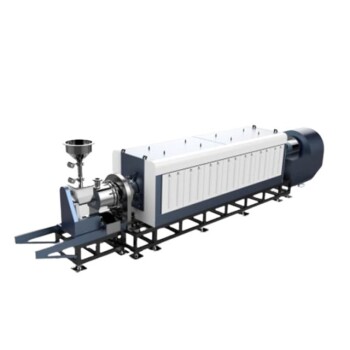
High-temperature pyrolysis devices are the essential engines of nitrogen-doped biochar synthesis. These furnaces provide a strictly controlled, oxygen-free thermal environment that facilitates the decomposition of biomass and the simultaneous chemical integration of nitrogen atoms. By precisely managing temperature and atmosphere, these devices transform raw organic precursors into stable, porous, and highly conductive carbon materials.
The core function of these devices is to provide a precise thermal field and inert atmosphere that enables the simultaneous carbonization of biomass and the embedding of nitrogen, resulting in a material with high electrical conductivity and superior electrochemical activity.
Precision Thermal Management for Structural Transformation
Facilitating Carbonization and Bond Cleavage
The primary role of the furnace is to provide the high temperatures—often ranging from 700°C to 1000°C—necessary to break C-O and C-C bonds within the biomass. This process drives off volatile components and initiates the transition from a loose organic structure to a stable carbon framework.
Enabling Aromatic Rearrangement
As the temperature rises, the furnace induces aromatic rearrangement, where carbon atoms align into graphitized layers. This structural shift is critical for enhancing the electrical conductivity of the biochar, making it suitable for applications in energy storage and catalysis.
Precise Control of Heating Rates
By accurately managing the heating rate and holding time, the furnace ensures that chemical reactions like dehydrogenation and decarboxylation occur uniformly. This level of control prevents structural collapse and ensures the resulting biochar maintains a consistent chemical stability.
Atmosphere Control and Chemical Functionalization
Maintaining an Inert Environment
Pyrolysis furnaces provide a sealed, oxygen-deficient environment, typically maintained by a continuous flow of nitrogen gas. This inert atmosphere is vital to prevent the combustion of the biomass, allowing it to carbonize rather than turn to ash.
Facilitating Nitrogen Embedding
In nitrogen-doped synthesis, the device allows for the co-pyrolysis of biomass with nitrogen sources like urea. The stable thermal field enables nitrogen atoms to embed themselves directly into the carbon skeleton, creating abundant chemical adsorption sites and enhancing charge transfer capabilities.
Driving Gas-Phase Etching
In specialized setups, these devices facilitate the Boudouard reaction by managing the interaction between carbon and evolved CO2. This process etches the biochar surface at a molecular level, creating a dense network of micropores that significantly increases the material's total surface area.
Engineering the Porous Architecture
Template-Assisted Pore Formation
When using additives like oyster shells or sodium bicarbonate, the furnace facilitates the thermal decomposition of these materials into hard templates (like CaO). These templates act as physical spacers during carbonization, leading to the formation of mesopores once the templates are later removed.
Determining Specific Surface Area
The furnace’s temperature precision directly dictates the final surface roughness and pore volume of the biochar. Achieving a high specific surface area—sometimes exceeding 340 m²/g—is entirely dependent on maintaining the optimal thermal window to prevent pore sintering or over-shrinkage.
Understanding the Trade-offs and Limitations
Temperature vs. Functional Group Retention
While higher temperatures (above 800°C) increase graphitization and conductivity, they often lead to a decrease in the total amount of surface functional groups. This can reduce the number of active sites available for specific chemical reactions or pollutant adsorption.
Energy Consumption and Scaling
High-temperature furnaces require significant energy input to maintain stable thermal fields over long durations. Furthermore, maintaining a perfectly sealed inert atmosphere becomes increasingly complex as the scale of the furnace increases from laboratory tubes to industrial-sized reactors.
Risk of Pore Blockage
If the heating rate is too rapid or the nitrogen source is improperly mixed, volatile gasses can become trapped or cause excessive foaming. This can lead to a clogged pore structure, negating the benefits of the high-temperature treatment and reducing the material's effectiveness as a catalyst support.
Applying Furnace Parameters to Your Synthesis Goals
Strategic Recommendation for Material Design
To achieve the best results with your pyrolysis device, align your temperature and atmosphere settings with your specific performance requirements.
- If your primary focus is high electrical conductivity: Operate the furnace at temperatures of 700°C or higher to maximize the formation of graphitized carbon layers.
- If your primary focus is maximum surface area: Incorporate gas-etching precursors and utilize a slower heating rate to allow for the gradual development of microporous networks.
- If your primary focus is high nitrogen content: Target a moderate temperature range (around 600°C to 700°C) to ensure nitrogen embedding occurs without excessive thermal desorbing of the nitrogen atoms.
By mastering the thermal and atmospheric variables of these devices, you can transform simple biomass into a highly engineered, functional carbon material.
Summary Table:
| Core Function | Thermal Mechanism | Key Synthesis Outcome |
|---|---|---|
| Carbonization | 700°C – 1000°C bond cleavage | Stable carbon framework |
| Graphitization | Aromatic rearrangement | Enhanced electrical conductivity |
| Atmosphere Control | Inert nitrogen flow | Prevents combustion/ash formation |
| Nitrogen Doping | Co-pyrolysis with nitrogen sources | Increased electrochemical activity |
| Pore Engineering | Gas etching & template assistance | High surface area (>340 m²/g) |
Optimize Your Biochar Synthesis with KINTEK Precision
Achieving the perfect balance of conductivity and surface area requires absolute control over your thermal environment. KINTEK specializes in advanced laboratory equipment, offering a comprehensive range of high-temperature furnaces, including tube, CVD, muffle, vacuum, and atmosphere furnaces, all fully customizable to meet your specific research parameters.
Whether you are scaling up nitrogen-doped biochar production or engineering complex carbon catalysts, our expertise ensures your lab has the reliability and precision it needs.
Ready to enhance your material performance? Contact KINTEK today to find the ideal furnace for your application!
References
- Gopi KrishnaBhonagiri, Shilpa ChakraCH. Development of metal free biochar based material for water electrolysis hydrogen production using anion exchange membrane: Creating circular economy. DOI: 10.59429/ace.v7i2.1871
This article is also based on technical information from Kintek Furnace Knowledge Base .
Related Products
- 1400℃ High Temperature Laboratory Tube Furnace with Alumina Tube
- 1700℃ High Temperature Laboratory Tube Furnace with Alumina Tube
- 1200℃ Split Tube Furnace Laboratory Quartz Tube Furnace with Quartz Tube
- Vertical Laboratory Quartz Tube Furnace Tubular Furnace
- 1200℃ Muffle Oven Furnace for Laboratory
People Also Ask
- How does zone-melting in tube furnaces synthesize bismuth micro-wires? Master Single-Crystal Thermoelectric Growth
- How do high-temperature laboratory tube furnaces ensure environmental stability? Precision Thermal Reduction Tips
- How are high-temp tube furnaces used to measure diffusion coefficients per Fick's law? Master Precision Annealing
- How are high-temperature laboratory tube furnaces applied in long-term vacuum homogenization heat treatments for intermetallic samples?
- How are high-temperature tube furnaces applied in testing ceramic-supported alloy membranes? Insights