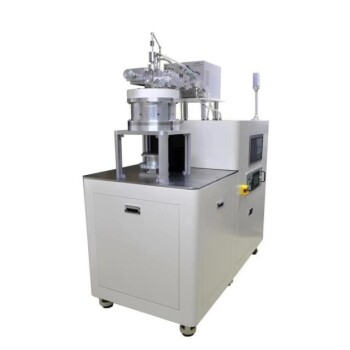
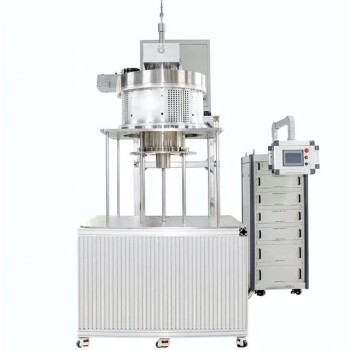
SPS laboratory equipment transforms the way researchers consolidate ceramic powders by combining pulsed electric current with uniaxial pressure to achieve near‑full densification in minutes—at temperatures far below those of conventional sintering. This radical acceleration suppresses grain growth, preserves nanoscale microstructures, and unlocks material properties that would be impossible to obtain with traditional kiln‑based methods.
SPS is not simply a faster furnace; it is a precision consolidation platform that gives you direct, real‑time control over the sintering trajectory, making it the definitive tool for engineering dense, fine‑grained ceramic compacts from nanopowders to ultra‑high‑temperature ceramics.
How SPS Works: The Core Mechanism
Pulsed Current and Internal Joule Heating
SPS passes high‑amperage, low‑voltage pulsed DC current directly through a conductive graphite die that holds the ceramic powder.
The current flows through the die and, particularly in early stages, through the powder compact itself.
This direct electrical heating circumvents the sluggish radiative heating of conventional furnaces, making heating rates of 600 °C/min (and up to 1000 °C/min) routine.
The rapid temperature rise is further amplified by microscopic spark discharges between particles, which clean surfaces and enhance mass transport.
Uniaxial Pressure as a Densification Accelerator
Simultaneously, a uniaxial mechanical pressure—typically 30 to 60 MPa—is applied through the punches.
This pressure adds a powerful thermodynamic driving force for pore elimination.
The combination of heat and pressure collapses pores in minutes rather than hours, enabling fully dense ceramics at temperatures 100–300 °C lower than pressureless sintering.
Non‑Contact Temperature Control
Temperature is monitored and controlled with an optical pyrometer aimed at the external die wall.
This non‑contact approach allows for precise thermal profiles while avoiding probe‑induced contamination.
Key Capabilities for Ceramic Compacts
Near‑Full Densification at Unmatched Speed
The most immediate capability is the ability to reach >99 % of theoretical density in 5–20 minutes of holding time.
This rapid consolidation bypasses many of the slow, diffusion‑limited processes that delay sintering in a conventional furnace.
Suppression of Grain Growth
For ceramic compacts, the true value lies in locking in the nanostructure.
Because the time‑at‑temperature is so short, grain boundaries barely move. You can start with 50 nm powder and finish with a 100–200 nm fully dense ceramic body—an impossibility in conventional sintering, where coarsening dominates.
Enhanced Material Response Through Field Effects
The pulsed current is not only a heat source; it also creates electro‑migration and plasma activation effects that strip oxide layers from particle surfaces.
This increases sinterability, notably in difficult‑to‑process ceramics like titanium diboride and silicon carbide, where surface contaminants would otherwise impede densification.
In‑Situ Dilatometry and Creep Testing
The precision punches of an SPS system act as a high‑temperature dilatometer with micrometer‑level displacement resolution.
By tracking relative punch displacement under controlled stress and temperature, you can measure high‑temperature creep deformation directly inside the sintering tool.
This capability turns your SPS into a powerful research instrument for determining stress exponents and activation energies of fine‑grained ceramics at 1100–1200 °C.
Net‑Shape and Complex Geometry Potential
Modern SPS tooling allows near‑net‑shape processing of ceramic compacts.
With custom graphite die inserts, parts can be sintered to final—or near‑final—dimensions, dramatically reducing post‑machining of hardened ceramics.
Porosity Control for Functional Ceramics
By intentionally limiting the applied pressure or interrupting the sintering cycle, researchers can engineer tailored porous structures.
This capability is crucial for bio‑scaffolds, filtration membranes, and lightweight thermal insulators where a controlled pore size and distribution are essential.
Practical Applications in Ceramics Research
Nanostructured Oxide Ceramics
SPS is the go‑to method for consolidating transparent or mechanically enhanced alumina, zirconia, and YAG nanopowders.
The resulting compacts exhibit hardness and strength values that scale with the retained nanoscale grain size, enabling studies on Hall‑Petch strengthening in bulk ceramics.
Ultra‑High‑Temperature Ceramics (UHTCs)
Materials like titanium diboride (TiB₂) and silicon carbide (SiC) represent the extreme of sintering challenges.
SPS enables full densification of SiC at 1800 °C in just 10 minutes, while TiB₂ reaches near‑full density within minutes at lower temperatures.
In both cases, the rapid cycle prevents destructive grain coarsening and yields compacts with exceptional Vickers hardness and flexural strength.
Bioceramics and Composites
For hydroxyapatite‑based composites, low‑temperature SPS (as low as 900 °C) prevents thermal decomposition of the bioceramic phase.
The short holding time also inhibits unwanted diffusion between the ceramic matrix and reinforcing metal or polymer particulates, preserving the designed microstructure.
Fiber‑Reinforced Ceramic Matrix Composites
When sintering ceramic compacts that contain carbon or SiC fibers, the brief high‑temperature exposure is the key enabler.
SPS limits the contact time between the fibers and the ceramic matrix, suppressing harmful interfacial reactions that would otherwise embrittle the composite.
Understanding the Trade‑offs
Graphite Contamination
The graphite die and punches can introduce carbon into the ceramic compact, especially on the surface.
This may be benign for dark‑colored ceramics but can discolor transparent oxides or alter electrical properties. Post‑annealing or protective coatings (e.g., BN spray) are common mitigations.
Temperature Measurement Uncertainty
The optical pyrometer measures the die wall temperature, not the sample core temperature.
Heat generation inside the powder compact can lead to a temperature gradient that is not captured; this must be calibrated, especially for large or electrically resistive samples.
Geometry Limitations
Uniaxial pressure confines SPS to shapes that can be ejected from a rigid die.
True net‑shape complexity is limited without sophisticated die designs, and internal undercuts are impossible. Isostatic pressing remains unmatched for the highest geometric freedom.
Sample Size and Throughput
Laboratory SPS systems typically process discs of 10–40 mm diameter.
Scaling to larger parts requires substantial tooling and can introduce radial temperature gradients that compromise uniformity.
Anisotropic Properties
Uniaxial pressure can induce texture or anisotropic residual stresses in some ceramics.
Researchers must verify that the observed mechanical properties are not artifacts of the pressing direction.
Making the Right Choice for Your Research Goal
SPS is not a one‑size‑fits‑all solution, but it excels when you need to surpass the limits of traditional sintering. Choose your approach based on your primary objective:
- If your primary focus is preserving a nano‑grain structure: Leverage the highest possible heating rates and shortest dwell times to freeze the as‑milled grain size in a fully dense body.
- If your primary focus is densifying a non‑oxide UHTC: Use SPS as the only viable route to full density at moderate temperatures without extensive sintering aids that degrade high‑temperature performance.
- If your primary focus is studying sintering and creep mechanisms: Deploy your SPS as an in‑situ dilatometer, taking advantage of continuous displacement data and atmospheric control to build accurate kinetic models.
- If your primary focus is producing small, complex‑shaped ceramic components: Invest in custom near‑net tooling to directly sinter parts that require minimal diamond grinding afterward.
- If your primary focus is engineering a specific porosity level: Program your pressure and temperature profile to arrest densification at the exact stage that yields your desired pore network.
When you match your goal to the unique capabilities of SPS, you turn a consolidation step into a true material design tool—and that is where the real power of this laboratory equipment lies.
Summary Table:
| Capability / Feature | Key Mechanism | Main Benefits & Applications |
|---|---|---|
| Rapid Densification | Pulsed DC current (Joule heating up to 1000 °C/min) + Uniaxial pressure (30–60 MPa) | Achieves >99% density in 5–20 mins; lowers required temperatures by 100–300 °C. |
| Nano-Grain Retention | Minimal dwell time at high temperature halts grain boundary movement | Preserves nanoscale microstructures (50 nm to 100–200 nm body) for enhanced strength. |
| Surface Activation | Field effects & micro-discharge strip surface oxide contamination | Sintering of difficult UHTCs (SiC, TiB₂) without excessive sintering aids. |
| In-Situ Dilatometry | Precision punches measure continuous micro-displacement under load | Enables direct measurement of high-temp creep, activation energy, and kinetics. |
| Tailored Porosity | Precise control of pressure interruption and heating profiles | Customized pore networks for bio-scaffolds, thermal barriers, and filtration media. |
Unlock Advanced Material Performance with KINTEK
Ready to transform your ceramics research and achieve full densification without sacrificing microstructural integrity? KINTEK offers state-of-the-art laboratory equipment and consumables, featuring fully customizable high-temperature furnace solutions—including SPS systems, vacuum, atmosphere, tube, and muffle furnaces designed for extreme thermal precision.
Whether you are engineering next-generation UHTCs, functional bioceramics, or nanostructured oxides, our expertise ensures your lab receives reliable, high-performance equipment tailored to your exact experimental parameters.
Contact KINTEK today to elevate your research efficiency and discuss custom equipment options!
Related Products
- Spark Plasma Sintering SPS Furnace
- Small Vacuum Heat Treat and Tungsten Wire Sintering Furnace
- High Temperature Muffle Oven Furnace for Laboratory Debinding and Pre Sintering
- Chairside Dental Porcelain Zirconia Sintering Furnace with Transformer for Ceramic Restorations
- Dental Porcelain Zirconia Sintering Ceramic Vacuum Press Furnace
People Also Ask
- Why is it necessary to maintain a high vacuum environment during the SPS of SiC? Key to High-Density Ceramics
- How does the heating mechanism of Spark Plasma Sintering (SPS) function? Enhance TiC/SiC Composite Fabrication
- What are the technical advantages of using an SPS sintering furnace? Elevate Al2O3-TiC Material Performance
- What are the advantages of Spark Plasma Sintering (SPS)? Achieve Superior Microstructures
- What are the steps in the discharge plasma sintering process? Master Fast, High-Density Material Consolidation