
Alumina tube furnaces are a cornerstone of modern thermal processing, serving as a versatile tool in research labs and industrial production. Their applications span materials processing, chemical synthesis, and advanced research, enabling everything from creating semiconductors to testing materials for aerospace.
The power of an alumina tube furnace is not just its ability to reach high temperatures. Its true value lies in providing an exceptionally uniform and precisely controlled atmospheric environment, making it the ideal tool for processes where consistency and purity are paramount.
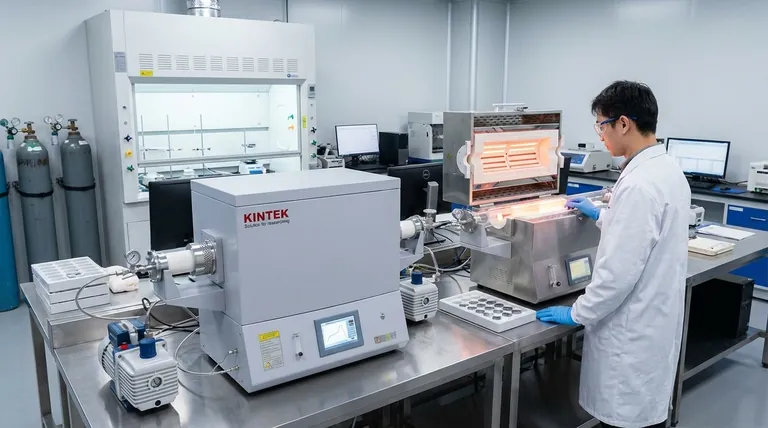
The Three Pillars of Application: Temperature, Atmosphere, and Uniformity
To understand the furnace's wide-ranging use, you must first understand its three core capabilities. Every application is built upon one or more of these foundational pillars.
Pillar 1: Achieving High Temperatures for Thermal Transformation
Alumina (aluminum oxide, Al₂O₃) is a highly stable ceramic that can withstand extreme heat without degrading. This makes it the ideal material for the furnace's process tube.
This high-temperature capability is essential for processes that fundamentally change a material's structure, such as sintering powdered metals or ceramics into a solid mass, annealing to relieve internal stresses, or melting small samples.
Pillar 2: Mastering the Environment with Atmospheric Control
The defining feature of a tube furnace is its enclosed, cylindrical chamber. This design makes it easy to seal and control the internal atmosphere.
You can operate the furnace under a vacuum to remove contaminants, with an inert gas (like argon or nitrogen) to prevent oxidation, or with a reactive gas to create specific chemical reactions on a material's surface, such as in Chemical Vapor Deposition (CVD).
Pillar 3: Ensuring Consistency with Thermal Uniformity
The heating elements are typically arranged symmetrically around the process tube. This creates a highly uniform temperature profile along a central "hot zone."
This precision is critical for applications like crystal growth, where even minor temperature fluctuations can ruin the result, or for the accurate calibration of temperature sensors like thermocouples.
Core Application Domains in Practice
These three pillars enable the tube furnace to excel in several key domains.
Advanced Materials Processing & Heat Treatment
This is the most common use case. The furnace provides the precise thermal energy and environmental control needed to modify a material's physical properties.
Key applications include sintering parts for powder metallurgy, annealing semiconductor wafers, hardening or tempering metal components, and drying sensitive samples without contamination.
Precise Chemical Synthesis & Reactions
The ability to control both temperature and atmosphere makes the tube furnace a miniature chemical reactor. It is indispensable for synthesizing materials that are impossible to create in open air.
This includes growing nanomaterials like carbon nanotubes and graphene, performing thermal decomposition of chemical precursors, and facilitating catalyst testing by passing reactive gases over a heated catalyst bed.
Foundational Research & Sample Preparation
In a research setting, repeatability is everything. The tube furnace provides the stable, controlled environment needed for materials testing and sample preparation for other analytical techniques.
Common uses are ashing organic samples to determine inorganic content, creating high-purity materials through purification and sublimation, and performing accelerated aging tests to study material degradation.
Understanding the Trade-offs and Limitations
While incredibly versatile, the alumina tube furnace is not the solution for every thermal problem. Objectivity requires acknowledging its limitations.
Limited Sample Volume
The tube's diameter inherently restricts the size and throughput of samples. For processing large components or high-volume batches, a box or conveyor furnace is often a more practical choice.
Thermal Shock Sensitivity
Alumina is a ceramic and can be brittle. Heating or cooling the tube too quickly can cause thermal shock, leading to cracks. This requires careful, programmed temperature ramping, which can increase process time.
System Complexity and Cost
A basic furnace is straightforward, but systems equipped for advanced atmospheric control—with vacuum pumps, mass flow controllers, and gas lines—are significantly more complex and expensive than simple ovens or box furnaces.
Making the Right Choice for Your Goal
To select the right approach, you must align the furnace's capabilities with your primary objective.
- If your primary focus is synthesizing novel materials (e.g., CVD, crystal growth): Prioritize a system with advanced atmospheric control and multi-zone heating for superior uniformity.
- If your primary focus is routine heat treatment or sample preparation (e.g., annealing, ashing): A single-zone furnace with reliable temperature control is often sufficient and more cost-effective.
- If your primary focus is processing large or numerous samples: You must assess if the limited volume of a tube furnace is a bottleneck, as a box or batch furnace might be more appropriate.
Ultimately, understanding these core principles allows you to leverage the tube furnace not just as a heater, but as a precision instrument for material innovation.
Summary Table:
| Application Domain | Key Uses | Core Capabilities Utilized |
|---|---|---|
| Materials Processing & Heat Treatment | Sintering, annealing, hardening, tempering, drying | High-temperature stability, thermal uniformity |
| Chemical Synthesis & Reactions | CVD, nanomaterial growth, catalyst testing, thermal decomposition | Atmospheric control, precise temperature |
| Research & Sample Preparation | Ashing, purification, accelerated aging, crystal growth | Uniform heating, environmental consistency |
Elevate your lab's capabilities with KINTEK's advanced high-temperature furnace solutions!
Leveraging exceptional R&D and in-house manufacturing, we provide diverse laboratories with tailored alumina tube furnaces and more, including Muffle, Tube, Rotary Furnaces, Vacuum & Atmosphere Furnaces, and CVD/PECVD Systems. Our strong deep customization capability ensures precise alignment with your unique experimental needs, whether for materials processing, chemical synthesis, or cutting-edge research.
Contact us today to discuss how our solutions can enhance your efficiency and results!
Visual Guide

Related Products
- 1400℃ High Temperature Laboratory Tube Furnace with Alumina Tube
- 1700℃ High Temperature Laboratory Tube Furnace with Alumina Tube
- Magnesium Extraction and Purification Condensing Tube Furnace
- Vertical Laboratory Quartz Tube Furnace Tubular Furnace
- High Pressure Laboratory Vacuum Tube Furnace
People Also Ask
- How do high-temperature laboratory tube furnaces ensure environmental stability? Precision Thermal Reduction Tips
- How are high-temperature laboratory tube furnaces applied in long-term vacuum homogenization heat treatments for intermetallic samples?
- How are high-temperature tube furnaces applied in testing ceramic-supported alloy membranes? Insights
- How does a laboratory high-temperature tube furnace contribute to the conversion of electrospun fibers? Expert Insights
- What is the mechanism of a high-temperature furnace in Bi-2223 sintering? Achieve Precision Phase Transformation



















