
A deep understanding of Chemical Vapor Deposition (CVD) principles is the critical difference between applying a simple coating and engineering a true performance-enhancing surface. By moving beyond a surface-level specification and engaging with the process, you can achieve superior precision, durability, and functional versatility in your components, directly boosting product reliability and competitive advantage.
The greatest benefits of CVD are unlocked not by simply ordering a coating, but by treating it as an integral part of the design process. A strategic, collaborative approach based on core principles transforms the coating from a commodity finish into a critical, performance-defining feature.
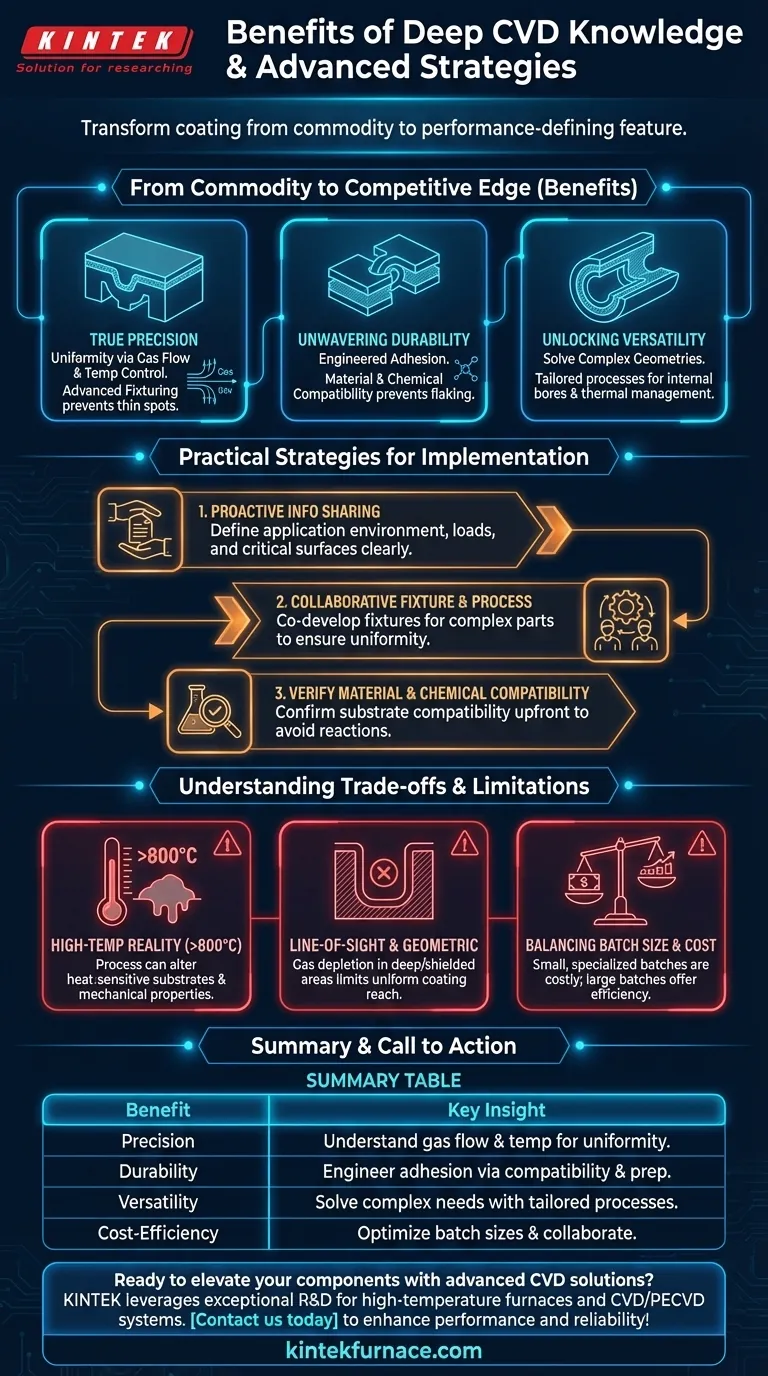
From Commodity to Competitive Edge: Why Deep CVD Knowledge Matters
Viewing CVD as a simple, final "finishing step" is a significant missed opportunity. True optimization requires understanding the interplay between the process, the substrate, and the intended application.
Beyond the Spec Sheet: Achieving True Precision
A coating that is technically "in spec" for thickness can still fail if it's not uniform. Understanding the principles of gas flow dynamics, temperature uniformity, and reactant depletion allows you to address this.
This knowledge informs advanced fixture design, which is about more than just holding a part. A well-designed fixture ensures that reactive gases reach all critical surfaces evenly, preventing thin spots or build-up that can compromise performance.
Engineering for Unwavering Durability
A coating's durability is fundamentally linked to its adhesion to the substrate. This adhesion is not guaranteed; it must be engineered.
Factors like substrate material selection, surface finish, and cleanliness are paramount. More importantly, understanding the chemical compatibility between the coating chemistry and the base material prevents unwanted reactions or poor bonding that can lead to flaking, chipping, or premature failure.
Unlocking Versatility for Complex Applications
A basic understanding of CVD limits you to standard applications. A deeper knowledge allows for creative problem-solving and the coating of complex geometries.
By collaborating with a coating expert, you can develop tailored processes to address challenges like coating internal bores, managing thermal expansion mismatches between the coating and substrate, or achieving specific functional properties beyond simple hardness.
Practical Strategies for Implementing CVD Excellence
Translating principles into results requires a deliberate and strategic approach. The following strategies are essential for moving from theory to tangible improvement in your components.
Strategy 1: Proactive and Detailed Information Sharing
The most common failure point is a lack of communication. Your coating provider needs to understand the problem the coating is meant to solve, not just the part number.
Clearly define the application environment, including loads, temperatures, and chemical exposure. Crucially, identify the critical functional surfaces on your part so the process can be optimized to protect them.
Strategy 2: Collaborative Fixture and Process Development
Do not leave fixturing solely to the provider. Engage in collaborative development to ensure the fixtures meet both your part's requirements and the needs of the CVD process.
This is especially critical for parts with complex shapes or internal passages, where standard fixturing will almost certainly lead to non-uniform results.
Strategy 3: Verifying Material and Chemical Compatibility
Before committing to a production run, confirm that your chosen substrate is compatible with both the specific CVD process and the final coating.
This involves checking for potential negative interactions. For example, some materials can "poison" the chemical reaction, while others may be altered by the process temperatures. This upfront verification saves significant time and cost.
Understanding the Trade-offs and Limitations
Even an optimized CVD process has inherent constraints. Acknowledging these limitations is key to making sound engineering decisions and avoiding costly mistakes.
The High-Temperature Reality
Most traditional CVD processes operate at very high temperatures (often >800°C). This can be a major constraint.
These temperatures can anneal, temper, or distort heat-sensitive materials, altering their core mechanical properties. You must ensure your substrate material can withstand the processing temperature without compromising its integrity.
Line-of-Sight and Geometric Constraints
While CVD is known for its excellent conformality, it is not magic. The process is still fundamentally line-of-sight, meaning reactive gases must be able to flow to a surface to coat it.
Deep, narrow holes or complex, shielded internal cavities can be extremely difficult to coat uniformly due to gas depletion, where the reactive chemicals are used up before reaching the deepest areas.
Balancing Batch Size and Cost
CVD is a batch process, and its economics are tied to scale. The reactor setup, heating cycle, and processing time are significant cost drivers.
Small, highly specialized batches are expensive on a per-part basis. Conversely, leveraging quantity break pricing on larger batches offers significant cost efficiency but requires a greater upfront investment in validated fixtures and process controls.
Making the Right Choice for Your Goal
Your strategy for implementing CVD should align directly with your primary objective for the component.
- If your primary focus is maximum performance and reliability: Engage in deep, collaborative development with your coating expert from the initial design phase to co-engineer the part, fixture, and process.
- If your primary focus is cost-efficiency for an established product: Standardize your process and optimize batch sizes to leverage the economic advantages of large-scale production.
- If your primary focus is solving a novel or complex challenge: Prioritize upfront validation of material compatibility and invest heavily in collaborative fixture design to ensure process feasibility before scaling.
By engaging with these core principles, you transform a coating from a simple layer into an integral, performance-defining component of your product.
Summary Table:
| Benefit | Key Insight |
|---|---|
| Precision | Understand gas flow and temperature for uniform coatings, avoiding failures. |
| Durability | Engineer adhesion through substrate compatibility and surface preparation. |
| Versatility | Solve complex geometries and functional needs with tailored CVD processes. |
| Cost-Efficiency | Optimize batch sizes and collaborative strategies for better economics. |
Ready to elevate your components with advanced CVD solutions? KINTEK leverages exceptional R&D and in-house manufacturing to provide high-temperature furnace solutions like Muffle, Tube, Rotary Furnaces, Vacuum & Atmosphere Furnaces, and CVD/PECVD Systems. Our deep customization capabilities ensure your unique experimental requirements are met precisely. Contact us today to discuss how we can enhance your product's performance and reliability!
Visual Guide
Related Products
- Custom Made Versatile CVD Tube Furnace Chemical Vapor Deposition CVD Equipment Machine
- Split Chamber CVD Tube Furnace with Vacuum Station CVD Machine
- Multi Heating Zones CVD Tube Furnace Machine for Chemical Vapor Deposition Equipment
- Slide PECVD Tube Furnace with Liquid Gasifier PECVD Machine
- Inclined Rotary Plasma Enhanced Chemical Deposition PECVD Tube Furnace Machine
People Also Ask
- Why are CVD tube furnace sintering systems indispensable for 2D material research and production? Unlock Atomic-Scale Precision
- What is a CVD tube furnace and what is its primary function? Discover Precision Thin-Film Deposition
- Which industries and research fields benefit from CVD tube furnace sintering systems for 2D materials? Unlock Next-Gen Tech Innovations
- How does CVD tube furnace sintering enhance graphene growth? Achieve Superior Crystallinity and High Electron Mobility
- What are the benefits of developing new precursor materials for CVD tube furnaces? Unlock Advanced Thin-Film Synthesis



















