For sintering hard metals like WC-Co, the required atmosphere is dictated not by the material alone, but by the duration of the thermal cycle. Conventional sintering, with its hours-long holding times, makes a controlled vacuum or inert gas atmosphere absolutely essential to prevent catastrophic oxidation. In contrast, rapid electric pulse processes can achieve full densification in air, often with holding times as brief as 500 milliseconds, because the material simply isn't hot long enough for significant surface reactions to occur.
While conventional liquid-phase sintering of WC-Co relies on meticulously controlled atmospheres (vacuum or inert gases like argon) to prevent oxidation, ensure proper wetting, and facilitate degasification over long cycles, ultra-fast single-pulse resistance sintering can densify these hard metals in open air. The key differentiator is kinetic—oxidation is a time-dependent reaction, and a sub-second process effectively outruns it. However, this speed introduces its own trade-offs in microstructural control and geometric flexibility.
The Atmosphere Demands of Conventional Sintering
For standard laboratory or industrial processes, a high-temperature furnace without a controlled atmosphere is a non-starter for hard metals. The requirement isn't just about keeping the parts shiny; it's foundational to the physics of liquid-phase sintering.
The Oxidation Risk Over Long Thermal Cycles
WC-Co powders oxidize rapidly when heated in air. Cobalt oxides form on particle surfaces, which hinder densification and embrittle the final compact.
Conventional cycles involve slow ramps and holding times of 30 minutes to several hours. At temperatures around 1400-1500°C, even trace oxygen levels will degrade the powder surfaces long before the liquid phase can do its work.
A vacuum or high-purity inert gas (argon, nitrogen, or forming gas) displaces oxygen, preserving the clean metallic surfaces needed for diffusion and sintering.
The Role of Atmosphere in Liquid-Phase Sintering
WC-Co sintering relies on liquid-phase formation, where cobalt melts and wets the tungsten carbide grains. This environment must be chemically pristine.
The process follows a sequence: compact degasification, atmosphere establishment, heating to the liquid-phase temperature. A poor atmosphere causes liquid oxidation, which raises viscosity and prevents proper wetting. This leads to porosity instead of full densification.
Furthermore, an inadequate atmosphere fails to remove trapped gases. These gases can cause compact swelling as they expand during heating, ruining dimensional stability.
Equipment as the Enabler of Reproducibility
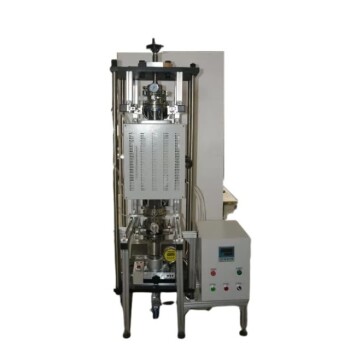
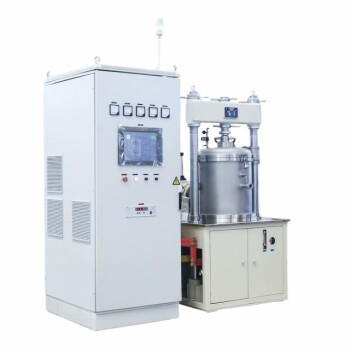
Atmosphere and vacuum furnaces are therefore the cornerstone of reliable hard metal sintering. They provide the precise, repeatable thermal profiles that guarantee uniform densification, especially for complex shapes.
Without this control, localized overheating or microstructural inhomogeneity is inevitable, resulting in parts with inconsistent hardness and fracture toughness.
How Rapid Electric Pulse Sintering Changes the Rules
Ultra-fast consolidation methods, such as high-density single-pulse resistance sintering, invert the conventional wisdom on atmosphere control. Their secret is not chemistry, but sheer speed.
Outrunning Oxidation Through Kinetic Control
These processes pass an enormous electrical current through the powder compact for a matter of milliseconds. The entire sintering cycle—heating, holding, and cooling—is over in less than a second.
Oxidation is a thermally activated, time-dependent chemical reaction. At 500 ms of hold time, the total exposure to high temperature is simply too short for a damaging oxide scale to nucleate and grow on the particle surfaces.
The result is a dense, cohesive part produced directly in air, without any vacuum chamber or shielding gas.
The Process Window: Speed Over Stability
This approach bypasses the classic liquid-phase sintering sequence. The heating rate is so extreme (thousands of degrees per second) that traditional solution-reprecipitation mechanisms may be compressed or altered.
Densification is driven by intense localized Joule heating at particle contacts, coupled with rapid plastic deformation. The entire powder mass is consolidated before oxidation can become a performance-limiting factor.
Understanding the Trade-offs: Speed vs. Control
The divergence in atmosphere requirements highlights a fundamental engineering trade-off. You are choosing between a process that eliminates the risk of oxidation through environmental control, and one that makes the risk irrelevant through extreme speed.
The Trade-off in Microstructural Uniformity
Conventional controlled-atmosphere sintering, with its slow, equilibrium-driven heating, allows for uniform grain growth and liquid-phase wetting throughout the entire compact. This yields predictable, homogeneous microstructures and properties, especially in large parts.
Rapid electric pulse sintering, by its nature, can create steep thermal gradients within the compact. The core and the periphery may experience different thermal histories, leading to microstructural inhomogeneity and potentially less predictable mechanical properties in complex geometries.
The Trade-off in Geometric Complexity
A vacuum furnace can accommodate complex-shaped parts with varying cross-sections. The slow, uniform heating ensures the entire body reaches the target temperature without thermal shock distortion.
Single-pulse resistance sintering is typically best suited for simple, near-net shapes between flat electrodes. The uniaxial current path and rapid expansion can cause cracking or non-uniform densification in geometrically complex components.
The Trade-off in Process Control and Repeatability
Conventional processes offer decades of established, repeatable thermal profiles. You can dial in the heating rate, hold time, and cooling rate with a high degree of certainty, which is critical for quality assurance in aerospace or tooling applications.
Ultra-fast methods require exquisite control over the electrical pulse parameters (current, voltage, pulse duration). Small variations in powder packing or electrode contact can lead to large differences in the final part density, making batch-to-batch repeatability a more significant challenge to engineer.
Making the Right Choice for Your Goal
The "correct" atmosphere requirement is a direct consequence of your chosen process and its inherent compromises. Your selection should be driven by your ultimate objective for the component.
- If your primary focus is achieving the highest, most uniform quality for complex WC-Co tooling: A conventional high-temperature vacuum or atmosphere furnace remains the gold standard by actively eliminating oxidation and enabling equilibrium liquid-phase sintering.
- If your primary focus is ultra-rapid prototyping or research into grain-growth suppression in simple shapes: A rapid electric pulse process in air offers a compelling advantage by completely side-stepping the need for elaborate atmospheric infrastructure.
- If your primary focus is a balance of speed and control for moderate-complexity parts: Field-assisted or rapid radiation heating methods under a protective atmosphere can offer a middle ground, but they reintroduce some of the conventional equipment constraints.
The atmosphere you need is ultimately a mirror reflecting your tolerance for the enduring trade-off between the metallurgical perfection of slow, controlled equilibrium and the kinetic convenience of extreme speed.
Summary Table:
| Process Parameter | Conventional Sintering | Rapid Electric Pulse Sintering |
|---|---|---|
| Atmosphere Requirement | Strict Vacuum or Inert Gas (Argon/Forming Gas) | Open Air (No protective gas required) |
| Cycle Duration | Slow ramp + long hold (30 min to hours) | Ultra-fast (< 1 second / milliseconds) |
| Oxidation Defense | Environmental isolation (prevents oxygen exposure) | Kinetic control (outruns time-dependent reaction) |
| Geometric Compatibility | High (Complex 3D geometries & varying sections) | Limited (Simple, near-net shapes between electrodes) |
| Microstructural Control | High uniformity (Equilibrium liquid-phase sintering) | Potential gradients (Rapid localized Joule heating) |
Master Your Sintering Processes with KINTEK Precision Furnaces
Whether you need precise vacuum environments, controlled atmosphere handling, or customized heating profiles for WC-Co and hard metal densification, KINTEK provides the advanced thermal processing solutions your lab demands. We specialize in high-performance laboratory equipment and consumables, offering a complete line of high-temperature furnaces—including vacuum, atmosphere, muffle, tube, CVD, rotary, and induction melting furnaces—all fully customizable to meet your exact research and production needs.
Achieve predictable microstructures, prevent unwanted oxidation, and elevate your material quality. Contact KINTEK today to discuss your customized furnace requirements!
Related Products
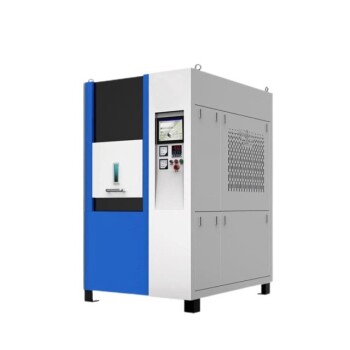
- Vacuum Heat Treat Sintering Furnace with Pressure for Vacuum Sintering
- Spark Plasma Sintering SPS Furnace
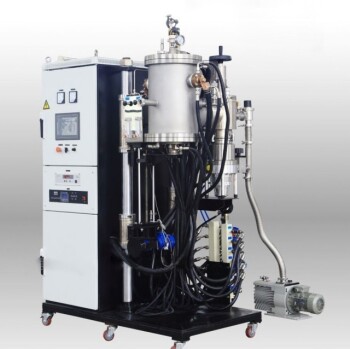
- Vacuum Heat Treat Sintering Furnace Molybdenum Wire Vacuum Sintering Furnace
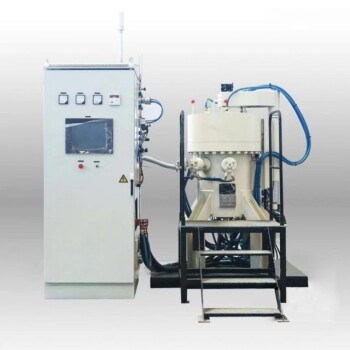
- Small Vacuum Heat Treat and Tungsten Wire Sintering Furnace
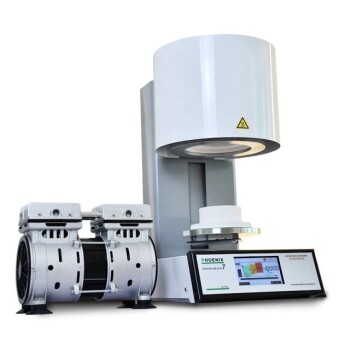
- Vacuum Dental Porcelain Sintering Furnace for Dental Laboratories
People Also Ask
- How does vacuum heat treating affect the grain structure of metal alloys? Achieve Precise Microstructure Control
- What is one of the most important uses of vacuum heat treating furnaces in aerospace? Achieve Superior Strength in Aircraft Alloys
- What are the benefits of using vacuum heat treating furnaces for metal alloys? Achieve Superior Metal Properties and Performance
- What are the key components of a vacuum sintering furnace? Essential Parts for Precision Material Processing
- What is the purpose of setting a mid-temperature dwell stage? Eliminate Defects in Vacuum Sintering