
At its core, a box type resistance furnace is valued for its exceptional control and versatility. The primary advantages are highly accurate temperature regulation, the ability to handle a wide range of materials and processes, and a simple, reliable structure that is easy to operate and maintain.
While many tools can generate heat, the true value of a box type resistance furnace lies in its ability to deliver that heat with precision and stability. This transforms it from a simple oven into a critical instrument for achieving repeatable, high-quality results in material science, research, and small-scale production.
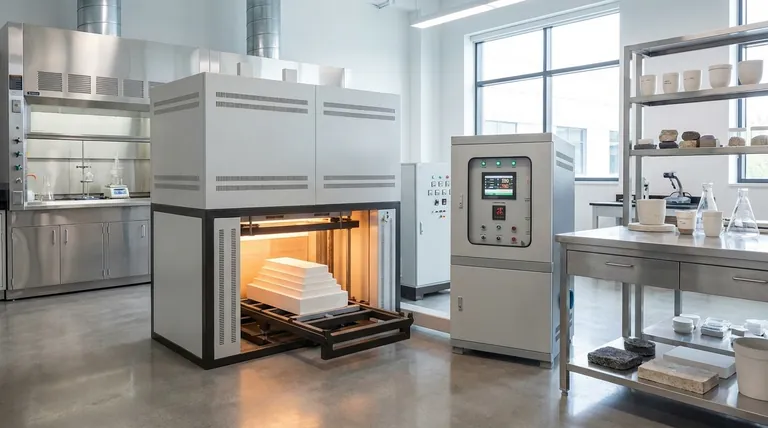
The Core Advantages: Precision, Versatility, and Control
A box furnace's design principles directly translate into tangible benefits for laboratory and industrial applications. These advantages center on creating a highly controlled and repeatable thermal environment.
Unmatched Temperature Precision and Stability
The most significant advantage is the ability to precisely manage temperature. These furnaces use sophisticated controllers and high-quality heating elements to achieve this.
This results in high temperature stability and accurate temperature control, often monitored via a clear digital display. This precision is not just a feature; it is a prerequisite for processes where slight temperature deviations can ruin a sample or batch.
Versatility Across Processes and Materials
Box furnaces are not single-purpose tools. Their design makes them suitable for a wide variety of high-temperature applications.
They are widely used for processes like heat treatment, sintering, dissolution, and analysis of materials ranging from metals to ceramics. This multifunctionality allows a single piece of equipment to serve many different research or production needs, improving the return on investment.
Controllable Atmospheres for Sensitive Work
Many modern material processes cannot be performed in ambient air. Box furnaces address this with well-designed chambers.
They offer good sealing capabilities, which are essential for creating an inert gas or vacuum environment. This prevents oxidation and other unwanted chemical reactions, protecting the integrity of the material being processed.
Simplicity in Operation and Maintenance
Despite their advanced capabilities, box type resistance furnaces are built on a foundation of operational simplicity.
They feature a simple structure that facilitates easy maintenance and troubleshooting. Modern units often include automatic temperature and time controls, making them straightforward to operate and reducing the potential for user error.
Understanding the Practical Considerations
The advantages of a box furnace are realized through proper selection and disciplined operation. Ignoring these factors can undermine the equipment's performance and safety.
The Importance of Operational Discipline
A furnace is a powerful tool that demands respect. To ensure safety and longevity, users must adhere to strict protocols.
Always follow the manufacturer's instructions for operation and perform regular maintenance. This is critical for ensuring consistent performance and preventing unexpected failures.
Furthermore, operators must be trained on all safety precautions for high-temperature work. Familiarity with the furnace's safety regulations is non-negotiable.
Matching the Furnace to Your Process Needs
Not all box furnaces are created equal. The key is to select a unit whose specifications align with your specific application.
Carefully consider your required temperature range, temperature uniformity, and atmosphere control needs. A furnace that is mismatched to the process requirements will fail to deliver the desired material properties, such as hardness or corrosion resistance.
Evaluating Total Cost of Ownership
The initial purchase price is only part of the investment. A smart evaluation looks at the complete lifecycle cost.
Pay close attention to the energy efficiency and ongoing maintenance costs of the equipment. A more efficient furnace may have a higher upfront cost but can provide a better long-term return on investment through lower operational expenses.
Making the Right Choice for Your Application
Selecting the right box type resistance furnace requires aligning its features with your primary goal.
- If your primary focus is high-purity material processing: Prioritize a model with superior atmosphere control (vacuum or inert gas) and documented temperature uniformity across the chamber.
- If your primary focus is general lab research and testing: A versatile, multifunctional unit with simple automated controls and a wide temperature range offers the best value.
- If your primary focus is cost-effective production: Carefully evaluate the energy efficiency, heating speed, and maintenance requirements to ensure a low total cost of ownership.
By understanding how these advantages align with your specific needs, you can select an instrument that will be a reliable and effective asset for years to come.
Summary Table:
| Advantage | Description |
|---|---|
| Temperature Precision | Highly accurate and stable temperature control for reliable results. |
| Versatility | Suitable for heat treatment, sintering, and more across diverse materials. |
| Atmosphere Control | Good sealing for inert gas or vacuum environments to prevent oxidation. |
| Ease of Use | Simple structure with automated controls for easy operation and maintenance. |
Ready to enhance your laboratory's capabilities with a high-performance furnace? At KINTEK, we leverage exceptional R&D and in-house manufacturing to provide advanced high-temperature solutions tailored to your needs. Our product line includes Muffle, Tube, Rotary Furnaces, Vacuum & Atmosphere Furnaces, and CVD/PECVD Systems, all backed by strong deep customization to meet your unique experimental requirements. Contact us today to discuss how our furnaces can deliver precise control, versatility, and reliability for your material science, research, or production processes!
Visual Guide

Related Products
- Mesh Belt Controlled Atmosphere Furnace Inert Nitrogen Atmosphere Furnace
- High Pressure Laboratory Vacuum Tube Furnace
- Vertical Laboratory Quartz Tube Furnace Tubular Furnace
- Multi Zone Laboratory Quartz Tube Furnace Tubular Furnace
- 1200℃ Controlled Inert Nitrogen Atmosphere Furnace
People Also Ask
- How is a controlled atmosphere furnace used in material research? Achieve Precise Material Synthesis and Heat Treatment
- What are the two main purposes of controlled atmosphere conditions in furnaces? Protect or Transform Materials for Peak Performance
- How does a controlled atmosphere furnace improve product quality and consistency? Master Precise Heat Treatment for Superior Results
- What types of gases can a controlled atmosphere furnace handle? Master Inert and Reactive Gases for Your Lab
- What types of furnaces have controlled atmosphere furnaces largely replaced? Boost Metallurgical Precision & Safety


















