To improve vacuum pump performance, you must focus on two key areas: reducing the vapor pressure of the pump's working fluid and minimizing or eliminating gas loads from your vacuum system. For liquid ring pumps, this most directly means keeping the working fluid—typically water—as cool and clean as possible, as higher water temperatures create higher vapor pressure, which directly limits the ultimate vacuum the pump can achieve.
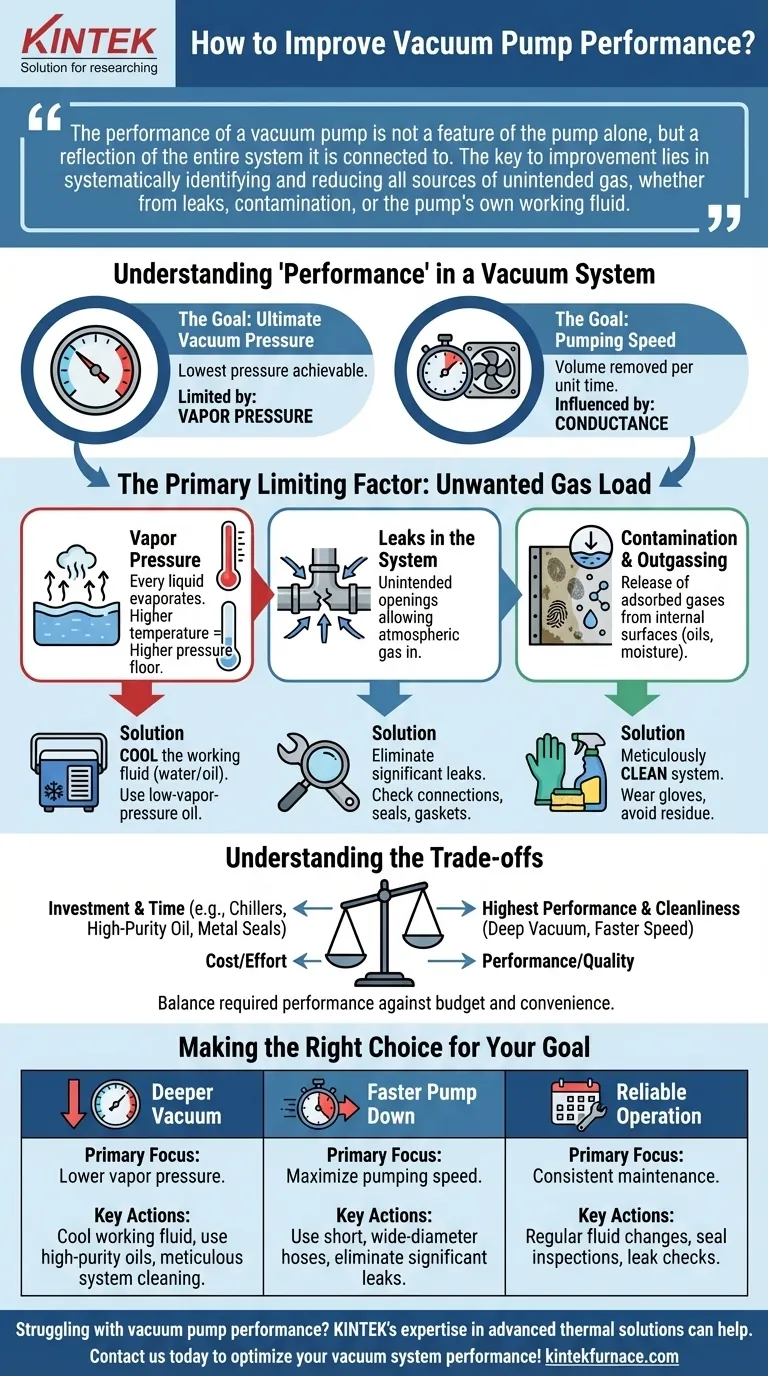
The performance of a vacuum pump is not a feature of the pump alone, but a reflection of the entire system it is connected to. The key to improvement lies in systematically identifying and reducing all sources of unintended gas, whether from leaks, contamination, or the pump's own working fluid.
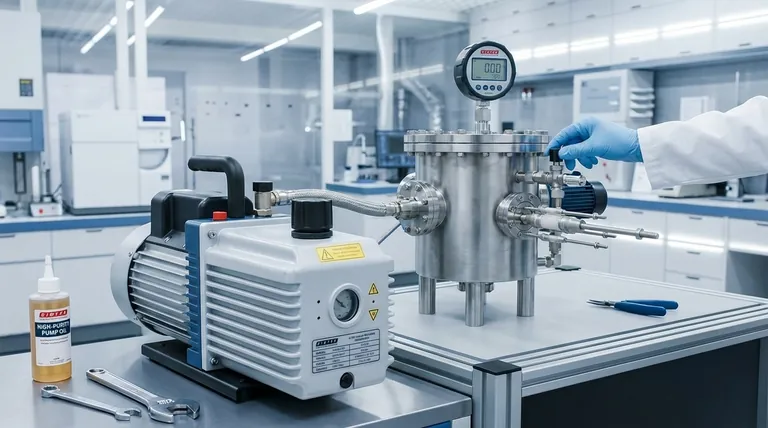
Understanding "Performance" in a Vacuum System
Before making improvements, it is critical to define what "performance" means. It is not a single metric but a balance of two distinct goals.
The Goal: Ultimate Vacuum Pressure
Ultimate vacuum is the lowest pressure a pump can achieve in a perfect, sealed system with no gas load. It represents the physical limit of the pump.
This limit is often dictated by the vapor pressure of the pump's own sealing fluid, whether it is oil in a rotary vane pump or water in a liquid ring pump.
The Goal: Pumping Speed
Pumping speed, or throughput, is the volume of gas a pump can remove from a system per unit of time. It determines how fast you can reach your target pressure.
Speed is heavily influenced by the conductance of your system—the ease with which gas can flow from your chamber to the pump inlet.
The Primary Limiting Factor: Unwanted Gas Load
A vacuum pump is constantly working against gases entering the system. Your pump's performance is a direct result of its ability to overcome this total gas load.
The Critical Role of Vapor Pressure
Every liquid has a tendency to evaporate, creating a gas pressure known as vapor pressure. This pressure is highly dependent on temperature.
For a circulating water vacuum pump, like one with a 15-liter tank, the water heats up during operation. As the water temperature rises, its vapor pressure increases, creating an internal gas load. This effectively places a "floor" on the pressure, preventing the pump from reaching its specified ultimate vacuum of -0.098 MPa (2 kPa). Cooling the water is the most direct way to lower this pressure floor.
The same principle applies to oil-sealed pumps. Contaminated oil (with water or solvents) or using the wrong type of oil leads to high vapor pressure and poor performance.
Leaks in the System
A leak is any unintended opening that allows atmospheric gas into your vacuum system. Even a microscopic leak can introduce a significant gas load that overwhelms the pump.
Common leak points include hose connections, chamber seals, and worn-out gaskets. A system can never be pumped down below the pressure at which the leak rate equals the pump's speed.
Contamination and Outgassing
Outgassing is the release of adsorbed gases and vapors from the internal surfaces of your vacuum chamber. Sources include fingerprints (oils), cleaning residues, and moisture trapped in materials.
Under vacuum, these contaminants turn into gas, creating a persistent internal load that slows down pumping and can prevent the system from reaching a deep vacuum.
Understanding the Trade-offs
Improving performance involves making deliberate choices, and it's essential to understand the associated compromises.
Cost vs. Performance
Achieving the highest levels of performance requires investment. A water chiller to cool a liquid ring pump, high-purity low-vapor-pressure oil for a rotary vane pump, or metal-sealed high-vacuum components all come at a significant cost. You must balance the required performance against your budget.
Convenience vs. Cleanliness
Proper vacuum practice demands discipline. Thoroughly cleaning all components before placing them in the chamber and always wearing gloves takes time but is non-negotiable for high-vacuum applications. Skipping these steps for convenience will always compromise your ultimate pressure.
The Pump is Only One Part of the Equation
Investing in a powerful pump is useless if it is connected to a dirty, leaky system with restrictive tubing. The overall performance is always limited by the weakest link in the chain. A well-maintained, clean, and leak-tight system with a modest pump will always outperform a high-end pump on a poorly managed system.
Making the Right Choice for Your Goal
To effectively improve performance, align your actions with your primary objective.
- If your primary focus is reaching the deepest possible vacuum: Your priority is to lower the vapor pressure by cooling your pump's working fluid and using high-purity oils, while meticulously cleaning your system to eliminate outgassing.
- If your primary focus is pumping down faster: Your priority is to maximize conductance by using short, wide-diameter hoses and to find and eliminate any significant leaks in the system.
- If your primary focus is consistent, reliable operation: Your priority is to establish a strict maintenance schedule for changing pump fluid, inspecting seals, and regularly leak-checking the entire system.
Ultimately, optimizing your vacuum pump's performance requires shifting your perspective from the pump itself to the entire system as a whole.
Summary Table:
| Goal | Primary Focus | Key Actions |
|---|---|---|
| Deeper Vacuum | Lower vapor pressure | Cool working fluid, use high-purity oils, meticulous system cleaning |
| Faster Pump Down | Maximize pumping speed | Use short, wide-diameter hoses, eliminate significant leaks |
| Reliable Operation | Consistent maintenance | Regular fluid changes, seal inspections, leak checks |
Struggling with vacuum pump performance? KINTEK's expertise in advanced thermal solutions can help. Our high-temperature furnaces, including Vacuum & Atmosphere models, are engineered for optimal performance in demanding laboratory environments. Leveraging exceptional R&D and in-house manufacturing, we provide deep customization to precisely meet your unique experimental requirements.
Contact us today to discuss how we can optimize your vacuum system performance – Get in touch now!
Visual Guide
Related Products
- Vacuum Hot Press Furnace Machine Heated Vacuum Press
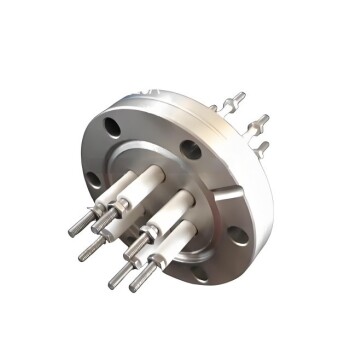
- CF KF Flange Vacuum Electrode Feedthrough Lead Sealing Assembly for Vacuum Systems
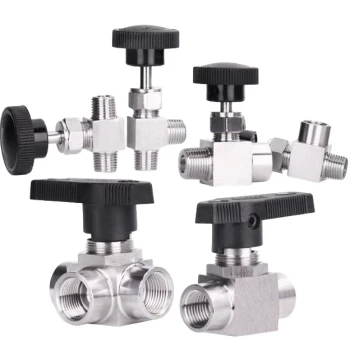
- 304 316 Stainless Steel High Vacuum Ball Stop Valve for Vacuum Systems
- Vacuum Hot Press Furnace Machine for Lamination and Heating
- Vacuum Hot Press Furnace Machine Heated Vacuum Press Tube Furnace
People Also Ask
- What are the primary components of a vacuum hot press furnace? Master the Core Systems for Precise Material Processing
- What safety features are incorporated in vacuum hot press furnaces? Ensure Operator and Equipment Protection
- What are the benefits of the vacuum environment system in a vacuum hot press furnace? Unlock High-Density Sintering
- What types of heating elements are used in vacuum hot press furnaces? Optimize for High-Temp Performance
- What are the core advantages of using a vacuum hot press furnace? Achieve Near-Forged Density for Ti-6Al-4V Alloys