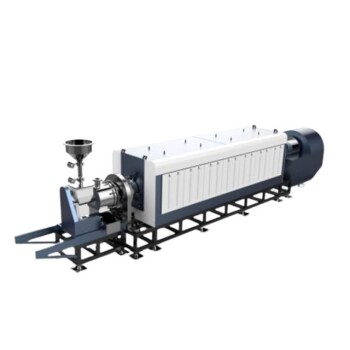
The high-temperature muffle furnace is the primary thermal reactor used to convert plantain and banana biomass into heterogeneous solid catalysts through a process known as calcination. By subjecting dried biomass to a controlled, oxygen-rich environment at temperatures typically between 550°C and 700°C, the furnace facilitates the thermal decomposition of organic tissues. This process results in the formation of highly alkaline ash rich in active chemical components like potassium oxide (K2O), calcium oxide (CaO), and magnesium oxide (MgO), which are essential for driving chemical reactions such as biodiesel transesterification.
Core Takeaway: The muffle furnace provides the precise thermal energy required to strip away organic matter and transform the mineral content of biomass into a porous, chemically active solid base catalyst.
The Mechanism of Thermal Transformation
Thermal Decomposition of Organic Matter
The muffle furnace acts as the environment for thermochemical decomposition, where organic components and volatile compounds are completely removed from the plant powder. At temperatures exceeding 500°C, the carbonaceous structure of the banana or plantain skins is incinerated, leaving behind inorganic mineral residues.
Synthesis of Active Metal Oxides
During calcination, the furnace triggers the conversion of naturally occurring minerals and carbonates within the biomass into catalytically active metal oxides. Specifically, it facilitates the transition of potassium and calcium elements into oxides like K2O and CaO, which serve as the "active sites" required for heterogeneous catalysis.
Development of Porous Microstructures
The stable heating environment of a muffle furnace is critical for inducing phase transformations that increase the specific surface area of the resulting ash. By carefully controlling the temperature, researchers can ensure the resulting catalyst is highly porous, allowing reactants to access the active sites more efficiently during chemical processing.
The Impact on Catalyst Performance
Exposure of Catalytic Active Sites
A muffle furnace ensures that the catalytic active sites are fully exposed by removing the organic matrix that previously shielded them. Without this high-temperature treatment, the biomass remains a raw material rather than a functional catalyst capable of facilitating industrial reactions.
Ensuring Chemical Stability
The furnace provides a stable thermal environment that allows for the uniform distribution of heat throughout the sample. This uniformity is vital for creating a consistent chemical structure, ensuring the catalyst performs reliably during repeated cycles of biodiesel production.
Verification of Ash Quality
Beyond synthesis, the muffle furnace is utilized to determine the ash content of the raw biomass. Precise ashing allows researchers to evaluate if a specific batch of plantain or banana waste contains sufficient mineral concentration to be a viable feedstock for catalyst production.
Understanding the Trade-offs
Temperature Sensitivity and Sintering
One of the primary risks in using a muffle furnace is sintering, which occurs if temperatures exceed the optimal range (often above 900°C). Overheating can cause the pores of the catalyst to collapse and the particles to fuse, significantly reducing the surface area and overall catalytic activity.
Energy Consumption vs. Yield
High-temperature calcination is an energy-intensive process that requires several hours of sustained heating to achieve complete conversion. While higher temperatures may produce a higher purity of metal oxides, the economic trade-off between energy costs and catalyst performance must be carefully balanced for large-scale production.
Variability in Feedstock Composition
The effectiveness of the furnace treatment is highly dependent on the inherent mineral makeup of the biomass. If the plantain or banana waste has low initial potassium or calcium levels, even the most precise furnace treatment will fail to produce a high-activity catalyst.
How to Apply This to Your Project
Recommendations for Catalyst Synthesis
- If your primary focus is maximizing catalytic activity: Calcine the biomass between 600°C and 700°C for at least 3 to 4 hours to ensure the full conversion of carbonates to active oxides.
- If your primary focus is cost-efficiency and energy savings: Utilize the furnace to determine the ash content first, ensuring only high-mineral-content biomass batches undergo full high-temperature calcination.
- If your primary focus is catalyst longevity and reusability: Maintain a strict upper temperature limit of 800°C to prevent sintering and preserve the porous structure of the alkaline ash.
Through precise thermal control, the muffle furnace transforms agricultural waste into a high-value technical asset for sustainable chemical synthesis.
Summary Table:
| Process Stage | Temperature Range | Key Outcome/Transformation |
|---|---|---|
| Decomposition | > 500°C | Complete removal of organic matter and volatiles |
| Calcination | 550°C – 700°C | Conversion of minerals into active oxides (K2O, CaO, MgO) |
| Activation | Sustained Heat | Exposure of active sites and development of porous structure |
| Sintering Risk | > 800°C – 900°C | Loss of surface area and pore collapse; reduced activity |
Elevate Your Catalyst Research with KINTEK Precision
To transform agricultural waste into high-performance technical catalysts, you need more than just heat—you need uncompromising thermal control. KINTEK specializes in high-quality laboratory equipment, offering a comprehensive range of muffle, tube, vacuum, and atmosphere furnaces specifically designed to meet the rigorous demands of biomass calcination and material synthesis.
Our furnaces ensure uniform heat distribution and precise temperature stability, preventing sintering while maximizing the activity of your solid catalysts. Whether you require standard lab high-temp furnaces or customized solutions for unique research needs, KINTEK provides the reliability your project deserves.
Ready to optimize your synthesis process? Contact KINTEK today to find the perfect furnace for your lab!
References
- Abdulmoseen Segun Giwa, Kaijun Wang. Biofuel Recovery from Plantain and Banana Plant Wastes: Integration of Biochemical and Thermochemical Approach. DOI: 10.32604/jrm.2023.026314
This article is also based on technical information from Kintek Furnace Knowledge Base .
Related Products
- 1700℃ High Temperature Muffle Oven Furnace for Laboratory
- 1800℃ High Temperature Muffle Oven Furnace for Laboratory
- 1200℃ Muffle Oven Furnace for Laboratory
- 1400℃ Muffle Oven Furnace for Laboratory
- High Temperature Muffle Oven Furnace for Laboratory Debinding and Pre Sintering
People Also Ask
- What is the primary function of a high-temperature laboratory muffle furnace in chemical synthesis? Achieve Precision.
- How does a high-temperature laboratory muffle furnace affect material properties? Transform Anodic Oxide Films Fast
- What role does a muffle furnace play in BCZY712 electrolyte powder production? Achieve Perfect Phase Purity
- What role does a muffle furnace play in sintering photocathodes? Enhance Electrode Conductivity & Catalytic Activity
- What is the role of a high-temperature muffle furnace in guava leaf carbonization? Master Precise Pyrolysis Control