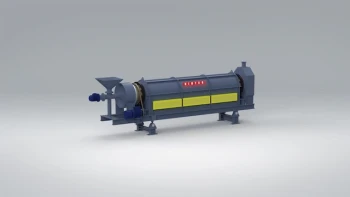
A high-temperature muffle furnace is the primary tool for isolating soil carbon fractions by selectively removing organic matter through controlled thermal oxidation. By heating soil samples at a constant temperature—typically 450°C for 16 hours—the furnace causes organic components to oxidize and volatilize. This leaves behind inorganic carbon (carbonates), allowing researchers to accurately calculate the ratio of organic to inorganic carbon and assess the soil's contribution to total carbon emissions.
The muffle furnace facilitates carbon differentiation by utilizing the specific thermal stability of organic versus inorganic compounds. By precisely controlling temperature and atmosphere, researchers can strip away organic matter to reveal the mineral carbon baseline, a process fundamental to soil science and carbon sequestration studies.
The Mechanism of Thermal Differentiation
Oxidation of Organic Matter
The primary role of the muffle furnace in soil analysis is the complete oxidation of organic carbon. When soil is subjected to temperatures around 450°C, the organic matter reacts with available oxygen and is released as volatile gases.
Preservation of Inorganic Carbon
Inorganic carbon, primarily found in the form of carbonates, remains stable at these specific temperature ranges. By maintaining a constant heat that does not exceed the threshold for carbonate decomposition, the furnace effectively separates the two carbon pools.
Thermogravimetric Basis
This process allows for thermogravimetric analysis, where the weight loss of the sample is recorded. This mass difference provides a direct measurement of the organic content previously held within the soil matrix.
Quantifying Soil Health through LOI
The Loss on Ignition (LOI) Method
The Loss on Ignition (LOI) method is a standard protocol where the muffle furnace calculates organic carbon content based on mass difference. By comparing the weight of the soil before and after the 16-hour heating cycle, researchers determine the "ignited" organic fraction.
Analyzing Total Carbon Contributions
Differentiating these components is vital for understanding carbon cycling. Identifying how much carbon is stored in stable inorganic forms versus volatile organic forms helps scientists predict how soil will respond to environmental changes or land management.
Support for Mineral Analysis
Once the organic matter is removed, the remaining sample is cleaner and easier to analyze for mineral components. The muffle furnace essentially "cleans" the soil skeleton, allowing for more accurate downstream testing of soil minerals.
Advanced Carbon Applications: Pyrolysis and Biochar
Creating Stable Carbon Frameworks
Beyond simple differentiation, muffle furnaces are used for carbonization, providing the activation energy required for thermal degradation. At temperatures between 500°C and 650°C, the furnace triggers dehydration and degassing of biomass.
Anaerobic Carbonization
When used with a closed crucible, the furnace creates an oxygen-limited environment necessary for pyrolysis. This transforms organic waste into biochar or activated carbon, characterized by a complex, stable pore structure.
Development of Activated Carbon
The furnace provides the precise thermal environment required to volatilize non-carbon components while leaving behind a stable framework of carbon atoms. This resulting material has a high specific surface area, useful for carbon sequestration and filtration.
Understanding the Trade-offs and Limitations
Temperature Sensitivity Pitfalls
If the furnace temperature exceeds the target (e.g., rising toward 600°C-800°C), inorganic carbonates may begin to decompose and release $CO_2$. This results in an overestimation of organic carbon and an underestimation of the inorganic mineral fraction.
Structural Alterations
High-temperature treatment can cause irreversible changes to the clay mineral structures within the soil. While effective for carbon differentiation, the process may render the sample unsuitable for certain types of subsequent physical or structural testing.
Time and Energy Intensive
The requirement for extended heating periods, such as 16 hours, makes this a slow process compared to chemical oxidation methods. It requires high energy consumption and careful monitoring to ensure temperature stability across the entire sample batch.
How to Apply Thermal Analysis to Soil Research
Selecting the right parameters for your muffle furnace depends on your specific analytical goals and the nature of your soil samples.
- If your primary focus is quantifying organic matter: Utilize the Loss on Ignition (LOI) method at 450°C for 16 hours to ensure complete oxidation without disturbing mineral carbonates.
- If your primary focus is producing soil amendments: Operate the furnace in an anaerobic or oxygen-limited state at 500°C to 600°C to facilitate pyrolysis and create stable biochar.
- If your primary focus is mineralogical purity: Use the furnace to strip all volatile organic components, leaving a clean mineral skeleton for X-ray diffraction or other mineral-heavy analyses.
By mastering the thermal gradients of a muffle furnace, researchers can transform a complex soil sample into a clear map of its constituent carbon parts.
Summary Table:
| Process / Method | Target Temperature | Primary Objective |
|---|---|---|
| Organic Oxidation (LOI) | 450°C (16 Hours) | Complete removal of organic matter via thermal oxidation |
| Carbonate Preservation | < 550°C | Maintaining stable inorganic carbon for baseline measurement |
| Pyrolysis / Carbonization | 500°C – 650°C | Creating stable biochar frameworks in oxygen-limited states |
| Mineral Purification | 450°C+ | Stripping volatiles to reveal the clean soil mineral skeleton |
Maximize Your Analytical Precision with KINTEK
Accurate soil carbon differentiation demands absolute thermal stability and uniform heat distribution. KINTEK specializes in high-performance laboratory equipment tailored for rigorous soil science and carbon sequestration studies.
Our extensive range of high-temperature solutions includes:
- Muffle & Tube Furnaces: Optimized for precise Loss on Ignition (LOI) and organic oxidation.
- Atmosphere & Vacuum Furnaces: Essential for controlled anaerobic pyrolysis and biochar development.
- Customizable Rotary & CVD Systems: Designed for unique material research and thermal degradation needs.
Ensure your lab achieves reproducible, high-accuracy results with our industry-leading technology. Contact KINTEK today to discuss your specific research requirements!
References
- Zsolt Kotroczó, István Fekete. Long-Term Changes in Organic Matter Content and Soil Moisture Determine the Degree of Root and Soil Respiration. DOI: 10.3390/plants12020251
This article is also based on technical information from Kintek Furnace Knowledge Base .
Related Products
- 1700℃ High Temperature Muffle Oven Furnace for Laboratory
- 1800℃ High Temperature Muffle Oven Furnace for Laboratory
- 1200℃ Muffle Oven Furnace for Laboratory
- 1400℃ Muffle Oven Furnace for Laboratory
- Laboratory Muffle Oven Furnace with Bottom Lifting
People Also Ask
- What is the primary function of a high-temperature laboratory muffle furnace in chemical synthesis? Achieve Precision.
- How does a high-temperature laboratory muffle furnace affect material properties? Transform Anodic Oxide Films Fast
- What role does a muffle furnace play in BCZY712 electrolyte powder production? Achieve Perfect Phase Purity
- What role does a muffle furnace play in converting rice husk to ash? Achieve High-Purity Biogenic Silica Isolation
- What role does a muffle furnace play in sintering photocathodes? Enhance Electrode Conductivity & Catalytic Activity