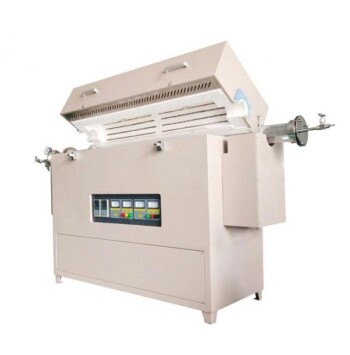
The volume fraction of hard reinforcing particles directly dictates the severity of strain localization in metal matrix composites. As you increase that fraction from a fraction of a percent to just a few percent by volume, the strain non-uniformity during deformation escalates sharply, concentrating stress in narrow bands directly ahead of and between the rigid particles. Simultaneously, accurate temperature control in laboratory high-temperature furnaces is critical because it eliminates the thermal gradients that would otherwise superimpose additional internal stress onto these already strained regions, preventing premature micro-cracking and enabling the matrix to densify without damaging the reinforcement.
Even a seemingly minor increase in reinforcement content can push a composite from a predictable, ductile flow into a brittle failure mode. The only way to safely unlock the benefits of higher particle loadings is through the kind of precise, uniform thermal management that only a high-quality laboratory furnace can provide—any deviation turns the inherent strain concentration into a catalyst for catastrophic micro-cracking.
The Direct Link Between Reinforcement Content and Strain Concentration
The primary reference confirms that in particle-reinforced metal matrix composites, strain non-uniformity is not just a side effect—it’s a direct function of how many hard particles are present. The physics behind this is straightforward but unforgiving.
Strain Builds at Particle-Matrix Interfaces
When the composite deforms, the soft metal matrix wants to flow plastically. The hard particles, however, behave as rigid obstacles.
This yield stress contrast forces the ductile matrix to shear and extrude around the particles. The strain concentrates exactly where the flow is most disrupted: directly in front of a particle and in the narrow bands that form between adjacent particles.
The Role of Particle Spacing and Flow Fields
At very low volume fractions, particles are far apart. The strain fields can dissipate before overlapping, and the composite still behaves largely like the unreinforced matrix.
But as the volume fraction climbs—from 0.0125% to 4.8% in the studied case—the inter-particle spacing collapses. The flow fields begin to interact, and the strain can no longer distribute evenly, creating extreme local peaks along the material flow paths.
From Strain Localization to Micro-Cracking
These concentrated strain peaks are the precursors to damage. They initiate voids at the particle-matrix interface and, if the local stress exceeds the matrix’s cohesive strength, they grow into micro-cracks.
The higher the volume fraction, the more intense and numerous these peaks become, drastically lowering the composite’s tolerance for any additional internal stress—including the kind introduced by poor thermal processing.
Why Precise Furnace Control Determines Composite Integrity
The primary reference states that the purpose of high-temperature laboratory vacuum and atmosphere furnaces is to provide the precise thermal control and uniform heat distribution that eliminate unwanted thermal gradients during sintering and annealing. This is not a minor processing detail; it is the critical line of defense against the strain concentrations inherent in the material’s design.
Eliminating Thermal Gradients That Amplify Internal Stress
If a sintering or annealing cycle introduces temperature non-uniformity, the metal matrix will expand and contract unevenly. These differential thermal strains superimpose directly onto the deformation-induced strain fields.
The result is that a region already teetering on the edge of micro-cracking because of a nearby particle is pushed over the limit. Uniform heating renders thermal gradients negligible, leaving only the manageable, predictable strain concentration from the reinforcement itself.
Sintering and the Delicate Balance of Densification
Rigid inclusions, including the very hard particles that create strain concentrations, also physically inhibit the sintering process. The retarding effect grows with both inclusion volume fraction and lower sintering temperatures.
Supplementary references clarify that to overcome this without cracking the composite, the furnace must execute a precise thermal profile that promotes matrix grain growth kinetics without macroscopic shrinkage. For oxide-oxide ceramic matrix composites, for example, the sintering must boost particle neck growth via surface diffusion alone—any appreciable shrinkage would tear the matrix apart around constraining fibers.
Preserving Designed Microstructures Through Thermal Profiling
Accurate peak temperature control dictates the crystal morphology and aspect ratio within the composite. A thermal overshoot or insufficient peak temperature can destroy the interlocking crystalline plates that give the material its high-temperature structural stability.
Furthermore, thermo-mechanical processing of powder metallurgy composites operates within narrow temperature windows. Warm deformation of BCC metals, for instance, must stay within the envelope of 0.8Tr to Tr to form the desired equiaxed cellular dislocation substructure. A laboratory furnace with precise control prevents premature grain coarsening on the high end and catastrophic embrittlement on the low end.
Atmosphere Control and Phase Purity
High-temperature atmosphere furnaces also purge the environment of oxygen and volatile phases like sulphur. The formation of brittle aluminum carbide (Al₄C₃) during vacuum hot pressing, for example, is temperature-dependent and occurs if a narrow peak temperature window around 655°C is exceeded or if the hold time is too long.
Accurate thermal control, combined with a controlled atmosphere, shuts down these unwanted interfacial reactions, ensuring the matrix bonds to the reinforcement without creating a new brittle phase that would amplify the existing strain concentration tenfold.
Understanding the Trade-offs
No processing route is without limitations. A clear-eyed view of the trade-offs is what separates a robust composite from a laboratory curiosity.
Higher particle volume fractions certainly raise strength and wear resistance. But they simultaneously slash ductility and drastically narrow the processing window. The strain concentrations become so intense that even the slightest thermal gradient during cooling can cause the part to crack before it exits the furnace.
Pushing for maximum densification in a rigid-inclusion system demands higher temperatures or longer hold times. Yet, as seen with Vacuum Hot Pressing of aluminum, exceeding that narrow temperature window triggers local melting or brittle intermetallic formation. The risk of over-sintering is as high as the risk of under-sintering.
Warm deformation processing requires hitting the sub-recrystallization temperature band with extreme precision. A drift of just a few degrees can erase the dislocation cell structure you are trying to engineer, leaving you with either a hardened, brittle forest of random dislocations or soft, coarsened grains—both disastrous for final performance.
Making the Right Choice for Your Goal
Your processing strategy must align with the reinforcement volume fraction and the performance demands of the final component. Use these goal-oriented guidelines to make the decision.
- If your primary focus is maximizing wear resistance or specific stiffness: Accept that a high volume fraction will create severe strain concentrations. Invest in a laboratory vacuum or atmosphere furnace with proven temperature uniformity of ±5°C or better across the entire load, and design a heating profile that ramps slowly through the critical phase transformation zones to prevent any thermal gradient from triggering micro-cracking.
- If your primary focus is achieving a balanced strength-ductility combination: Keep the reinforcement volume fraction moderate and exploit the narrow warm-deformation temperature window (0.8Tr to Tr). Your high-temperature furnace must be able to hold a stable setpoint within a few degrees for extended periods to build the dislocation substructure that refines the grain and lowers the ductile-to-brittle transition temperature.
- If your primary focus is producing a crack-free ceramic matrix composite with controlled porosity: Rely on an atmosphere furnace to promote non-densifying mass transport mechanisms. Program the controller to avoid any macroscopic shrinkage by matching the heating rate to the surface diffusion kinetics of the matrix, preserving the critical 30% porosity needed for crack deflection.
The hard particles define where the strain will go; the furnace control determines whether the material can survive the journey.
Summary Table:
| Processing Aspect | High Particle Loading Effect | Role of Precise Furnace Control |
|---|---|---|
| Strain Localization | Concentrates stress in narrow matrix bands | Eliminates thermal gradients that trigger micro-cracks |
| Densification & Sintering | Rigid inclusions retard matrix shrinkage | Executes precise thermal profiles to promote uniform bonding |
| Phase Purity | Increases risk of brittle interfacial reactions | Controls atmosphere & temperature windows to prevent impurities |
| Microstructure Control | Collapses inter-particle spacing | Preserves crystal morphology and dislocation substructures |
Optimize Your Composite Materials with KINTEK High-Temp Furnaces
Don't let unwanted thermal gradients destroy your high-performance metal matrix composites. KINTEK offers advanced laboratory high-temperature furnaces—including custom vacuum, atmosphere, tube, muffle, and CVD systems—designed with ultra-precise temperature control and exceptional thermal uniformity to eliminate internal strain and prevent micro-cracking.
Whether you are synthesizing particle-reinforced alloys or engineering complex ceramic composites, KINTEK provides tailored furnace solutions engineered for your exact research and production needs.
Contact KINTEK today to consult with our thermal processing experts!
Related Products
- 1400℃ High Temperature Laboratory Tube Furnace with Alumina Tube
- 1700℃ High Temperature Laboratory Tube Furnace with Alumina Tube
- 1800℃ High Temperature Muffle Oven Furnace for Laboratory
- 1700℃ High Temperature Muffle Oven Furnace for Laboratory
- 1200℃ Muffle Oven Furnace for Laboratory
People Also Ask
- How does zone-melting in tube furnaces synthesize bismuth micro-wires? Master Single-Crystal Thermoelectric Growth
- How are high-temperature laboratory tube furnaces applied in long-term vacuum homogenization heat treatments for intermetallic samples?
- How are high-temp tube furnaces used to measure diffusion coefficients per Fick's law? Master Precision Annealing
- How do high-temperature laboratory tube furnaces ensure environmental stability? Precision Thermal Reduction Tips
- How are high-temperature tube furnaces applied in testing ceramic-supported alloy membranes? Insights