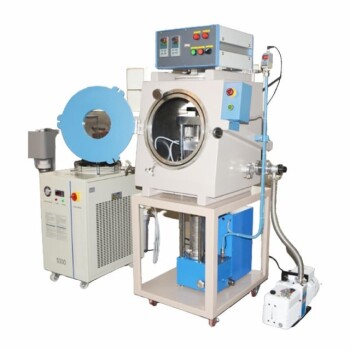
Hydrostatic stress drives uniform pore closure; deviatoric stress unlocks accelerated densification. In a high-temperature hot-press, breaking down the applied stress into its hydrostatic (volumetric) and deviatoric (shear) parts reveals that full densification of advanced ceramics or powder metals doesn’t rely on isotropic pressure alone—it’s the controlled application of shear that triggers grain boundary sliding, plastic flow, and rapid mass transport. This decomposition lets furnace operators design cycles that reach near-theoretical density at lower pressures and shorter hold times, while keeping dimensional integrity.
The stress tensor decomposition is not just a mechanics textbook exercise—it’s the practical framework for how you optimize every hot-pressing cycle. Hydrostatic stress compacts the powder; deviatoric stress makes it densify fast. Separating the two tells you when and why shear is beneficial, and when it becomes a source of failure.
Why the Decomposition Matters in a Hot Press
The Two Drivers of Material Response
A stress tensor T_σ is always the sum of a spherical (hydrostatic) tensor A_σ and a deviatoric tensor D_σ.
The hydrostatic component, defined by the mean stress σ_m, tries to change the volume of the compact without altering its shape—it squeezes pores uniformly.
The deviatoric component represents shear stresses. These are responsible for shape distortion, plastic flow, and all yielding in isotropic materials.
In a uniaxial hot press, the force applied by the punches is directional. The powder experiences differential stress between the axial and radial directions, automatically generating a deviatoric stress field even if you only push straight down.
How Hydrostatic Stress Underpins Densification
At temperature, the hydrostatic part of the stress directly opposes the sintering stress.
It provides the thermodynamic driving force for pore shrinkage.
Simply put, the higher the uniform pressure, the more pores collapse. But in a hot press, pure hydrostatic loading is rarely enough—powders locked in a rigid die still need a mechanism to rearrange and bond.
How Deviatoric Stress Accelerates the Process
This is the critical insight from the decomposition. Deviatoric shear stress works alongside temperature to activate faster densification mechanisms.
At particle contacts, the local stress concentration quickly exceeds the material’s yield strength. Shear drives:
- Plastic deformation at contact points, smashing particles into closer packing.
- Grain boundary sliding, which lets particles rearrange without fracturing.
- Creep and diffusion along grain boundaries, a transport path that closes pores far more efficiently than lattice diffusion alone.
Because the yield strength drops dramatically with temperature inside a high-temperature furnace (thermal softening), you need much less pressure to get the same level of plastic flow. The deviatoric component effectively replaces brute force with thermal activation, protecting expensive die tooling and extending press life.
Controlling the Two Components in a Laboratory Furnace
Designing the Temperature-Pressure Profile
Temperature is the dominant lever for densification—it lowers the yield strength and accelerates diffusion—but the deviatoric stress determines how fast that potential is realized.
By decomposing the stress state, you can:
- Increase the hydrostatic component early to collapse large pores and set the compact.
- Introduce or intensify the deviatoric component at a hold temperature where grain boundary sliding becomes active, without pushing the compact into shear localization.
- Use the knowledge that stress intensification factor
φchanges with pore geometry. As density rises, pores become non-spherical; the deviatoric stress around them intensifies, which can either help close the last pores or cause cracking if unaccounted for.
Avoiding Die Wall Friction and Warping
The decomposition also tells you where danger lies. The deviatoric stress tensor doesn’t just act inside the powder—it acts on the tooling too.
- Die wall friction generates additional shear that can cause density gradients from the center to the edge of the compact.
- Excessive deviatoric stress can lead to localized shear bands, edge cracking, or component warping upon cooling.
Monitoring both A_σ and D_σ allows you to adjust ram speed, lubrication, or die design to keep the shear beneficial rather than destructive.
Understanding the Trade-offs
The Limit of “More Shear = Better”
While deviatoric stress accelerates densification, it is not a free lunch. Shear-induced flow can sometimes trap porosity by closing off diffusion paths prematurely if temperature is too low.
The compact may reach an apparent density plateau where gas-filled pores remain sealed because the surrounding matrix has yielded but diffusion cannot finish the job.
Sample Size and Die Constraints
In laboratory furnaces, the mass of graphite or refractory dies creates a significant thermal lag.
Deviatoric stress applied before the center of the compact reaches uniform temperature can cause differential deformation.
This is why the hydrostatic-deviatoric decomposition must be interpreted dynamically over the whole cycle, not as a single snapshot.
Strain Contributions Matter Too
Just as stress decomposes, the strain tensor splits into volumetric strain A_ε (densification/shrinkage) and deviatoric strain D_ε (shape change at constant volume).
Effective densification means maximizing the volumetric part while suppressing the deviatoric part in the final net shape. The two stress components drive these two strain responses—understanding their link prevents the common mistake of confusing higher measured deformation with better density.
Making the Right Choice for Your Hot-Pressing Goal
Use the stress decomposition to tailor your protocol to what you’re actually trying to achieve.
- If your primary focus is achieving maximum final density with minimal grain growth: Apply a moderate hydrostatic pressure early, then introduce a controlled deviatoric shear step at a temperature just high enough for grain boundary sliding but below rapid grain coarsening. The shear finishes densification without over-firing.
- If your primary focus is tight dimensional tolerance and net-shape accuracy: Keep the deviatoric component low during the entire heating phase. Rely mainly on hydrostatic pressure and soak time, and increase temperature to lower the required stress, thus avoiding die friction-induced distortion.
- If your primary focus is processing large, thick compacts: Account for thermal mass lag by delaying the onset of high deviatoric stress until the core temperature equalizes. Use the hydrostatic phase to homogenize thermal gradients first, then engage shear to complete densification uniformly.
Mastering the split between hydrostatic and deviatoric stress turns a basic hot-press run into a precisely tunable densification process—giving you the freedom to push advanced materials to their theoretical limit without outrunning your tooling or your design intent.
Summary Table:
| Stress Component | Core Mechanism | Impact on Densification | Cycle Optimization Role |
|---|---|---|---|
| Hydrostatic Stress ($A_\sigma$) | Uniform volumetric compression | Opposes sintering stress; drives isotropic pore shrinkage | Collapses large voids early; maintains uniform compact shape |
| Deviatoric Stress ($D_\sigma$) | Shear stress & localized flow | Activates plastic flow, grain boundary sliding, and creep | Accelerates rapid mass transport at lower temperatures & pressures |
Maximize Densification and Precision with KINTEK Lab Furnaces
Take full control of your material synthesis cycles with high-precision high-temperature furnace technology. At KINTEK, we specialize in premium laboratory equipment and consumables—including customizable hot-press furnaces, vacuum systems, muffle, tube, CVD, and atmosphere furnaces designed to withstand rigorous thermal and mechanical demands.
Whether you are refining ceramic sintering protocols or developing advanced alloys, KINTEK provides tailored solutions engineered for superior temperature uniformity and structural reliability.
Contact KINTEK today to discuss your custom furnace needs
Related Products
- 1400℃ High Temperature Laboratory Tube Furnace with Alumina Tube
- 1700℃ High Temperature Laboratory Tube Furnace with Alumina Tube
- 1800℃ High Temperature Muffle Oven Furnace for Laboratory
- 1700℃ High Temperature Muffle Oven Furnace for Laboratory
- 1200℃ Muffle Oven Furnace for Laboratory
People Also Ask
- How does zone-melting in tube furnaces synthesize bismuth micro-wires? Master Single-Crystal Thermoelectric Growth
- How are high-temperature laboratory tube furnaces applied in long-term vacuum homogenization heat treatments for intermetallic samples?
- How do high-temperature laboratory tube furnaces ensure environmental stability? Precision Thermal Reduction Tips
- How are high-temp tube furnaces used to measure diffusion coefficients per Fick's law? Master Precision Annealing
- How are high-temperature tube furnaces applied in testing ceramic-supported alloy membranes? Insights