The precise control of thermal gradients is the single most decisive factor in dictating both polytype purity and defect populations during high-temperature SiC epitaxy. Lowering the temperature gradient within the reaction zone directly increases the proportion of the 6H-SiC polytype in the grown layer, and it strongly reduces stacking fault (SF) densities within 3C-SiC domains. Because SiC polytype stability is exquisitely sensitive to even minimal thermal variations and the strain they induce, mastering gradient control is not optional—it is the foundational requirement for growing reproducible, high-quality epitaxial films.
The over-arching imperative is this: a lower and precisely managed thermal gradient in the reaction zone simultaneously steers phase selection toward 6H-SiC and suppresses the formation of performance-killing stacking faults in 3C-SiC. Uncontrolled gradients, by contrast, trigger polytypic intermixing, create complex twin structures, and let defects propagate unhindered.
The Thermodynamic Foundation of Polytype Selection
Why Thermal Gradients Dictate Which Polytype Grows
Silicon carbide can crystallize in over 200 polytypes, but the cubic (3C) and common hexagonal (4H, 6H) forms dominate device applications. The energy differences between these structures are so small—on the order of meV per atom—that their formation is easily tipped by local thermal fluctuations and the resulting strain fields. The temperature gradient across the growth interface governs both the thermodynamic driving force and the kinetic pathways available, making it the master control knob for phase selection.
How Lower Gradients Steer Growth Toward 6H-SiC
When you dial down the thermal gradient, you reduce the local supersaturation spikes and thermal stresses that typically nucleate metastable or mixed phases. In this calmer, lower-gradient environment, the 6H polytype becomes energetically dominant. The primary reference explicitly confirms that lowering the temperature gradient increases the proportion of 6H-SiC in the grown layer. This is not a marginal effect—it is the difference between a single-polytype film and a layer riddled with unwanted 15R, 4H, or 3C inclusions.
The Special Case of Cubic 3C-SiC Growth
For 3C-SiC epitaxy, the gradient story focuses on defect density rather than polytype purity (since the cubic phase is already the target). Research shows that when growing 3C-SiC at temperatures between 1500°C and 2000°C, vertical thermal gradients in the range of 5 to 8 K/mm are critical. Lower gradients within this window strongly favor the reduction of stacking fault densities. The underlying mechanism is straightforward: a gentle gradient minimizes the strain that drives partial dislocation glide and fault formation, allowing the cubic lattice to build with far fewer interruptions.
Defect Density: Why Gradient Flatness Equals Film Quality
The Direct Link Between Low Gradients and Reduced Stacking Faults
Stacking faults are planar defects where the regular ABCABC… stacking of the cubic lattice is interrupted. In SiC, they act as carrier traps, kill light emission, and degrade device reliability. The primary reference states unequivocally that a lower temperature gradient strongly promotes the reduction of stacking fault densities within 3C-SiC domains. This happens because a shallow gradient lowers the thermo-elastic stress that would otherwise trigger fault nucleation at the growth front.
What Happens When the Gradient is Too Steep
An improperly steep thermal profile does far more than just increase the number of faults. It creates a cascade of related problems: polytypic intermixing, where unwanted phases like 15R-SiC or 6H-SiC form, often in layered transition zones. It also encourages the formation of complex twin structures and microtwins, which themselves act as sources for further fault propagation. In extreme cases, a high gradient can force the entire film to transform into a different polytype altogether during growth, rendering the wafer useless.
Mastering the Thermal Environment: Practical Control
Multi-Zone Furnaces and Precision Profiling
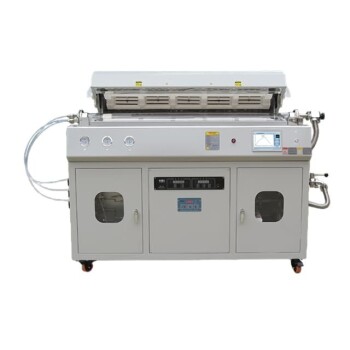
Achieving the required low, uniform gradient is not a matter of hoping for the best. It demands furnaces with multi-zone heating elements and high-precision programmable controllers. These systems allow you to independently tune temperatures across the reaction zone, flattening the gradient to exactly where it needs to be—often 5–8 K/mm for 3C growth, and even tighter for 6H stabilization. Such hardware, combined with in-situ monitoring, moves gradient control from an art to a reproducible science.
The Synergy Between Temperature and Atmosphere
The gradient story does not exist in a vacuum. The thermal environment interacts strongly with the gas phase. For example, introducing nitrogen during growth can stabilize the 3C and 2H polytypes, while an argon-rich environment at high temperature pushes dominance toward 6H. The crucial point is that these atmospheric effects are magnified or muted by the gradient: a well-controlled gradient amplifies the desired chemical effect, while a poor gradient can override even the most carefully chosen gas chemistry.
Understanding the Trade-Offs
Flat Gradients Are Not Free
While low gradients benefit polytype purity and fault reduction, they demand a compromise. Extremely flat gradients can slow the overall growth rate, as the driving force for vapor transport diminishes. You may also face a tighter process window: if the gradient is too flat, uniformity can suffer across larger-area wafers, leading to center-to-edge variations in thickness and doping. The goal is not to eliminate the gradient entirely but to find the narrow, sweet region where it is low enough to suppress defects yet sufficient to maintain acceptable throughput and large-area uniformity.
The Orientation Factor Complicates the Equation
A gradient that works perfectly on an on-axis substrate may fail on a vicinal or off-cut surface. The primary reference focuses on the gradient effect in general, but supplementary work underscores that substrate orientation dramatically alters how the film responds. For instance, growing 3C-SiC on (100) seeds closes inversion domain boundaries below the growth surface, leaving stacking faults as the primary remaining defect; on (111) surfaces, those same faults and polytypic inclusions can propagate across the entire film thickness. Thus, the ideal temperature gradient is not an absolute number—it must be tailored to the specific substrate orientation and polytype target.
Making the Right Choice for Your Growth Goal
The optimal temperature gradient decision depends entirely on what you are trying to achieve with your SiC epitaxy process. Use the recommendations below to align your furnace profile with your objectives.
- If your primary focus is growing pure, single-polytype 6H-SiC layers: Implement the lowest practical thermal gradient in your reaction zone, as this directly increases the 6H fraction and suppresses competing polytypes.
- If your primary focus is minimizing stacking fault density in 3C-SiC epitaxy: Maintain a tightly controlled, low vertical gradient in the 5–8 K/mm range, and pair it with (100)-oriented seeds to prevent fault propagation.
- If your primary focus is maximizing growth rate while preserving acceptable quality: Accept a slightly steeper gradient, but invest in multi-zone heating to keep the gradient profile uniform and avoid localized hot spots that trigger defect cascades.
- If your primary focus is stabilizing metastable polytypes like 2H or 3C at high temperature: Combine a precisely flat gradient with intentional nitrogen doping, which chemically reinforces the cubic lattice against thermal transformation.
Ultimately, temperature gradient control is not merely one parameter among many—it is the fundamental performance lever that decides whether your SiC film will be a high-purity, low-defect semiconductor layer or a compromised mixture of polytypes and faults. Master it, and you master the epitaxy itself.
Summary Table:
| Target Parameter / Phase | Thermal Gradient Strategy | Primary Impact & Benefits |
|---|---|---|
| 6H-SiC Polytype | Lower gradient across reaction zone | Enhances phase purity; eliminates 15R/4H/3C inclusions |
| 3C-SiC Epitaxy | 5 – 8 K/mm (1500°C – 2000°C) | Reduces thermo-elastic stress & suppresses stacking fault (SF) density |
| Steep Gradients | High / Uncontrolled gradient | Triggers polytypic intermixing, microtwins, and defect cascades |
| Process Optimization | Multi-zone precision heating | Balances low defect density with optimal film growth rates |
Unlock precision crystal growth for superior SiC epitaxy with KINTEK. As specialists in high-temperature laboratory equipment, KINTEK offers a comprehensive range of customizable furnaces—including multi-zone tube, CVD, vacuum, atmosphere, and high-temp crystal growth systems—engineered to deliver the exact thermal gradient control your research demands. Minimize defect densities and ensure reproducible polytype purity in your semiconductors—contact KINTEK today to consult with our high-temperature furnace experts!
Related Products
- 1400℃ High Temperature Laboratory Tube Furnace with Alumina Tube
- 1700℃ High Temperature Laboratory Tube Furnace with Alumina Tube
- 1700℃ High Temperature Muffle Oven Furnace for Laboratory
- 1800℃ High Temperature Muffle Oven Furnace for Laboratory
- 1700℃ Controlled Inert Nitrogen Atmosphere Furnace
People Also Ask
- How does zone-melting in tube furnaces synthesize bismuth micro-wires? Master Single-Crystal Thermoelectric Growth
- How are high-temperature laboratory tube furnaces applied in long-term vacuum homogenization heat treatments for intermetallic samples?
- How do high-temperature laboratory tube furnaces ensure environmental stability? Precision Thermal Reduction Tips
- How are high-temp tube furnaces used to measure diffusion coefficients per Fick's law? Master Precision Annealing
- How are high-temperature tube furnaces applied in testing ceramic-supported alloy membranes? Insights