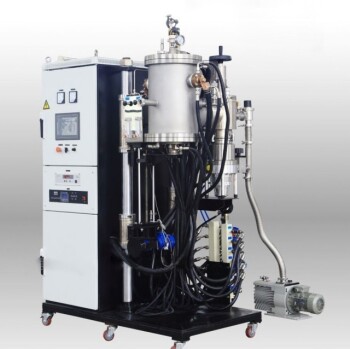
Suppressing surface diffusion relative to densification mechanisms directly prevents abnormal grain growth by keeping pores small and highly mobile. These mobile micropores stay pinned to migrating grain boundaries instead of detaching, which blocks the runaway grain coarsening that creates a bimodal, low-density microstructure. The net result is uniform grain growth and high final density, precisely what you aim for in a precision high-temperature sintering furnace.
While surface diffusion is unavoidable at lower temperatures, its dominance leads to pore coarsening without shrinkage. The key insight is that small pores are the critical defect that keeps grain boundaries in check; suppress the coarsening effect of surface diffusion, and you preserve those small, mobile pores until densification can eliminate them entirely.
The Essential Link Between Pore Size and Grain Growth
Abnormal grain growth is not just a cosmetic issue. It's a direct cause of trapped porosity and poor mechanical performance. Understanding the pore-grain boundary relationship is where control begins.
Why Small Pores Stay Attached to Grain Boundaries
A pore’s mobility depends inversely on its size. Small pores can move along with a migrating grain boundary via surface diffusion around the pore itself.
When the pore is small, the boundary's driving force for migration is insufficient to break it free. The pore acts as a pinning point, exerting a drag force that limits boundary velocity. This keeps the entire grain structure uniformly fine.
What Happens When Pores Become Too Large
If surface diffusion coarsens pores early in the cycle, those large pores lose mobility. A migrating boundary can then detach and sweep past them.
Once detached, the pore sits inside a grain where lattice diffusion paths are extremely long. It becomes a permanent defect, while the unpinned boundary is free to accelerate, causing abnormal grain growth and a bimodal microstructure.
Surface Diffusion vs. Densification: The Kinetic Battle
You can't stop surface diffusion entirely. But you can shift the kinetic balance in the furnace so that it never gets the chance to ruin your microstructure.
Activation Energies and Temperature Windows
Surface diffusion has the lowest activation energy (Qs < Qgb < Ql). This means it becomes active at relatively low temperatures during heat-up, while grain boundary and lattice diffusion—the mechanisms that actually shrink porosity—require higher temperatures to dominate.
If you linger too long in this low-temperature window, surface diffusion runs unchecked. It builds necks between particles without densification, coarsening the pore network before real shrinkage ever begins.
How Surface Diffusion Leads to Pore Coarsening
Surface diffusion moves atoms across pore surfaces, smoothing them out and merging smaller pores into larger ones. There is no center-to-center particle approach, so the compact does not shrink.
The result is a coarsened, larger-scale pore structure. When you finally reach densification temperatures, these big pores are immobile, and the battle against abnormal grain growth is already lost.
Leveraging Furnace Control to Suppress Surface Diffusion
Precision thermal programming in a high-temperature laboratory furnace is your direct lever to suppress surface diffusion’s impact. The goal is to minimize the time the ceramic spends in the temperature regime where surface diffusion dominates.
Rapid Heating to Bypass Low-Temperature Regimes
A fast ramp rate pushes the material quickly through the dangerous low-temperature zone. This denies surface diffusion the time it needs to coarsen pores.
By the time the compact reaches peak temperature, grain boundary and lattice diffusion are immediately active, locking in the original fine pore distribution. Modern programmable controllers make this approach both repeatable and reliable.
Optimized Dwell Temperatures for Densification-Dominant Diffusion
The final soak temperature should be selected to maximize the densification rate while keeping grain boundary mobility in check. Since densification rate scales inversely with grain size (∝ 1/G^3 or 1/G^4), maintaining a fine grain throughout the cycle accelerates shrinkage.
Two-step sintering profiles can be exceptionally effective here. A brief high-temperature spike to activate grain boundary diffusion is followed by a lower-temperature hold where densification continues but grain boundary migration is kinetically frozen, preventing abnormal growth.
Understanding the Trade-offs
Suppressing surface diffusion is powerful, but it’s not free. You must balance heating speed against other process limits to avoid creating new defects.
- Thermal stress and cracking: Faster heating rates can induce temperature gradients that crack the ceramic body, especially in large or complex shapes. This risk often necessitates a compromise ramp rate.
- Uniformity challenges: Rapid heating makes it harder to maintain a uniform temperature distribution across the entire furnace hot zone, which can lead to localized abnormal grain growth if some areas lag.
- Reduced process window: Aggressive profiles leave less room for error in binder burnout or other thermochemical steps that must happen at lower temperatures. You may need a multi-step profile that still minimizes time at surface-diffusion-dominant temperatures.
- Furnace capability limits: Not all furnaces can achieve the required high-power ramps or ultra-stable low-temperature holds. Hybrid heating arrangements or specific element configurations may be needed.
Making the Right Choice for Your Sintering Goal
Process design is a direct answer to your final microstructure goals. Here’s how to tailor your approach when using a high-temperature sintering furnace.
- If your primary focus is maximum density with fine grain size: Prioritize a fast heating rate past the surface-diffusion regime and use a two-step profile to decouple densification from grain growth.
- If your primary focus is large, crack-free components: Moderate the ramp rate to reduce thermal stress, accepting a slightly coarser pore structure, and rely on dopants or second-phase pinning particles to compensate for reduced pore-boundary drag.
- If your primary focus is process repeatability in a production furnace: Invest in precise thermal control and multi-zone heating elements to ensure the entire load experiences the same rapid bypass of the low-temperature window, eliminating local abnormal grain growth.
- If your primary focus is minimizing energy and time: Use the fastest ramp your parts can survive, then shorten the high-temperature dwell by relying on the fine initial grain size to accelerate densification to completion quickly.
The ultimate lesson is that pore mobility is a kinetic tool. By suppressing surface diffusion, you keep that tool sharp, enabling your furnace to deliver dense, uniform ceramics every time.
Summary Table:
| Diffusion Mechanism | Activation Energy | Effect on Compact | Impact on Grain Growth |
|---|---|---|---|
| Surface Diffusion | Lowest ($Q_s$) | Coarsens pores without shrinkage | Causes pore detachment & runaway grain growth |
| Grain Boundary Diffusion | Intermediate ($Q_{gb}$) | Promotes densification & shrinkage | Retains small, mobile pores to pin boundaries |
| Lattice Diffusion | Highest ($Q_l$) | Eliminates residual interior porosity | Enables final stage high-density microstructure |
Mastering thermal profiles to control diffusion kinetics requires reliable, high-precision heating equipment. KINTEK specializes in premium laboratory equipment and consumables, offering a comprehensive range of high-temperature furnaces—including muffle, tube, rotary, vacuum, CVD, atmosphere, dental, and induction melting furnaces—all customizable for your unique material processing needs. Enhance your lab's sintering repeatability and achieve superior density—contact KINTEK today!
Related Products
- 2200 ℃ Tungsten Vacuum Heat Treat and Sintering Furnace
- High Temperature Muffle Oven Furnace for Laboratory Debinding and Pre Sintering
- 2200 ℃ Graphite Vacuum Heat Treat Furnace
- Vacuum Heat Treat Sintering Furnace Molybdenum Wire Vacuum Sintering Furnace
- 1400℃ High Temperature Laboratory Tube Furnace with Alumina Tube
People Also Ask
- How does a tungsten-heated vacuum sintering furnace prepare (TbxY1-x)2O3 ceramics? Achieve 99%+ Density & Purity
- How do compaction pressure and vacuum sintering optimize porous ceramics? Maximize Density & Toughness
- What wear-resistance enhancements are achieved by powder coating? The Role of Vacuum Sintering Furnaces
- What role does a high-temperature vacuum sintering furnace play in the densification of WC-10(Ni, Ni/Co) alloys?
- How does high-temp vacuum sintering influence Y-TZP mechanical properties? Achieve Max Toughness