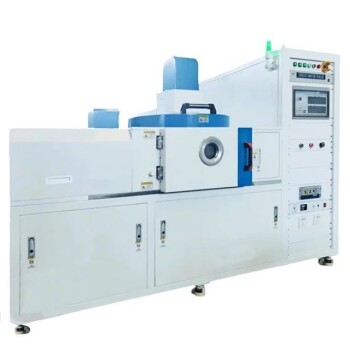
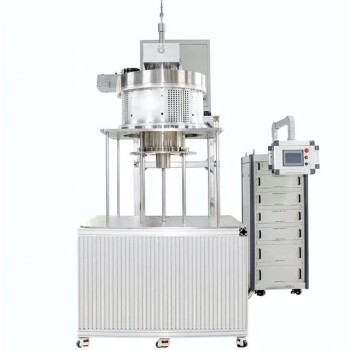
Pulse plasma sintering achieves ultra-high density through a sophisticated interplay of micro-arc discharges, localized surface melting, and applied pressure—all under vacuum.
The process passes high‑amplitude, short‑duration current pulses directly through a graphite die and powder compact, stripping surface oxides and instantly welding particle contacts together. Combined with the protective vacuum environment, this mechanism pushes relative densities beyond 99% while keeping the bulk of the sample relatively cool, drastically suppressing grain growth and delivering fine‑grained microstructures in record time.
Achieving true ultra‑high density in a lab vacuum furnace is not merely a matter of heating and pressing harder. Pulse plasma sintering (PPS) solves the core problem—pore‑grain boundary separation—by sparking micro‑arcs between particles, cleaning their surfaces, and creating fleeting local melting that anchors pores to grain boundaries until they are eliminated. The result is a near‑theoretical density compact, produced in minutes rather than hours, with grains that remain almost as small as the starting powder.
The Challenge: Why Conventional Vacuum Sintering Falls Short
The Density Ceiling and Pore Breakaway
In a conventional vacuum sintering process, densification often plateaus around 92–95% theoretical density.
At this stage, rapidly growing grains can break away from pores, leaving isolated pores trapped inside crystals.
From that point, further densification relies on slow, bulk vacancy diffusion through the crystal lattice.
The so‑called “density ceiling” is a direct consequence of this structural divorce between pores and fast grain‑boundary pathways.
Why a Vacuum Alone Is Not Enough
Evacuating the furnace does enhance vapor‑phase transport, helping to move material from convex to concave pore surfaces.
This can pins pores to grain boundaries a little longer, but it cannot overcome the fundamental breakaway dynamic when sintering is purely thermally driven.
The real breakthrough requires a way to keep particles surfaces clean and to deliver energy precisely where it is needed—at the inter‑particle contacts.
This is exactly where pulse plasma sintering rewrites the rules.
The PPS Mechanism: How Pulses Drive Densification
Micro‑Arc Discharges and Surface Purification
Pulse plasma sintering applies high‑frequency current pulses, each lasting only several hundred microseconds, across a powder compact held in a graphite die.
During each pulse, the electrical potential difference between adjacent particles triggers micro‑arc discharges.
These tiny, localized arcs act like a microscopic sandblaster.
They strip off surface oxides faster than any vacuum bake‑out, exposing pristine, highly reactive metal surfaces.
Simultaneously, the intense thermal spike at the particle contact points accelerates surface diffusion.
Atoms migrate across the clean surfaces with extreme efficiency, initiating neck formation almost instantly.
Localized Surface Melting While the Bulk Stays Cool
Because the pulse duration is so short relative to the interval between pulses, the heating is quasi‑adiabatic.
The energy is concentrated in a thin skin at the particle surfaces, often causing localized surface melting exactly where necks must form.
The bulk of each particle remains at a much lower temperature.
This temperature disparity is the secret behind PPS’s microstructural control: the sample densifies rapidly at the contacts, yet the crystals themselves do not have enough time or thermal energy to grow significantly.
Synergy with Axial Pressure
External mechanical pressure from the graphite punches works in concert with the electrical pulses.
Once the micro‑arcs create molten or highly softened contact points, the pressure collapses the pores immediately, squeezing the compact to near‑theoretical density.
This combined electro‑mechanical driving force simultaneously eliminates multiple pores along grain boundaries in seconds.
The result is a fully dense, fine‑grained monolith that a conventional furnace could never produce in practical soak times.
The Essential Role of Vacuum in PPS
Preventing Re‑Oxidation and Trapping Impurities
All of this is performed inside a vacuum chamber, typically at pressures below 10⁻² Pa.
If the process ran in air, the freshly exposed, micro‑arc‑cleaned surfaces would oxidize immediately, rewinding the purification step.
Vacuum also removes gaseous by‑products released during oxide dissociation.
It keeps the pore surfaces clean, ensuring that fast grain‑boundary diffusion can keep eliminating vacancies all the way to 99%+ density.
Stabilizing the Micro‑Arc Process
The dielectric breakdown characteristics between particles depend on a clean, controlled atmosphere.
A vacuum environment reduces parasitic arcing and makes the micro‑arc discharge pattern more uniform and repeatable, improving densification homogeneity across the sample.
Key Operational Advantages for Laboratory Systems
Unmatched Speed and Thermal Efficiency
A PPS cycle typically completes densification in minutes instead of hours.
The process only heats the die and the particle contacts, not the entire furnace volume, so energy consumption is sharply reduced and turnaround times are accelerated.
Exceptional Grain Size Control
Because the bulk sample temperature stays relatively low, the powders’ fine grain structure is largely preserved.
This allows researchers to produce nanostructured or ultrafine‑grained materials that retain high hardness, strength, and even enhanced functional properties.
Adaptability to Hard‑to‑Sinter Materials
The micro‑arc cleaning effect makes PPS particularly effective for refractory metals, advanced ceramics, and composite powders—materials that normally require extreme temperatures and long holds to even reach moderate density.
In a lab setting, this means one can densify challenging compositions like tungsten‑rhenium alloys or carbides without contaminating the microstructure through prolonged heating.
Near‑Theoretical Densities, Reproducibly
Relative densities exceeding 99%—often 99.9%—are achievable consistently once the pulsing profile, pressure, and die configuration are optimized.
This reproducibility is critical for academic studies where a single processing variable must be correlated to final performance.
Understanding the Trade‑offs of Pulse Plasma Sintering
Equipment Complexity and Capital Cost
A PPS setup demands a high‑power pulsed current supply, precision timing controls, and a robust vacuum system.
This complexity translates to higher upfront cost compared to a simple hot press or tube furnace, and it requires operator training to manage the pulsing profiles safely.
Sample Geometry and Tooling Limitations
The graphite die assembly imposes size and shape constraints; producing large, complex‑geometry parts can be challenging.
Dies wear over time, especially when processing reactive or hard materials, which adds a recurring consumables cost and may require frequent tooling maintenance.
Conductivity Requirements
For the current to pass effectively and generate micro‑arcs, the powder compact must have at least some degree of electrical conductivity.
Highly insulating ceramics sometimes need conductive additives or indirect heating strategies, which can complicate the simple direct‑pulse approach.
Risk of Localized Overheating
If pulse energy is not carefully calibrated, the micro‑arcs can intensify into localized macro‑discharges, causing uneven melting, microstructural inhomogeneity, or even die damage.
This makes process development a non‑trivial task for each new material system.
Making the Right Choice for Your Sintering Goals
Whether pulse plasma sintering is the best route depends on the property targets and constraints of your laboratory research. Consider the following guide to align the technology with your primary objective.
- If your primary focus is achieving the highest possible density while retaining a near‑nanocrystalline grain size: PPS is almost always the superior choice, as its quasi‑adiabatic pulsing uniquely suppresses grain growth while delivering 99%+ density.
- If your primary focus is processing oxygen‑sensitive or refractory materials that form tenacious surface oxides: The micro‑arc cleaning effect under vacuum gives PPS a decisive advantage by exposing pristine surface layers that conventional vacuum sintering cannot match.
- If your primary focus is simple, low‑cost densification of large, uncomplicated shapes where moderate density (95%) is acceptable: A conventional vacuum hot press may be more economical and easier to operate, accepting the trade‑off in grain size and maximum density.
- If your primary focus is high‑throughput screening of multiple powder compositions in a teaching or core‑facility environment: The rapid cycle time and reproducibility of PPS can offset the initial learning curve, making it a versatile workhorse for diverse research programs.
By matching the unique strengths of pulse plasma sintering to the true priorities of your lab, you can move past incremental improvements in density and produce materials with precisely the microstructure needed for cutting‑edge performance.
Summary Table:
| Feature / Metric | Conventional Vacuum Sintering | Pulse Plasma Sintering (PPS) |
|---|---|---|
| Relative Density | Plateau at 92% – 95% | Exceeds 99% (near-theoretical) |
| Sintering Time | Hours | Minutes |
| Microstructural Control | Significant grain growth | Fine-grained / Nanostructured |
| Oxide Removal | Slow thermal vacuum dissociation | Rapid micro-arc discharge stripping |
| Energy Efficiency | Low (heats entire furnace volume) | High (localized contact heating) |
Ready to achieve near-theoretical density and precise grain control in your laboratory? KINTEK specializes in high-performance laboratory equipment and consumables, offering a comprehensive range of customizable high-temperature furnaces—including vacuum, tube, muffle, CVD, and atmosphere systems—tailored to your unique research needs. Discover how our cutting-edge thermal solutions can elevate your material processing—contact KINTEK today!
Related Products
- Spark Plasma Sintering SPS Furnace
- Vacuum Heat Treat Sintering Furnace with Pressure for Vacuum Sintering
- Vacuum Heat Treat Sintering Furnace Molybdenum Wire Vacuum Sintering Furnace
- Small Vacuum Heat Treat and Tungsten Wire Sintering Furnace
- 9MPa Air Pressure Vacuum Heat Treat and Sintering Furnace
People Also Ask
- Why is it necessary to maintain a high vacuum environment during the SPS of SiC? Key to High-Density Ceramics
- How does the heating mechanism of Spark Plasma Sintering (SPS) function? Enhance TiC/SiC Composite Fabrication
- What are the technical advantages of using an SPS sintering furnace? Elevate Al2O3-TiC Material Performance
- What are the advantages of Spark Plasma Sintering (SPS)? Achieve Superior Microstructures
- What are the steps in the discharge plasma sintering process? Master Fast, High-Density Material Consolidation