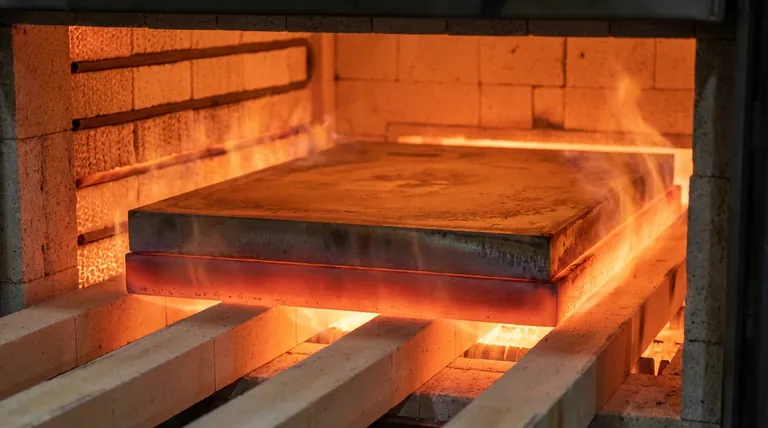
Increasing the soaking zone temperature in a walking-beam furnace serves as a direct lever to elevate the core temperature of a Titanium/Steel clad plate. Data from numerical simulations reveals a highly efficient thermal transfer ratio: for every 5°C increase in the soaking zone's ambient temperature, the plate's center temperature rises by an average of 4.5°C.
Increasing the soaking zone temperature effectively drives heat into the plate's core, but it introduces a delicate variable: while the core heats up, the temperature gap between the surface and the center may slightly widen, challenging the uniformity required for precision rolling.
The Mechanics of Thermal Transfer
Driving Core Temperature
The primary function of adjusting the soaking zone is to ensure the inner layers of the clad plate reach the necessary thermal state.
Unlike the preheating stage, where surface heating is rapid and gradients are high, the soaking zone focuses on penetrating the core. The data indicates that the core is highly responsive to changes in this specific zone's ambient temperature.
Achieving Thermal Equilibrium
The soaking zone is designed to provide a high-temperature environment with minimal fluctuations.
This stability allows the plate to reach internal thermal equilibrium, ensuring that the Titanium and Steel layers possess consistent plastic deformation capabilities. This consistency is a prerequisite for meeting high-precision rolling requirements downstream.
Understanding the Trade-offs
The Risk to Uniformity
While raising the temperature helps reach the target core heat faster, the primary reference notes a critical side effect: it may slightly increase the cross-sectional temperature difference.
Ideally, the soaking zone reduces the delta between the surface and the core. However, aggressively increasing the zone's temperature can push the surface temperature higher before the core has fully equalized, potentially reintroducing a thermal gradient.
Balancing Heating Speed vs. Quality
Optimization requires finding the "sweet spot" between how fast you heat the plate and how uniform the temperature remains.
If the temperature is too low, the core remains too cool for effective rolling; if raised too aggressively, the resulting temperature inequality across the cross-section could compromise the clad interface.
Making the Right Choice for Your Goal
To optimize the heating process curve, you must weigh the need for core temperature against the strict requirement for cross-sectional uniformity.
- If your primary focus is increasing rolling speed: You can raise the soaking zone temperature to rapidly bring the plate's core to the target rolling temperature, provided you monitor the cross-sectional gradient.
- If your primary focus is interface integrity and precision: Prioritize a moderate temperature increase combined with optimized residence time to ensure the surface and core temperatures are as close as possible.
precise thermal control in the soaking zone is the key to preventing stress damage while ensuring the plate is sufficiently malleable for processing.
Summary Table:
| Factor | Impact of 5°C Zone Increase | Goal in Soaking Zone |
|---|---|---|
| Core Temperature | Increases by ~4.5°C | Ensure sufficient malleability for rolling |
| Thermal Gradient | May slightly widen/increase | Minimize surface-to-center delta |
| Layer Consistency | Variable based on heat depth | Achieve uniform plastic deformation |
| Process Focus | High thermal transfer efficiency | Balance heating speed vs. interface quality |
Optimize Your Clad Plate Processing with KINTEK
Precision thermal control is critical for maintaining the interface integrity of Titanium/Steel clad plates. Backed by expert R&D and world-class manufacturing, KINTEK offers high-performance Muffle, Tube, Rotary, Vacuum, and CVD systems, all fully customizable to meet your unique laboratory or industrial high-temperature needs.
Ready to achieve superior thermal uniformity? Contact our specialists today to discuss how our custom furnace solutions can enhance your production quality and efficiency.
References
- Zhanrui Wang, Hui Yu. Numerical investigation on heating process of Ti/Steel composite plate in a walking-beam reheating furnace. DOI: 10.2298/tsci231108082w
This article is also based on technical information from Kintek Furnace Knowledge Base .
Related Products
- Slide PECVD Tube Furnace with Liquid Gasifier PECVD Machine
- Electric Rotary Kiln Small Rotary Furnace Biomass Pyrolysis Plant Rotating Furnace
- Vacuum Sealed Continuous Working Rotary Tube Furnace Rotating Tube Furnace
- Mesh Belt Controlled Atmosphere Furnace Inert Nitrogen Atmosphere Furnace
- Vertical Laboratory Quartz Tube Furnace Tubular Furnace
People Also Ask
- What are the main advantages of PECVD tube furnaces compared to CVD tube furnaces? Lower Temp, Faster Deposition, and More
- What is plasma in the context of PECVD? Unlock Low-Temperature Thin Film Deposition
- What are the typical conditions for plasma-enhanced CVD processes? Achieve Low-Temperature Thin Film Deposition
- What plasma source is used in PE-CVD tube furnaces? Unlock Low-Temperature, High-Quality Deposition
- What are the advantages of using a tube furnace CVD system for Cu(111)/graphene? Superior Scalability and Quality