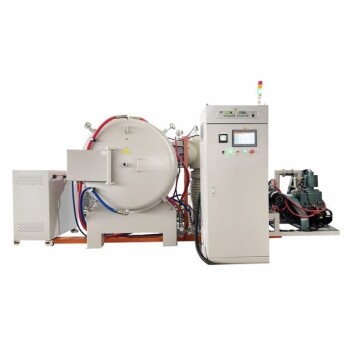
The invisible lever governing powder densification is total gas pressure inside your furnace.
Controlling the total gas pressure and atmosphere composition in high-temperature vacuum or atmosphere furnaces directly selects which gas-phase sintering mechanism dominates. At very low pressures (vacuum), the mean free path of vapor species becomes longer than the distance between particles, making evaporation‑condensation the primary transport mode—this grows necks without shrinking the compact. Raising the total gas pressure shortens the mean free path, suppresses evaporation, and shifts mass transport toward solid‑state diffusion paths that produce densification. Atmosphere management also dictates surface chemistry, volatile species removal, and the back‑pressure from gases trapped in isolated pores, all of which determine final density and microstructural integrity.
Controlling furnace pressure and atmosphere is a precision engineering decision, not just a shield against oxidation. By tuning total gas pressure, you toggle between vapor‑phase neck growth (no densification) and solid‑state diffusion (bulk densification), while simultaneously eliminating trapped gas pockets that would otherwise arrest pore closure and cause blistering.
The Physics of Gas‑Phase Transport
How Pressure Governs the Mean Free Path
In any gas environment, the mean free path—the distance a vapor atom travels before colliding with another gas molecule—is inversely proportional to the total pressure.
In a vacuum furnace, the mean free path easily exceeds the interparticle distance in a powder compact. Vapor atoms can traverse the gaps between particles without scattering; they re‑condense on particle surfaces, building necks.
When you raise the total pressure by introducing an inert gas, the mean free path shrinks drastically.
Collisions multiply, and vapor atoms can no longer travel particle‑to‑particle efficiently. The evaporation‑condensation mechanism is choked off. At the same time, the diffusivity of any gas species (Dg) drops because it is also inversely proportional to pressure, further dampening gas‑phase transport.
Two Competing Mechanisms: Evaporation‑Condensation vs. Gas Diffusion
Under high‑vacuum conditions, evaporation‑condensation dominates for materials with high vapor pressure.
Material evaporates from convex regions of particles, diffuses through the spacious vacuum “channels”, and condenses onto concave neck regions. The neck grows, but the centers of the particles do not move closer—there is no bulk shrinkage or densification.
When the total gas pressure is elevated, the short mean free path greatly reduces vapor‑phase transport. The system now prefers solid‑state diffusion along grain boundaries or through the lattice.
These diffusion processes remove material from between particles and deposit it at the neck, pulling particle centers together. The result is measurable shrinkage and a rise in density. Gas‑phase diffusion still exists, but it becomes a minor contributor compared to solid‑state pathways.
Impact on Sintering Stages
Initial‑Stage Neck Growth: When Vapor‑Phase Transport Helps or Hurts
In the early stage, evaporation‑condensation can rapidly bridge particles with smooth, well‑developed necks.
For applications that require a porous skeleton (e.g., filters, catalyst supports), this is beneficial. You obtain mechanical integrity without losing void volume.
Conversely, if your goal is a fully dense component, neck growth without shrinkage is a pitfall.
It consumes surface area that would otherwise drive densification later. By raising the furnace pressure (e.g., with argon), you suppress this non‑densifying mechanism and redirect the sintering kinetics toward grain‑boundary diffusion, which actively eliminates porosity.
Final‑Stage Densification: The Battle Against Trapped Gases
During liquid‑phase sintering or the final solid‑state stage, pores become isolated bubbles.
Any insoluble gas trapped inside—argon, nitrogen, or reaction by‑products—exerts an internal pressure (Pg) that counters the capillary pressure (Pc) trying to squeeze the pore shut.
Sintering stalls when Pg equals Pc, leaving residual porosity.
Over extended cycles, gas diffuses through the liquid or solid, causing pore coarsening, overall swelling, and surface blisters. Using a vacuum or controlled atmosphere to evacuate volatile species before pore closure eliminates this back‑pressure, allowing capillary forces to drive near‑theoretical density.
Atmosphere Chemistry: More Than Just Pressure
Protective Atmospheres and Surface Oxide Removal
Merely setting total pressure is not enough—the chemical identity of the gas matters.
Inert atmospheres (argon, helium) and high vacuum prevent oxidation of reactive metals and non‑oxide ceramics. They maintain the chemistry of the powder surface, avoiding diffusion‑blocking oxide layers.
A reducing atmosphere, such as hydrogen, goes further by chemically stripping native surface oxides.
Clean particle surfaces enhance solid‑state diffusion, accelerating densification while simultaneously removing the barrier that would otherwise keep particles apart. This is a dual benefit of atmosphere control: you suppress unwanted vapor transport with pressure and activate densifying diffusion with chemistry.
Active Gases and Stoichiometry Control
Some processes demand more than protection or reduction.
Active gas mixtures can deliberately participate in reactions—carburizing, nitriding, or maintaining precise oxygen partial pressures to preserve stoichiometry in sensitive ceramics. By choosing a gas that reacts in a controlled way, you turn the atmosphere into a tool for tailoring phase composition and defect chemistry, which directly influences diffusion rates and final properties.
Understanding the Trade‑offs
Controlling sintering atmospheres is a balancing act with real consequences.
- Vacuum can cause undesirable volatilization. If your material contains high‑vapor‑pressure species (e.g., Li, Pb, or certain oxides), excessive evaporation can alter composition and create surface depletion zones.
- High pressure does not completely eliminate all vapor transport. Materials with extremely high vapor pressures may still exhibit non‑negligible evaporation‑condensation even at elevated inert gas pressures, requiring a careful process window.
- Incomplete gas removal before pore closure is catastrophic. If you switch from vacuum to pressure too late, trapped gas pockets will inflate, causing swelling and blistering regardless of the external pressure.
- Active atmospheres can overshoot their chemical purpose. A reducing atmosphere that is too aggressive may cause decarburization in cemented carbides or over‑reduce oxide ceramics, leaving metallic phases that degrade performance.
Every choice of pressure and gas composition must be calibrated to the material system and the targeted final state.
Making the Right Choice for Your Goal
The same furnace can produce a porous scaffold or a fully dense part—the difference lies in how you set the gas parameters.
- If your primary focus is achieving maximum final density: Suppress evaporation‑condensation by operating under an elevated inert gas pressure (e.g., argon) and ensure a high‑vacuum or reducing‑atmosphere cycle early to evacuate trapped gases before pore isolation.
- If your primary focus is preserving a porous network with strong necks: Use high vacuum with materials that exhibit significant vapor pressure. This promotes neck growth through evaporation‑condensation without bulk shrinkage, locking in the open porosity.
- If your primary focus is processing reactive powders without oxidation: Employ a flowing reducing atmosphere (hydrogen) or ultra‑high vacuum to strip surface oxides and maintain chemical cleanliness, while selecting a total pressure that either encourages or discourages vapor transport depending on your densification target.
Mastery of total furnace pressure and atmosphere chemistry transforms sintering from an empirical recipe into a predictive engineering dial—you decide whether mass moves by vapor or by solid‑state diffusion, and whether pores shrink or remain open, to meet the exact demands of your part.
Summary Table:
| Mechanism | Pressure & Atmosphere | Mass Transport Pathway | Density & Shrinkage Impact | Primary Application |
|---|---|---|---|---|
| Evaporation-Condensation | High Vacuum (Low Pressure) | Vapor phase (Long mean free path) | Neck growth without shrinkage; preserves void volume | Porous scaffolds, filters, catalyst supports |
| Solid-State Diffusion | Elevated Pressure (Inert Gas) | Grain boundary & lattice diffusion | Active shrinkage and high bulk densification | Fully dense structural parts & technical ceramics |
| Surface Oxide Reduction | Flowing Atmosphere (e.g., $H_2$) | Surface cleaning + boundary diffusion | Removes diffusion barriers, accelerates pore closure | Reactive powders, MIM components, non-oxide ceramics |
Elevate Your Thermal Processing Precision with KINTEK
Achieving theoretical density or tailored porosity requires uncompromised control over your furnace environment. KINTEK offers industry-leading laboratory equipment and consumables, specializing in customizable high-temperature furnaces—including vacuum, controlled atmosphere, tube, muffle, CVD, atmosphere, dental, and induction melting furnaces—designed to give you exact control over total pressure, atmosphere chemistry, and thermal profiles.
Whether you are refining advanced ceramic microstructures or optimizing powder metallurgy densification, our technical experts are ready to tailor the perfect solution for your lab.
Contact KINTEK Today for a Custom Solution
Related Products
- 1400℃ Controlled Inert Nitrogen Atmosphere Furnace
- 1700℃ Controlled Inert Nitrogen Atmosphere Furnace
- 2200 ℃ Tungsten Vacuum Heat Treat and Sintering Furnace
- Molybdenum Vacuum Heat Treat Furnace
- 2200 ℃ Graphite Vacuum Heat Treat Furnace
People Also Ask
- How does nitrogen atmosphere control in high-temperature furnaces prevent the decomposition of silicon nitride during sintering?
- How does oxygen partial pressure control affect ceramic sintering? Master Defect Chemistry
- How do controlled-atmosphere furnaces support polymer pyrolysis? Master SiC & Si3N4 Ceramic Conversion
- Why is controlled-atmosphere heating required for functional ceramics and sensors? Master Defect Engineering
- Why is thorough binder burnout necessary before sintering advanced ceramics? Ensure Peak Density & Zero Defects