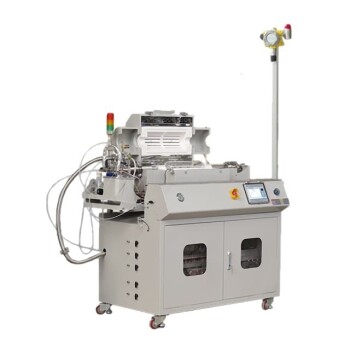
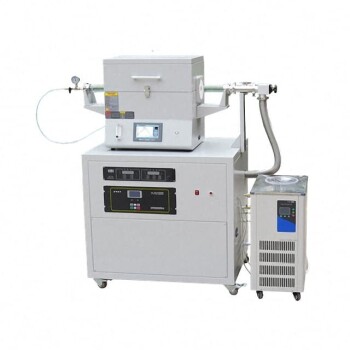
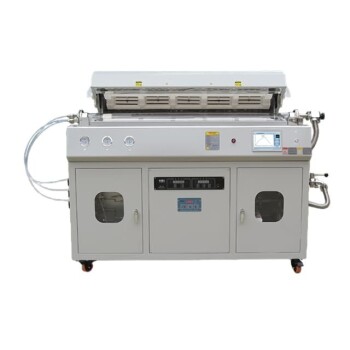
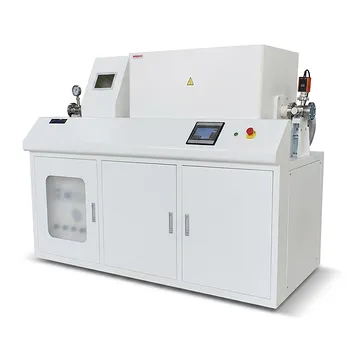
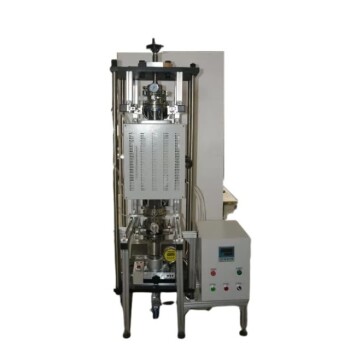
The synthesis of wide bandgap III-nitride semiconductors like GaN and AlN directly dictates the fundamental specifications of the laboratory CVD furnace. The need to grow defect‑free epitaxial layers at temperatures exceeding 1100°C under carefully controlled low‑pressure atmospheres means researchers cannot choose a generic high‑temperature oven. They must select a furnace purpose‑built to deliver exceptional thermal homogeneity, precise vacuum and gas‑handling capability, and absolute protection from contamination.
To reliably deposit high‑quality III‑nitride films, a laboratory CVD furnace must sustain stable temperatures beyond 1100°C with minimal thermal gradients, maintain a tightly controlled low‑pressure environment, and prevent parasitic side reactions—all while heating the substrate uniformly. These aren’t optional features; they are the direct consequence of the material’s fundamental synthesis chemistry.
Why III‑Nitride Synthesis Pushes Furnace Boundaries
The crystalline quality of GaN, AlN, and AlGaN directly determines their mechanical, electrical, and piezoelectric performance. The furnace becomes the enabler—or the bottleneck—of that quality.
Synthesis Temperatures Exceeding 1100°C
Wide bandgap III‑nitrides require high thermal energy to break precursor bonds, promote surface mobility of adatoms, and achieve the ordered wurtzite crystal structure. Temperatures reliably exceeding 1100°C are non‑negotiable for minimizing structural defects that degrade Young’s modulus, internal mechanical losses, and piezoelectric stability. A furnace that merely “reaches” these temperatures is insufficient; it must hold them without drift for the duration of the deposition run.
The Critical Role of Thermal Homogeneity
Defect‑free epitaxial layers depend on every point of the substrate experiencing the same temperature. Even small thermal gradients create local variations in growth rate and alloy composition—disastrous for heterostructures like AlGaN/GaN where a 2D electron gas (2DEG) must form at a precise interface. Non‑uniform heating introduces dislocations and point defects that directly compromise the material’s high‑frequency and harsh‑environment performance. Laboratory CVD furnaces designed for this purpose therefore incorporate multi‑zone heating and advanced insulation to flatten thermal profiles.
Low‑Pressure Atmospheres for Purity and Control
III‑nitride deposition is predominantly performed at reduced pressure, often in the 10–200 Pa range. This environment enhances precursor transport, suppresses gas‑phase nucleation, and gives the operator fine control over film stress. A furnace without a reliable vacuum system and precise pressure regulation simply cannot deliver the controlled low‑pressure atmosphere that prevents parasitic reactions and maintains stoichiometry. The chamber must be leak‑tight and capable of rapid pump‑down while holding a steady process pressure.
Matching Furnace Design to Material Demands
Translating these synthesis requirements into furnace specifications dictates every hardware decision, from the heating element to the gas panel.
Heating Element and Insulation: Beyond Just High Temperatures
Reaching and maintaining >1100°C with excellent uniformity calls for advanced heating elements based on molybdenum disilicide (MoSi₂) or silicon carbide. These materials offer the necessary thermal stability and resist oxidation. Coupled with high‑performance refractory insulation, they create a hot zone where temperature gradients are kept ±1°C or better across the substrate. Multi‑zone control further refines this uniformity, compensating for edge losses that could ruin an epitaxial run.
Precision Atmosphere Control: Gas Handling and Vacuum Systems
The furnace must integrate mass flow controllers, vacuum gauges, and throttle valves to precisely meter organometallic precursors (trimethylgallium, trimethylaluminum) and reactive gases (ammonia) under reduced pressure. The system’s pumping speed and downstream pressure control must balance sufficient residence time for deposition against rapid removal of reaction byproducts. Any lag in gas switching or pressure instability blurs the interface sharpness in heterostructures—a critical failure for 2DEG‑confined devices.
Contamination Prevention: A Non‑Negotiable Requirement
At temperatures exceeding 1100°C, even trace oxygen or moisture can catastrophically degrade III‑nitride film quality. The furnace’s process tube material—typically high‑purity quartz or alumina—must be resistant to thermal shock and chemical attack. The design must enable thorough bake‑out cycles and provide inert atmosphere purging. For MEMS applications, where a high Young’s modulus and low mechanical loss depend on perfect crystallinity, contamination control is not an accessory; it is the deciding factor in furnace selection.
Understanding the Trade‑offs
Every high‑performance furnace embodies intentional compromises. Recognizing them helps you match the tool to your most critical objectives.
Energy Consumption and Operational Costs
Running a furnace continuously at >1100°C draws significant power and accelerates wear on heating elements and insulation. A furnace with thicker insulation and robust elements may have a higher upfront cost but a lower total cost of ownership over years of III‑nitride research. Conversely, an under‑built system may save capital but cost more in downtime and element replacements.
Balancing Temperature Uniformity with Rapid Thermal Cycling
Some furnace designs emphasize fast ramp rates for rapid prototyping. Aggressive heating and cooling can introduce thermal stress in the process tube and compromise the temperature uniformity essential for defect‑free epitaxy. Researchers who prioritize throughput over absolute crystalline perfection must accept a slight trade‑off in film quality.
Vacuum Level vs. Precursor Utilization
Deeper vacuum levels improve ambient purity but can also strip unreacted precursors before they contribute to film growth. An overly aggressive pumping scheme leads to wasted organometallics and poor deposition efficiency. The optimum furnace configuration balances base pressure, pumping speed, and precursor delivery to maximize material utilization without sacrificing film purity.
Making the Right Choice for Your III‑Nitride Research
The perfect laboratory CVD furnace doesn’t exist in a vacuum—it exists in the context of your specific research goals. Tailor your selection to the outcome you need.
- If your primary focus is defect‑sensitive MEMS devices: Prioritize a furnace with the highest achievable thermal uniformity (<±1°C across the substrate) and low‑leak vacuum integrity to preserve the film’s high Young’s modulus and piezoelectric stability.
- If your primary focus is rapid heterostructure prototyping: Opt for a system with flexible multi‑zone temperature control and fast gas‑switching capabilities, even if it means a slight trade‑off in ultimate temperature uniformity.
- If your primary focus is sustained, long‑term epitaxial runs for advanced 2DEG structures: Choose a furnace with proven long‑term stability, heating elements rated for continuous >1100°C operation, and a contamination‑resistant process tube that minimizes maintenance interruptions.
Understanding the exacting thermal and atmospheric demands of III‑nitride growth transforms furnace selection from a simple purchase into a strategic decision—one that directly enables the next generation of high‑performance semiconductor devices.
Summary Table:
| Synthesis Requirement | Key CVD Furnace Feature | Impact on III-Nitride Material Quality |
|---|---|---|
| High Thermal Energy (>1100°C) | MoSi₂ or SiC heating elements with robust insulation | Breaks precursor bonds, promotes adatom mobility, and minimizes structural defects. |
| Thermal Homogeneity (<±1°C) | Multi-zone heating control and advanced refractory lining | Prevents local growth rate variations, dislocations, and compositional drift. |
| Low-Pressure Atmosphere (10–200 Pa) | Integrated vacuum pumps, throttle valves, and precise MFCs | Suppresses gas-phase nucleation, enables sharp heterostructure interfaces, and optimizes stoichiometry. |
| High Material Purity | High-purity quartz/alumina process tubes and purge capabilities | Prevents trace oxygen/moisture contamination that degrades piezoelectric and mechanical performance. |
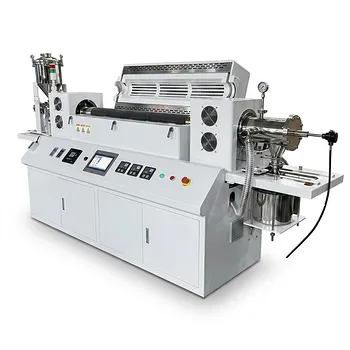
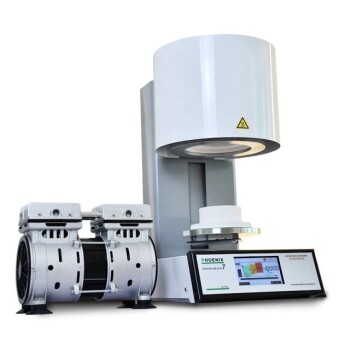
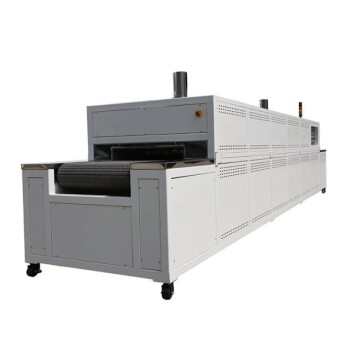
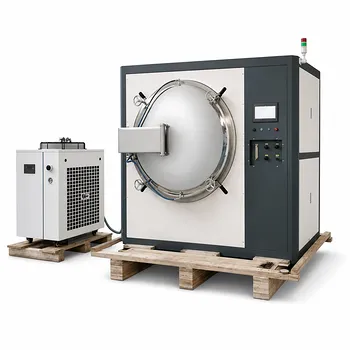
Ready to elevate your semiconductor research with precision thermal processing? KINTEK specializes in laboratory equipment and consumables, offering a comprehensive range of high-temperature furnaces—including advanced CVD, vacuum, tube, muffle, rotary, atmosphere, dental, and induction melting systems. Tailored to sustain continuous >1100°C temperatures with exceptional thermal uniformity and strict atmosphere control, our lab high-temp furnaces are fully customizable for your unique material synthesis needs. Contact KINTEK today to discuss your customized CVD furnace solution!
Related Products
- Custom Made Versatile CVD Tube Furnace Chemical Vapor Deposition CVD Equipment Machine
- Split Chamber CVD Tube Furnace with Vacuum Station CVD Machine
- Multi Heating Zones CVD Tube Furnace Machine for Chemical Vapor Deposition Equipment
- Slide PECVD Tube Furnace with Liquid Gasifier PECVD Machine
- Controlled Inert Nitrogen Hydrogen Atmosphere Furnace
People Also Ask
- What is a CVD tube furnace and what is its primary function? Discover Precision Thin-Film Deposition
- Why are CVD tube furnace sintering systems indispensable for 2D material research and production? Unlock Atomic-Scale Precision
- How does CVD tube furnace sintering enhance graphene growth? Achieve Superior Crystallinity and High Electron Mobility
- Which industries and research fields benefit from CVD tube furnace sintering systems for 2D materials? Unlock Next-Gen Tech Innovations
- What is the working principle of a CVD tube furnace? Achieve Precise Thin Film Deposition for Your Lab