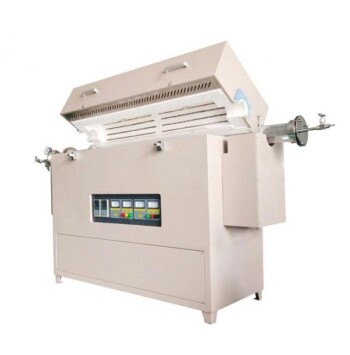
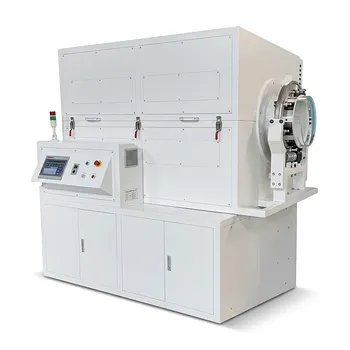
The melting point of a technical ceramic is not its only thermal threshold—it’s the absolute ceiling that dictates every safe processing choice in a high-temperature laboratory furnace. For alumina (Al₂O₃), that ceiling is approximately 2053 °C; for aluminum nitride (AlN), it’s around 2000 °C; and for boron carbide (B₄C), it’s a robust 2350 °C. These numbers directly determine the maximum furnace temperature you can set, the crucible and hearth materials you select, and whether you need a simple muffle furnace or a vacuum/inert-gas system to avoid catastrophic failure.
The melting points of alumina, AlN, and B₄C set the absolute safe operating limit, but real-world processing almost always occurs at a fraction of that temperature. Selection hinges on matching not only the thermal ceiling but also the required sintering window and the material’s chemical stability in the furnace atmosphere.
The Melting Point Ceiling: Why Absolute Limits Matter
A ceramic’s melting point is not just a spec-sheet number. It’s the immediate redline for any furnace operation.
Defining Maximum Safe Operating Temperatures
When you program a laboratory furnace, you must never approach the melting point of the crucible, hearth plate, or structural lining. Exceeding it leads to fusion, sample loss, and irreparable damage to the hot zone. For AlN, staying well below 2000 °C is critical; even a brief overshoot can weld a crucible to its support or destroy a delicate work tube.
Preventing Crucible Fusion and Chamber Contamination
Operating below the melting threshold ensures physical integrity. If an alumina crucible softens near 2053 °C, it can contaminate the sample with dissolved ceramic and leave a glassy mess on the furnace floor. This contamination then degrades the heating elements and ruins future runs. The melting point therefore acts as the primary safety lock.
From Melting to Sintering: Setting Process Temperatures
In most labs, the goal isn’t to melt a ceramic but to sinter it. The melting point tells you exactly where the useful processing window begins.
The 50–80% Rule for Solid-State Densification
Solid-state sintering typically requires a temperature between 50% and 80% of the material’s melting point (in Kelvin). This is where atomic diffusion becomes fast enough to bond particles and eliminate pores, without triggering melting. The melting point thus directly predicts the operational temperature range of your furnace.
Sintering Windows: Alumina, AlN, and Boron Carbide
- Alumina (Al₂O₃) melts at 2053 °C, so high-purity alumina bodies are commonly fired between 1550 °C and 1700 °C. This avoids deformation while achieving near-full density in a standard muffle or tube furnace.
- Aluminum Nitride (AlN), with a 2000 °C melting point, requires 1850 °C–1900 °C sintering to reach >97.5% density, especially when using yttria additives. The span is narrow and demands a furnace capable of precise, stable control near its thermal limit.
- Boron Carbide (B₄C) melts at 2350 °C, pushing practical sintering temperatures well above 2000 °C. This mandates specialized vacuum or inert-atmosphere furnaces that can operate reliably in that extreme range.
The Hidden Challenge: Atmosphere Sensitivity in Non-Oxides
A melting point alone can be misleading. For AlN and B₄C, chemical stability often trumps the thermal ceiling.
AlN Oxidation Above 700 °C
Although AlN’s melting point is 2000 °C, it begins to oxidize in air at just 700 °C. Processing AlN in a conventional muffle furnace with an oxidizing atmosphere will degrade its surface and ruin its high thermal conductivity. Proper processing demands a high-temperature atmosphere furnace with argon or nitrogen flow, regardless of the setpoint below the melt.
Boron Carbide and the Need for Inert or Vacuum Environments
B₄C is a non-oxide that cannot tolerate oxygen at high temperature. Sintering it near 2350 °C requires a vacuum furnace or a rigorously purged inert atmosphere. The melting point dictates the furnace’s thermal capability, but its chemical nature dictates the type of furnace you must buy. A standard air-ambient muffle furnace is useless for B₄C, no matter how high it can go.
Understanding the Trade‑offs
No single ceramic wins in every category. Each choice brings limitations you must manage.
The Alumina Workhorse Versus Its Temperature Cap
Alumina is economical and widely available, but its 2053 °C limit means you cannot exceed ~1800 °C in practice. If your process requires temperatures above that, you must step up to magnesia (MgO, melts at 2850 °C) or ultra‑refractories like zirconia, accepting higher cost or more complex handling.
AlN’s Conductivity Versus Its Processing Sensitivity
AlN delivers exceptional thermal conductivity (up to 148.5 W/m·K), but it demands an atmosphere-controlled furnace with precise temperature homogeneity near 1900 °C. The risk of carbon contamination from graphite hot zones also forces you to choose a metal hot zone or use sacrificial powder beds—adding cost and complexity.
B₄C’s Extreme Hardness Versus Hard‑to‑Reach Temperatures
B₄C offers outstanding hardness and a 2350 °C melting point, but reaching its sintering range pushes most laboratory furnaces to their absolute design limits. Heating elements made of graphite or refractory metals are mandatory, and the vacuum system must handle high outgassing without pressure spikes. This raises capital and maintenance expenses significantly.
Making the Right Choice for Your Goal
Align your material selection and furnace configuration with your operational priorities.
- If your primary focus is routine high‑temperature oxide processing: Stick with alumina crucibles and work tubes inside a well‑calibrated muffle furnace. Its 2053 °C ceiling and predictable sintering window near 1600 °C provide safe, repeatable results.
- If your primary focus is producing components with extreme thermal conductivity: Invest in an atmosphere‑controlled furnace for AlN, built with a metal hot zone and capable of stable operation at 1850–1900 °C under nitrogen. Protect the material from oxidation and carbon contamination at every stage.
- If your primary focus is ultra‑high‑temperature densification without oxygen: Choose boron carbide and pair it with a high‑vacuum or inert‑gas furnace that can reliably hold above 2000 °C. Ensure the heating elements (graphite, tungsten) and furnace shell are rated for sustained operation near the 2350 °C melt point.
By letting the melting point—and the material’s atmospheric requirements—drive your decision, you turn a fundamental property into a guarantee of process integrity and hardware longevity.
Summary Table:
| Technical Ceramic | Melting Point (°C) | Sintering Temp Range (°C) | Atmosphere Requirement | Recommended Furnace Type |
|---|---|---|---|---|
| Alumina (Al₂O₃) | ~2053 °C | 1550 °C – 1700 °C | Air / Inert | Muffle / Tube Furnace |
| Aluminum Nitride (AlN) | ~2000 °C | 1850 °C – 1900 °C | Nitrogen / Inert (Oxidizes >700 °C) | Atmosphere Furnace (Metal Hot Zone) |
| Boron Carbide (B₄C) | ~2350 °C | >2000 °C | High Vacuum / Inert Gas | Vacuum / High-Temp Inert Furnace |
Need precise temperature control and atmosphere management for high-temperature ceramic sintering? KINTEK specializes in laboratory equipment and consumables, offering a comprehensive range of high-temperature furnaces—including muffle, tube, rotary, vacuum, CVD, atmosphere, dental, and induction melting systems—all fully customizable for your unique needs. Protect your components and optimize densification by partnering with our thermal processing experts. Contact KINTEK today to discover the ideal furnace solution for your laboratory!
Related Products
- 1400℃ High Temperature Laboratory Tube Furnace with Alumina Tube
- 1700℃ High Temperature Laboratory Tube Furnace with Alumina Tube
- 1800℃ High Temperature Muffle Oven Furnace for Laboratory
- 1700℃ High Temperature Muffle Oven Furnace for Laboratory
- 1200℃ Muffle Oven Furnace for Laboratory
People Also Ask
- How does zone-melting in tube furnaces synthesize bismuth micro-wires? Master Single-Crystal Thermoelectric Growth
- How are high-temp tube furnaces used to measure diffusion coefficients per Fick's law? Master Precision Annealing
- How do high-temperature laboratory tube furnaces ensure environmental stability? Precision Thermal Reduction Tips
- How are high-temperature laboratory tube furnaces applied in long-term vacuum homogenization heat treatments for intermetallic samples?
- How are high-temperature tube furnaces applied in testing ceramic-supported alloy membranes? Insights