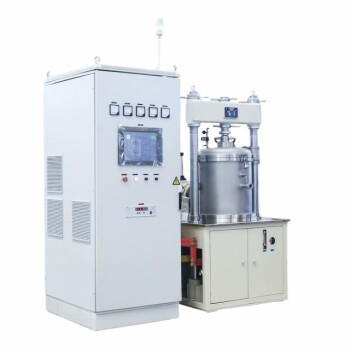
The core difference lies in the application of mechanical force. In ceramic processing, Spark Plasma Sintering (SPS) and hot-pressing furnaces introduce uniaxial pressure during heating, while conventional pressureless sintering relies entirely on thermal energy and capillary driving forces. This single addition fundamentally changes the densification pathway—pressure-assisted techniques lower the required peak temperature, slash holding times, and arrest grain growth in ways pressureless furnaces cannot match.
Pressure accelerates densification at the atomic level, enabling fully dense, fine-grained ceramics that are nearly impossible to achieve in a standard pressureless furnace. The trade-off is complexity: pressurized systems sacrifice shape flexibility, throughput, and simplicity in return for unmatched microstructural control.
The Fundamental Distinction: Pressure as a Driving Force
All sintering aims to transform a powder compact into a dense solid. The difference between the techniques lies in what drives matter to the pores.
How Pressureless Sintering Works
Conventional furnaces rely solely on capillary forces. At high temperatures, the system reduces its surface energy by neck formation and pore elimination through slow, thermally activated diffusion. This process demands high temperatures and long dwells, often leading to significant grain coarsening because grain boundary motion and densification compete for thermal energy.
Why Uniaxial Pressure Changes the Game
Adding mechanical pressure superimposes a stress-driven plastic flow mechanism onto the thermal diffusion. Uniaxial force directly squeezes particle contacts, lowers the activation energy for diffusion, and accelerates grain boundary sliding. As a result, densification occurs at lower temperatures and in shorter times, locking in a fine-grained microstructure before grains have a chance to grow.
Unpacking the Two Pressurized Techniques
Both SPS and conventional hot pressing apply uniaxial pressure, but their heating mechanisms differ dramatically, creating a performance gap.
Conventional Hot Pressing: Steady, Indirect Heat
A traditional hot press uses external heating elements (resistance or radiant) to heat a chamber, which then heats a die assembly containing the powder. Thermal energy must conduct from the outside inward, resulting in slow heating rates (often 10–50°C/min), process cycles spanning hours, and significant energy waste heating the entire furnace volume. The applied pressure amplifies densification, but the sluggish thermal response limits how quickly consolidation can occur.
Spark Plasma Sintering: Direct Electrical Energy
An SPS system passes a pulsed direct current (DC) directly through the electrically conductive graphite die and, in many cases, through the powder compact itself. This generates internal Joule heating and localized spark discharges at inter-particle contact points, enabling extreme heating rates—up to 1000°C/min. Energy is delivered exactly where it is needed, not wasted on the chamber.
Key Performance Consequences
- Heating rate and cycle time: SPS completes a full cycle in 5 to 20 minutes; conventional hot pressing requires several hours. Pressureless sintering may take tens of hours.
- Sintering temperature: SPS can achieve full density at 200°C to 500°C lower than pressureless methods and significantly below typical hot pressing temperatures.
- Grain structure preservation: The combination of lower temperature and minutes-long dwells effectively freezes nanostructured grains—a feat impossible in a pressureless furnace and challenging even in a conventional hot press.
How This Shapes Ceramic Microstructures and Properties
The practical outcome of these differences is decisive for demanding applications.
Densification and Grain Size
Pressureless sintering of difficult ceramics often ends with porous microstructures and coarse grains, because the high temperatures needed for densification inevitably drive grain growth. SPS and hot pressing decouple these two processes: pressure pulls pores shut while the low thermal budget keeps grain boundaries almost stationary, often yielding relatives densities above 99% with sub-micron grains.
Processing Volatile or Hard-to-Sinter Compositions
Materials that lose stoichiometry at high temperatures, such as chromite-based ceramics with volatile Cr₂O₃, become nearly impossible to densify in air pressureless furnaces without severe evaporation. SPS under a controlled vacuum can consolidate them at 1300°C in 10 minutes instead of 1600°C for hours, preserving the intended chemistry and reaching over 97% theoretical density.
Understanding the Trade-offs
Neither SPS nor hot pressing is a universal solution. Objectivity requires acknowledging their limitations.
Shape and Scale Constraints
Both SPS and conventional hot pressing use a uniaxial die, restricting parts to simple disks, rings, or plates. Complex near-net shapes demand extensive post-sintering machining, which adds cost and time. Pressureless sintering, by contrast, can handle intricate, pre-formed green bodies directly.
Throughput and Equipment Cost
SPS furnaces are expensive, high-technology systems with limited production volume per run. Conventional hot presses are simpler but still slower and less scalable than a continuous pressureless tunnel kiln. For high-volume, cost-driven ceramic manufacturing, pressureless sintering often remains the only economically viable choice.
Potential Contamination and Anisotropy
In SPS, the graphite die and punches can introduce carbon contamination at the sample surfaces. Additionally, uniaxial pressure creates directional stresses that may lead to texturing or anisotropic properties, which can be undesirable depending on the application.
Making the Right Choice for Your Ceramic Processing Goal
Selecting a sintering method requires matching the technique to your most critical requirement, not just chasing the latest technology.
- If your primary focus is achieving full density with ultra-fine grain sizes for advanced structural or functional ceramics: SPS is the top-performing choice, enabling near-theoretical density in minutes while preserving nanostructures.
- If your primary focus is processing volatile compositions or hard-to-sinter materials that lose stoichiometry at high temperatures: SPS under vacuum provides the rapid, low-temperature consolidation needed to maintain chemical integrity.
- If your primary focus is balancing improved densification with simpler equipment and a slightly wider shape window: Conventional hot pressing offers a pragmatic middle ground—better than pressureless, less expensive and complex than SPS.
- If your primary focus is high-throughput manufacturing of complex-shaped ceramic components at competitive cost: Pressureless sintering remains the industry workhorse, accepting slightly lower density and coarser grains in exchange for unparalleled shape freedom and scalability.
Your ultimate choice is a deliberate compromise between microstructural perfection and production practicality.
Summary Table:
| Feature / Parameter | Spark Plasma Sintering (SPS) | Conventional Hot Pressing | Pressureless Sintering |
|---|---|---|---|
| Driving Force | Uniaxial pressure + Direct Joule heating | Uniaxial pressure + External heating | Capillary forces (Thermal diffusion only) |
| Heating Rate | Ultra-fast (up to 1000°C/min) | Slow (10–50°C/min) | Moderate to slow |
| Processing Cycle Time | Rapid (5 to 20 minutes) | Long (several hours) | Very long (hours to tens of hours) |
| Sintering Temperature | Lowest (200°C–500°C lower) | Reduced | Highest peak temperature required |
| Microstructure & Grain Control | Prevents coarsening; locks in sub-micron/nanograins | Good grain growth control | Significant grain coarsening |
| Shape & Geometry | Restricted (simple disks, rings, plates) | Restricted (simple disks, rings, plates) | High flexibility (intricate near-net shapes) |
| Production & Cost | High equipment cost; batch processing | Moderate/High cost; batch processing | Highly scalable; cost-effective for mass production |
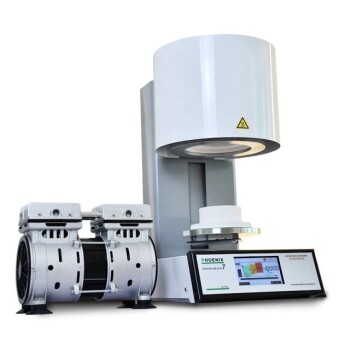
Achieve superior densification and precise microstructural control in your ceramic processing with KINTEK. As a trusted specialist in laboratory equipment and consumables, KINTEK offers a comprehensive range of advanced high-temperature furnaces—including muffle, tube, rotary, vacuum, CVD, atmosphere, dental, and induction melting furnaces—all fully customizable to meet your unique research and production demands. Whether you need high-vacuum precision, extreme heating rates, or tailored pressure solutions, our experts are here to help. Upgrade your lab's thermal processing capabilities—contact us today!
Related Products
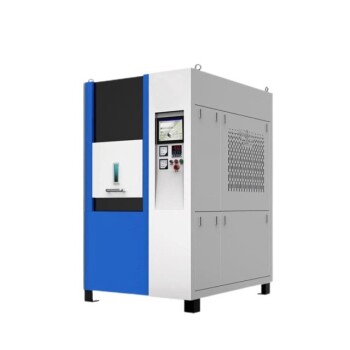
- Spark Plasma Sintering SPS Furnace
- 9MPa Air Pressure Vacuum Heat Treat and Sintering Furnace
- Vacuum Heat Treat Sintering Furnace with Pressure for Vacuum Sintering
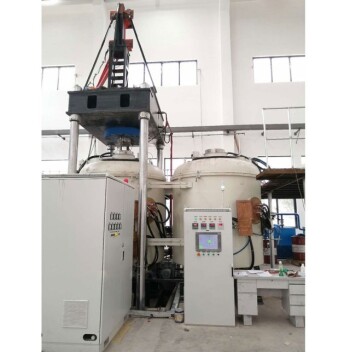
- 600T Vacuum Induction Hot Press Vacuum Heat Treat and Sintering Furnace
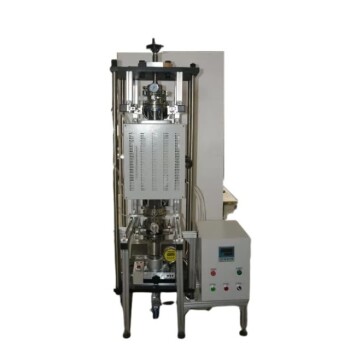
- Small Vacuum Heat Treat and Tungsten Wire Sintering Furnace
People Also Ask
- How does the heating mechanism of Spark Plasma Sintering (SPS) function? Enhance TiC/SiC Composite Fabrication
- Why is it necessary to maintain a high vacuum environment during the SPS of SiC? Key to High-Density Ceramics
- What are the technical advantages of using an SPS sintering furnace? Elevate Al2O3-TiC Material Performance
- What are the advantages of Spark Plasma Sintering (SPS)? Achieve Superior Microstructures
- What are the steps in the discharge plasma sintering process? Master Fast, High-Density Material Consolidation