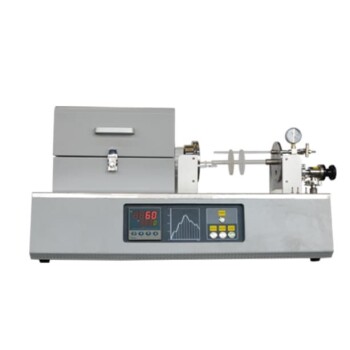
Precise temperature-resolved data is the key. High-temperature laboratory furnaces equipped with simultaneous Thermogravimetric Analysis (TGA) and Differential Thermal Analysis (DTA) directly measure mass loss and heat flow as a sample is heated. Under a programmed temperature ramp—typically from 50°C to 600°C at 10°C/min and under a controlled inert gas like argon—they pinpoint the exact onset and range of precursor evaporation (e.g., a sublimation window from 140°C to 250°C) and map out exothermic reaction thresholds. This allows you to replace guesswork with a precise thermal fingerprint that defines where your material transforms, volatilizes, or reacts.
A single TGA-DTA run captures the critical interplay between mass loss and thermal events. The mass loss curve reveals evaporation and decomposition parameters, while the exo/endothermic signals mark chemical reactions. Together, they provide the definitive temperature window and reaction thresholds needed to engineer processes like vacuum deposition and high-temperature curing with repeatable results.
The Analytical Foundation: Simultaneous TGA and DTA
High-temperature thermal analysis furnaces do not simply heat a sample; they interrogate its thermal personality with milligram-level precision. The real power comes from measuring two interdependent signals at the same time, on the same specimen, under exactly the same atmospheric and heating conditions.
Tracking Mass Loss to Define Evaporation Parameters
TGA measures the change in sample mass as a function of temperature. When a precursor evaporates or sublimes, the recorded mass drops. The derivative of this mass loss curve—the DTG—shows the rate of mass loss, making it immediately clear where evaporation is slow, where it peaks, and where it is complete.
For a volatile precursor, this yields a precise sublimation range rather than a single point. You see the temperature at which mass loss first becomes detectable (onset) and the temperature where the sample is fully evaporated. That range, not a textbook value, is your real process parameter.
Probing Reaction Thresholds with Heat Flow Data
DTA detects thermal events by measuring the temperature difference between the sample and an inert reference. When your precursor or material undergoes a chemical reaction—decomposition, oxidation, or a solid-state transformation—it either releases or absorbs energy. These appear as sharp exothermic or endothermic peaks on the DTA curve.
The onset temperature of an exotherm often corresponds to the exact reaction threshold you need to know. If the reaction is undesirable during evaporation, this data tells you exactly which temperature you must stay below. If it is a desired curing reaction, it tells you where to initiate and sustain the process.
The Power of Simultaneous Measurement
Running TGA and DTA simultaneously on the same sample eliminates ambiguity. A mass loss event that coincides with an endothermic dip strongly indicates evaporation or sublimation. A mass loss combined with a sharp exotherm signals a self-sustaining decomposition. Correlating the two signals transforms raw data into a clear interpretation: you know not just what is happening, but why, and at exactly which temperature.
From Raw Data to Process Parameters
Knowing the temperature thresholds is only half the story. The data from a high-temperature thermal analysis furnace must be translated directly into the operational language of your downstream process—ramp rates, dwell times, and atmosphere control.
Programming the Ramp Rate
The thermal analysis furnace tests your material under a known heating rate, typically 10°C/min. This becomes a baseline. If your DTG shows a rapid mass loss that occurs within a narrow 30°C band, you may need to slow down the heating rate in your full-scale process within that specific window. This prevents violent evaporation, foaming, or the entrainment of unvaporized particulate.
Defining Dwell Points
When the DTA curve reveals a reaction threshold—for instance, a critical curing exotherm starting at 380°C—you can program a dwell segment into your industrial furnace profile just above that temperature. Holding at that point provides the energy needed to drive the reaction to completion without overshooting and triggering unwanted side reactions or shrinkage.
Controlling the Atmosphere
The primary reference specifies inert gas atmospheres (such as argon) during analysis. This is not accidental. If you identify a sublimation range under argon, you know that the same precursor will behave predictably in a purged vacuum chamber backfilled with inert gas. If you need oxidation data, the same furnace can switch to air, but the principle of matching the analytical and process atmospheres remains critical for accurate parameter transfer.
Understanding the Trade-offs and Potential Pitfalls
Even the most precise thermal analysis furnace has limitations. Ignoring them can turn an accurate threshold measurement into a process failure.
The Crucible-Vessel Discrepancy
A microgram sample sitting in an alumina crucible behaves differently from a bulk charge in an industrial reactor. Heat transfer geometry and vapor removal rates differ. The onset temperature you measure is real but applies to that specific thermal environment. Always validate a pilot-scale run bridging the analytical data to your actual process.
Thermal Lag and Sensor Calibration
The furnace temperature readout may not be the exact sample temperature, especially at high heating rates. DTA peak temperatures are dynamic and can shift with ramp rate. Using the onset temperature rather than the peak temperature for reaction thresholds provides a more robust, kinetics-independent parameter. For mass loss, the TGA signal is equally sensitive to buoyancy and gas-flow effects that must be baseline-corrected.
Interpreting Complex, Overlapping Events
A real precursor often does not neatly separate evaporation from decomposition. You may see a TGA mass loss with a convoluted DTA signal—partly endothermic evaporation, partly exothermic breakdown. The furnace provides the raw signal; the critical skill lies in recognizing that a supposed “evaporation window” may contain damaging chemical side reactions that could contaminate your deposition. Running complementary techniques like DSC or evolved gas analysis can resolve this ambiguity.
Making the Right Choice for Your Process Goal
The data from a high-temperature TGA-DTA furnace empowers you to define process parameters based on the true behavior of your material. How you act on that data depends on what you are trying to achieve.
-
If your primary focus is precursor delivery for vacuum deposition: Use the measured sublimation range to set your source temperature. Program your furnace or crucible heater to operate just above the onset of significant mass loss, ensuring a steady, vaporized flux without overshoot into any decomposition exotherm detected in the DTA signal.
-
If your primary focus is optimizing a high-temperature curing cycle: Identify the reaction onset temperature from the exothermic DTA peak. Build a heating profile with a slow ramp up to that point, then a prolonged dwell to complete the cure before ramping to your final temperature. This prevents runaway exotherms and ensures uniform crosslinking or densification.
-
If your primary focus is preventing material defect formation: Review the TGA curve for residual mass and the DTA for unexpected endotherms above the main evaporation range. If a small mass loss persists into high-temperature zones, it indicates a slow decomposition or binder burnout that must be managed with a separate low-temperature dwell to avoid warping, blistering, or internal stresses in the final product.
The furnace transforms your precursor’s unknown thermal personality into a clear, actionable map. By respecting its thresholds and accounting for the gap between crucible and production scale, you move from trial-and-error to a first-principles process design.
Summary Table:
| Technique | Signal Measured | Key Parameter Identified | Downstream Application |
|---|---|---|---|
| TGA | Mass loss vs. temperature | Sublimation & evaporation range | Optimizes source temp & heating ramp rates |
| DTA | Differential heat flow (Exo/Endotherm) | Reaction onset thresholds & phase changes | Defines process dwell points & curing cycles |
| Simultaneous TGA-DTA | Combined mass & thermal signals | Distinguishes evaporation from decomposition | Prevents material defects & vapor deposition failure |
Ready to eliminate guesswork and achieve precise thermal control for your advanced materials? KINTEK specializes in premium laboratory equipment and consumables, offering a comprehensive range of high-temperature furnaces—including muffle, tube, rotary, vacuum, CVD, atmosphere, and customizable lab furnaces engineered for your unique research needs. Contact KINTEK today to partner with our thermal processing experts and elevate your lab's performance!
Related Products
- 1700℃ High Temperature Laboratory Tube Furnace with Alumina Tube
- 1400℃ High Temperature Laboratory Tube Furnace with Alumina Tube
- 1800℃ High Temperature Muffle Oven Furnace for Laboratory
- 1700℃ High Temperature Muffle Oven Furnace for Laboratory
- 1200℃ Muffle Oven Furnace for Laboratory
People Also Ask
- How does zone-melting in tube furnaces synthesize bismuth micro-wires? Master Single-Crystal Thermoelectric Growth
- How do high-temperature laboratory tube furnaces ensure environmental stability? Precision Thermal Reduction Tips
- How are high-temperature laboratory tube furnaces applied in long-term vacuum homogenization heat treatments for intermetallic samples?
- How are high-temp tube furnaces used to measure diffusion coefficients per Fick's law? Master Precision Annealing
- How are high-temperature tube furnaces applied in testing ceramic-supported alloy membranes? Insights