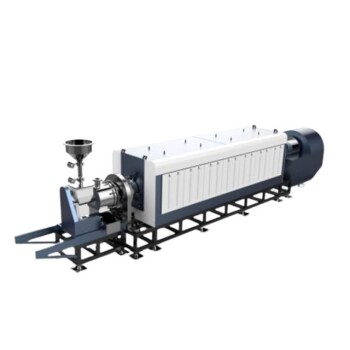
High-precision temperature control is the primary driver of product quality and chemical selectivity in lignin pyrolysis. By maintaining exact heating rates and constant reaction temperatures, these devices allow for the controlled cleavage of lignin side chains and the specific rearrangement of methoxy groups. This precision is necessary to maximize the yield of high-value single phenolic substances and ensure the repeatability of the chemical profile across different batches.
High-precision thermal management transforms lignin pyrolysis from a broad decomposition process into a predictable chemical synthesis. By strictly governing the thermal environment, these systems enable the targeted production of specific phenolic compounds while preventing unwanted secondary reactions.
The Impact on Molecular Cleavage and Rearrangement
Precision in Side Chain Cleavage
Lignin is a complex polymer that requires specific energy inputs to break its various chemical bonds. High-precision control ensures that the energy provided corresponds exactly to the bond dissociation energy required for side-chain cleavage.
Without this precision, the reaction may fail to initiate properly or may bypass the optimal window for targeted molecular breakdown. This leads to a mixture of partially decomposed fragments rather than clean, usable products.
Managing Methoxy Group Rearrangement
The rearrangement of methoxy groups is highly sensitive to even minor thermal fluctuations. High-precision devices maintain a stable environment that favors specific rearrangement pathways over others.
This level of control is essential for researchers looking to produce bio-oils with specific chemical functionalities. Precise isothermal maintenance ensures the molecular architecture shifts in a predictable, repeatable manner.
Optimizing Selectivity and Yield
Maximizing Single Phenolic Substances
The primary goal of many pyrolysis operations is the production of single phenolic substances. These high-value chemicals are only produced in high yields within narrow temperature windows, such as exactly 550 °C.
High-precision systems prevent the reactor from drifting outside these windows. This "thermal locking" ensures that the selectivity of the process remains focused on the desired chemical outputs rather than generic bio-oil.
Controlling Heating Rates for Kinetic Stability
A stable heating rate, such as 10 °C/min, is vital for managing the kinetics of decomposition. Precise ramping ensures that the lignin reaches its target temperature without experiencing thermal shock or premature degradation.
This controlled approach allows dehydration and carbonization reactions to proceed in an orderly fashion. It dictates the final reduction state and the structural integrity of the resulting carbon matrix.
Understanding the Trade-offs and Pitfalls
The Risk of Local Overheating
In systems lacking high-precision measurement, such as infrared thermometry, local hotspots can occur within the reactor. These hotspots cause "abnormal grain coarsening" in the solid residue and lead to over-cracking of the vapor phase.
Over-cracking reduces the quality of the liquid bio-oil and increases the production of low-value gases. Uniform thermal distribution is the only way to maintain a consistent microstructure in the final biochar.
Inconsistency in Physical Properties
Inaccurate temperature regulation leads to significant variations in the pH values, ash content, and surface functional groups of the resulting biochar. This makes the product unsuitable for specialized applications like heavy metal passivation.
Precision is the "bridge" to repeatability. Without it, researchers cannot accurately distinguish between light pyrolysis (torrefaction) and deep pyrolysis, leading to inconsistent data and unreliable industrial scaling.
How to Apply Precision Control to Your Goals
When selecting or programming a temperature control system for lignin pyrolysis, your specific research or production goal should dictate your thermal strategy.
- If your primary focus is Chemical Feedstock Production: Prioritize devices that offer strict isothermal maintenance at 550 °C to maximize the selectivity of single phenolic substances.
- If your primary focus is Biochar Functionalization: Focus on programmable heating curves that allow for precise control over ash content and surface functional groups.
- If your primary focus is Kinetic Modeling: Ensure your system can maintain a perfectly linear heating rate (e.g., 10 °C/min) to accurately map the decomposition stages.
Superior temperature control is the difference between a chaotic thermal event and a sophisticated chemical refinery.
Summary Table:
| Impact Area | Precision Mechanism | Key Outcome |
|---|---|---|
| Molecular Cleavage | Accurate energy input for bond dissociation | Targeted side-chain breakdown; cleaner products |
| Methoxy Rearrangement | Isothermal maintenance & stable environment | Predictable molecular architecture and bio-oil quality |
| Phenolic Yield | Thermal locking at specific windows (e.g., 550°C) | Maximized production of high-value single phenolics |
| Kinetic Stability | Linear heating rates (e.g., 10°C/min) | Orderly dehydration and structural carbon integrity |
| Thermal Uniformity | Prevention of local hotspots/over-cracking | Consistent pH, ash content, and biochar functionality |
Transform Your Lignin Research with KINTEK Precision
Achieving the "thermal locking" necessary for high-value phenolic synthesis requires equipment that refuses to compromise on accuracy. KINTEK specializes in high-performance laboratory equipment, providing the precision control needed to turn chaotic thermal events into sophisticated chemical synthesis.
Our extensive range of customizable high-temperature furnaces includes:
- Muffle & Tube Furnaces for precise batch testing.
- Rotary & Vacuum Furnaces for advanced material processing.
- CVD & Atmosphere Furnaces for controlled chemical vapor deposition.
- Induction Melting & Dental Furnaces for specialized applications.
Whether you are focusing on kinetic modeling or biochar functionalization, KINTEK delivers the repeatability and reliability your research demands. Contact our experts today to find the perfect furnace solution tailored to your unique laboratory needs!
References
- Yue Huang, Yi Wei. Pyrolysis of Lignin in the Presence of Cerium Oxide Coupled with Molten Salts. DOI: 10.3390/catal13050878
This article is also based on technical information from Kintek Furnace Knowledge Base .
Related Products
- Electric Rotary Kiln Small Rotary Furnace Biomass Pyrolysis Plant Rotating Furnace
- Electric Rotary Kiln Pyrolysis Furnace Plant Machine Small Rotary Kiln Calciner
- Electric Rotary Kiln Continuous Working Small Rotary Furnace Kiln for Pyrolysis Plant Heating
- Vacuum Heat Treat Sintering Furnace Molybdenum Wire Vacuum Sintering Furnace
- Spark Plasma Sintering SPS Furnace
People Also Ask
- What are the main applications of a rotary kiln electric furnace? Achieve Uniform Heat Treatment for Powders
- What are the key components of a rotary kiln electric furnace? Unlock Efficient Thermal Processing
- What is the significance of the refractory lining in a rotary kiln electric furnace? Unlock Efficiency and Longevity
- What is the benefit of adjustable speed control in rotary kilns? Optimize Efficiency and Quality
- What are the main advantages of using rotary kilns for bulk solids processing? Achieve High-Volume, Uniform Thermal Processing